

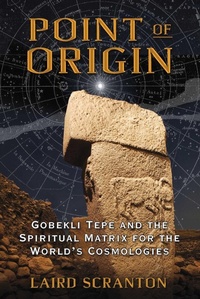
Point of Origin
Gobekli Tepe and the Spiritual Matrix for the World's Cosmologies
Published on 22. February 2015
224 pages
978-1-62055-445-6 (ISBN)
Description

Reveals Gobekli Tepe as a center of civilizing knowledge for the ancient world
• Details how symbolic elements at Gobekli Tepe link a pre-Vedic cult in India to cosmological myths and traditions in Africa, Egypt, Tibet, and China
• Discusses how carved animal images at Gobekli Tepe relate to stages of creation and provide an archaic foundation for symbolic written language
• Defines how classical elements of ancient Egyptian myth and religion characterize an archaic cosmological tradition that links ancestrally back to Gobekli Tepe
How could multiple ancient cultures, spanning both years and geography, have strikingly similar creation myths and cosmologies? Why do the Dogon of Africa and the civilizations of ancient Egypt, India, Tibet, and China share sacred words and symbols? Revealing the existence of a long-forgotten primal culture and the world's first center of higher learning, Laird Scranton shows how the sophisticated complex at Gobekli Tepe in Turkey is the definitive point of origin from which all the great civilizations of the past inherited their cosmology, esoteric teachings, and civilizing skills, such as agriculture, metallurgy, and stone masonry, fully developed.
Scranton explains how the carved images on Gobekli Tepe's stone pillars were the precursors to the sacred symbols of the Dogon, Egyptians, Tibetans, and Chinese as well as the matriarchal Sakti cult of ancient Iran and India. He identifies Gobekli Tepe as a remote mountain sanctuary of higher knowledge alluded to in Sakti myth, named like an important temple in Egypt, and defined in ancient Buddhist tradition as Vulture Peak. Scranton reveals how Gobekli Tepe's enigmatic "H" carvings and animal symbolism, symbolic of stages of creation, was presented as a kind of prototype of written language accessible to the hunter-gathers who inhabited the region. He shows how the myths and deities of many ancient cultures are connected linguistically, extending even to the name of Gobekli Tepe and the Egyptian concept of Zep Tepi, the mythical age of the "First Time."
Identifying Gobekli Tepe not only as the first university but also as the first temple, perhaps built as a civilizing exercise, Scranton definitively places this enigmatic archaeological site at the point of origin of civilization, religion, and ancient science.
• Details how symbolic elements at Gobekli Tepe link a pre-Vedic cult in India to cosmological myths and traditions in Africa, Egypt, Tibet, and China
• Discusses how carved animal images at Gobekli Tepe relate to stages of creation and provide an archaic foundation for symbolic written language
• Defines how classical elements of ancient Egyptian myth and religion characterize an archaic cosmological tradition that links ancestrally back to Gobekli Tepe
How could multiple ancient cultures, spanning both years and geography, have strikingly similar creation myths and cosmologies? Why do the Dogon of Africa and the civilizations of ancient Egypt, India, Tibet, and China share sacred words and symbols? Revealing the existence of a long-forgotten primal culture and the world's first center of higher learning, Laird Scranton shows how the sophisticated complex at Gobekli Tepe in Turkey is the definitive point of origin from which all the great civilizations of the past inherited their cosmology, esoteric teachings, and civilizing skills, such as agriculture, metallurgy, and stone masonry, fully developed.
Scranton explains how the carved images on Gobekli Tepe's stone pillars were the precursors to the sacred symbols of the Dogon, Egyptians, Tibetans, and Chinese as well as the matriarchal Sakti cult of ancient Iran and India. He identifies Gobekli Tepe as a remote mountain sanctuary of higher knowledge alluded to in Sakti myth, named like an important temple in Egypt, and defined in ancient Buddhist tradition as Vulture Peak. Scranton reveals how Gobekli Tepe's enigmatic "H" carvings and animal symbolism, symbolic of stages of creation, was presented as a kind of prototype of written language accessible to the hunter-gathers who inhabited the region. He shows how the myths and deities of many ancient cultures are connected linguistically, extending even to the name of Gobekli Tepe and the Egyptian concept of Zep Tepi, the mythical age of the "First Time."
Identifying Gobekli Tepe not only as the first university but also as the first temple, perhaps built as a civilizing exercise, Scranton definitively places this enigmatic archaeological site at the point of origin of civilization, religion, and ancient science.
More details
Other editions
Additional editions
Book
03/2015
Inner Traditions Bear and Company
€19.00
Article not available at the moment
Person
Laird Scranton is a recognized authority on Dogon mythology and symbolism. A frequent guest on radio programs such as Coast to Coast AM and Red Ice Radio, he has been a featured speaker at national conferences on ancient mysteries, including the Paradigm Symposium. He is the author of several books, including The Science of the Dogon and China's Cosmological Prehistory. He lives in Albany, New York.
Content
Foreword by Isaac Scranton
Introduction
1 The Ancient Cosmological/Civilizing Plan
2 Symbolic Constructs of the Cosmology
3 Constructs of the Language of Cosmology
4 Gobekli Tepe and Zep Tepi
5 Archaic Temple Names
6 Turkish and Archaic Word Forms
7 The Sakti Cult in Orissa
8 Sakti References in Ancient Egypt
9 Ascension
10 The Concept of Untying
11 The Heliacal Rise of Sirius
12 Ancestors, Dual Arms, and the Concept of the Embrace
13 Defining a Temple
14 The Bridge of Sirah
15 The Cosmological Role of Ganesha
16 Elephantine, the Nile Inundation,and the God Hapy
17 Tamil Word Forms
18 A Rationale for the Civilizing Plan
Epilogue
Notes
Bibliography
Index
Introduction
1 The Ancient Cosmological/Civilizing Plan
2 Symbolic Constructs of the Cosmology
3 Constructs of the Language of Cosmology
4 Gobekli Tepe and Zep Tepi
5 Archaic Temple Names
6 Turkish and Archaic Word Forms
7 The Sakti Cult in Orissa
8 Sakti References in Ancient Egypt
9 Ascension
10 The Concept of Untying
11 The Heliacal Rise of Sirius
12 Ancestors, Dual Arms, and the Concept of the Embrace
13 Defining a Temple
14 The Bridge of Sirah
15 The Cosmological Role of Ganesha
16 Elephantine, the Nile Inundation,and the God Hapy
17 Tamil Word Forms
18 A Rationale for the Civilizing Plan
Epilogue
Notes
Bibliography
Index
