

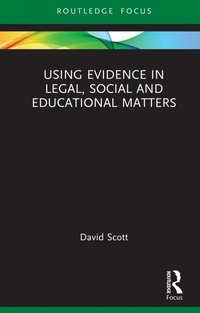
Using Evidence in Legal, Social and Educational Matters
Published on 1. June 2026
118 pages
978-1-040-80680-7 (ISBN)
Description

Evidence as a concept is central to our understanding of the world and the way in which we establish or verify the truth or otherwise of a statement, assertion or proposition. This interdisciplinary book focuses on the multiple and sometimes complex meanings that can be attached to the idea of evidence and its relationship to knowledge, learning and educational research.
By exploring some of the key issues in the field of educational research, this title allows the reader to understand what evidence is and why it is important while also questioning the gatekeepers of evidence and the power they have in terms of use and control. Chapters unpack the ways that several prominent organisations use evidence in their work, including the Programme for International Student Assessment (PISA), the Education Endowment Foundation (EEF) and the BBC, among others.
A thought-provoking analysis of the field, this is an essential read for all those looking to develop an understanding of evidence and the ways it can be used in educational settings as well as researchers and postgraduate students in the field of educational research.
By exploring some of the key issues in the field of educational research, this title allows the reader to understand what evidence is and why it is important while also questioning the gatekeepers of evidence and the power they have in terms of use and control. Chapters unpack the ways that several prominent organisations use evidence in their work, including the Programme for International Student Assessment (PISA), the Education Endowment Foundation (EEF) and the BBC, among others.
A thought-provoking analysis of the field, this is an essential read for all those looking to develop an understanding of evidence and the ways it can be used in educational settings as well as researchers and postgraduate students in the field of educational research.
More details
Series
Language
English
Place of publication
London
United Kingdom
Publishing group
Taylor & Francis Ltd
Target group
College/higher education
Professional and scholarly
Product notice
Reflowable
Illustrations
2 Tables, black and white
File size
0,53 MB
ISBN-13
978-1-040-80680-7 (9781040806807)
Copyright in bibliographic data and cover images is held by Nielsen Book Services Limited or by the publishers or by their respective licensors: all rights reserved.
Schweitzer Classification
Other editions
Additional editions
Book
05/2026
1st Edition
Qualitative and Visual Methodologies in Educational Research
€66.00
Shipment within 15-20 days
Person
David Scott is Emeritus Professor of Curriculum, Pedagogy and Assessment at the Institute of Education, University College London, UK.
Content
Preface
1. What is evidence?
2. Legal and scientific evidence in the Scopes Trial
3. Evidence for what works from the Programme for International Student Assessment (PISA)
4. Anonymised peer-reviewing and inspection as bureaucratic evidence
5. The Education Endowment Foundation (EEF) and evidence
6. The evidence base for the UK 2025 Curriculum Review
7. The Research Excellence Framework as evidence
8. Impartiality, evidence and the BBC
9. Truth, knowledge and evidence
Index
1. What is evidence?
2. Legal and scientific evidence in the Scopes Trial
3. Evidence for what works from the Programme for International Student Assessment (PISA)
4. Anonymised peer-reviewing and inspection as bureaucratic evidence
5. The Education Endowment Foundation (EEF) and evidence
6. The evidence base for the UK 2025 Curriculum Review
7. The Research Excellence Framework as evidence
8. Impartiality, evidence and the BBC
9. Truth, knowledge and evidence
Index
