

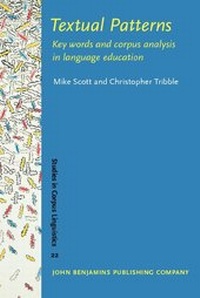
Textual Patterns
Key words and corpus analysis in language education
1st Edition
Published on 22. March 2006
X, 203 pages
978-90-272-9363-3 (ISBN)
Description

Textual Patterns introduces corpus resources, tools and analytic frameworks of central relevance to language teachers and teacher educators. Specifically it shows how key word analysis, combined with the systematic study of vocabulary and genre, can form the basis for a corpus informed approach to language teaching. The first part of the book gives the reader a strong grounding in the way in which language teachers can use corpus analysis tools (wordlists, concordances, key words) to describe language patterns in general and text patterns in particular. The second section presents a series of case studies which show how a key word / corpus informed approach to language education can work in practice. The case studies include: General language education (i.e. students in national education systems and those following international examination programmes), foreign languages for academic purposes, literature in language education, business and professional communication, and cultural studies in language education.
More details
Other editions
Additional editions
Mike Scott | Christopher Tribble
Textual Patterns
Key words and corpus analysis in language education
Book
03/2006
John Benjamins Publishing Co
€100.70
Shipment within 10-15 days
Persons
Content
- Textual Patterns
- Editorial page
- Title page
- LCC data
- Table of contents
- Preface
- Part I
- Texts in language study and language education
- Introduction
- Why have corpus-based methods caused an upheaval?
- A text focus, a language focus, a culture focus or a brain focus?
- The notion of context
- Word-lists
- Introduction
- Transformation
- Selection
- Kinds of word-list
- Alphabetically ordered
- Frequency ordered
- Other possible orderings
- One-word vs. n-word clusters
- Adding contextual information to wordlists
- Characteristics of word-lists
- The nature of high-frequency items
- Medium-frequency items
- Hapax legomena
- The distribution curve and the notion of a "power law''
- The notion of "consistency''
- What then do word-lists offer?
- Notes
- Concordances
- Introduction
- What is meant by co-occurrence?
- How much overlap is there between textual co-occurrence and the mental lexicon?
- Handling a concordance
- Patterns
- Clusters
- Is ago text-initial? - The dispersion plot
- Notes
- Key words of individual texts
- Introduction
- Keyness
- An example
- Exclamations in Romeo
- Different reference corpora
- Where do the KWs come in the text?
- Local versus global KWs
- Links between KWs
- Wide- and narrow-span linkages
- KWs and part of speech
- Key words and genres
- Introduction
- Keyword linkage between texts
- Formal patterns of Keyword linkage
- Examples of Keyword linkage between texts
- Associates
- Conclusion
- Notes
- Part II
- General English language teaching
- Summary
- Introduction
- Resources
- Approach
- Procedure
- Step 1 - Select texts
- Step 2 - Make wordlists
- Step 3 - Make Keyword lists
- Step 4 - Save lists as text files
- Step 5 - Create an Excel workbook containing all the data
- Findings
- Written academic vs. conversation
- Of
- That
- Looking at a middle ground: Keywords in Fiction and Spoken Academic
- Spoken Academic and Fiction Keywords referenced against BNC Sampler Written
- Spoken Academic and Fiction Keywords referenced against BNC Spoken
- Conclusions
- Notes
- Business and professional communication
- Summary
- Introduction
- Resources
- Approach
- Preliminary analysis
- Example A
- Example B
- Example C
- Example D
- Preliminary analysis: Discussion
- KW analysis - hope
- Discourse moves
- Contractions
- Ellipsis
- Vague language
- Lexical density
- KW analysis: Discussion
- Notes
- Appendix
- English for academic purposes
- Summary
- Introduction
- Resources
- Approach
- Analysis 1: Clusters in academic writing in English
- Single word lists
- Two-word clusters
- Three-word clusters
- Four-word clusters
- Cluster lists - conclusion
- Analysis 2: Clusters in apprentice texts
- The Poznan literature MA dissertation corpus
- Comparing expert with apprentice academic writing
- Comparing apprentice academic writing with general academic texts and expert texts in literary studies
- BNC_LIT vs. POZ_LIT - mapping similarity and difference: Three-word clusters
- BNC_LIT vs. POZ_LIT - mapping similarity and difference: Four-word clusters
- Analysis 1
- Analysis 2
- Analysis 3
- Analysis 4
- Analysis 5
- Identifying contrast between apprentice and expert performances - An interim conclusion
- Notes
- Appendix - BNC texts
- Poznan literature dissertation titles
- What counts in current journalism
- Summary
- Introduction
- Resources
- Approach
- Analysis 1: Who, what, where?
- Who?
- Second step - Check the immediate collocates
- What and where?
- Analysis 1: Conclusion
- Analysis 2: It's a man's world - gender balance in the Guardian Weekly's news reporting
- Titles
- Pronouns
- Discussion 1: Family words
- Discussion 2: Nouns
- Discussion 3: Verbs
- Analysis 2: Conclusion
- Analysis 3: A changing world - UK news 1996-2001
- UK News top five - GW_UK_NEWS vs. BNC
- UK News top twenty
- Conclusion
- Notes
- Counting things in texts you can't count on
- Summary
- Introduction
- Resources
- The text
- Tools
- Analysis 1
- Pivot 1
- Pivot 2
- Pivot 3
- Analysis 2
- Wordlists and keyword lists
- Concordances and keywords
- But can you count on it?
- Conclusion
- References
- Name index
- Subject index
- The series Studies in Corpus Linguistics
