

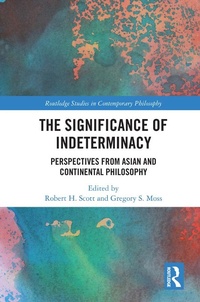
The Significance of Indeterminacy
Perspectives from Asian and Continental Philosophy
1st Edition
Published on 20. July 2018
402 pages
978-1-351-38330-1 (ISBN)
Description

While indeterminacy is a recurrent theme in philosophy, less progress has been made in clarifying its significance for various philosophical and interdisciplinary contexts. This collection brings together early-career and well-known philosophers-including Graham Priest, Trish Glazebrook, Steven Crowell, Robert Neville, Todd May, and William Desmond-to explore indeterminacy in greater detail. The volume is unique in that its essays demonstrate the positive significance of indeterminacy, insofar as indeterminacy opens up new fields of discourse and illuminates neglected aspects of various concepts and phenomena. The essays are organized thematically around indeterminacy's impact on various areas of philosophy, including post-Kantian idealism, phenomenology, ethics, hermeneutics, aesthetics, and East Asian philosophy. They also take an interdisciplinary approach by elaborating the conceptual connections between indeterminacy and literature, music, religion, and science.
Reviews / Votes
"This anthology is well organized and provides the reader with a grasp of the notion indeterminacy in both continental European and Asian philosophy . . . Although the theme is one previously neglected concept and the contributions are written by experts, most chapters are highly accessible and well structured . . . It brings into focus that indeterminacy has always played an important role in philosophical thinking ever since Aristotle in the West and Daoism in the East, and thereby opens up new areas for inter-disciplinary investigation in a global context. In short: it is determined to inspire in-depth philosophical reflection on an important theme." - Philosophy East & West"This topical and diverse collection of essays extends the critical and consequential problem of indeterminacy into both Continental and Comparative traditions. Creative yet rigorous, these essays enliven our sense of philosophy's powers, defending the delicate ambiguity yet resonant force of philosophical claims as well as extending it to include traditions as varied as Buddhism and climate change policy." - Jason M. Wirth, Seattle University, USA
More details
Series
Edition
1. Auflage
Language
English
Place of publication
London
United Kingdom
Publishing group
Taylor & Francis Ltd
Target group
College/higher education
Product notice
Reflowable
Illustrations
2 Line drawings, black and white
ISBN-13
978-1-351-38330-1 (9781351383301)
Copyright in bibliographic data and cover images is held by Nielsen Book Services Limited or by the publishers or by their respective licensors: all rights reserved.
Schweitzer Classification
Other editions
Additional editions
Robert H. Scott | Gregory S. Moss
The Significance of Indeterminacy
Perspectives from Asian and Continental Philosophy
Book
09/2020
1st Edition
Routledge
€70.50
Shipment within 15-20 days
Robert H. Scott | Gregory S. Moss
The Significance of Indeterminacy
Perspectives from Asian and Continental Philosophy
Book
07/2018
1st Edition
Routledge
€207.50
Shipment within 10-20 days
Persons
Robert H. Scott is an Assistant Professor of Philosophy at the University of North Georgia. His research focuses on phenomenology and environmental ethics, and in his recent published work he has developed a phenomenological theory of ecological responsibility. Dr. Scott currently serves as the President of the Georgia Philosophical Society.
Gregory S. Moss is currently an Assistant Professor of Philosophy at Chinese University of Hong Kong. He specializes in Post-Kantian German philosophy, and has published in a variety of philosophical journals, such as Idealistic Studies, International Philosophical Quarterly, the Journal for the British Society for Phenomenology, Journal of Speculative Philosophy, and the Northern European Journal of Philosophy (forthcoming). Before completing his PhD on Hegel's Logic of the Concept under Richard Winfield, he was a Fulbright Fellow with Markus Gabriel at the Rheinische Friedrich-Wilhelms-Universitaet Bonn. He is author of Ernst Cassirer and the Autonomy of Language and translator for Markus Gabriel's Why the World Does Not Exist. His forthcoming book Hegel's Foundation Free Metaphysics: The Logic of Singularity is forthcoming with Routledge,
Gregory S. Moss is currently an Assistant Professor of Philosophy at Chinese University of Hong Kong. He specializes in Post-Kantian German philosophy, and has published in a variety of philosophical journals, such as Idealistic Studies, International Philosophical Quarterly, the Journal for the British Society for Phenomenology, Journal of Speculative Philosophy, and the Northern European Journal of Philosophy (forthcoming). Before completing his PhD on Hegel's Logic of the Concept under Richard Winfield, he was a Fulbright Fellow with Markus Gabriel at the Rheinische Friedrich-Wilhelms-Universitaet Bonn. He is author of Ernst Cassirer and the Autonomy of Language and translator for Markus Gabriel's Why the World Does Not Exist. His forthcoming book Hegel's Foundation Free Metaphysics: The Logic of Singularity is forthcoming with Routledge,
Content
Introduction: The Emerging Philosophical Recognition of the Significance of Indeterminacy
Gregory S. Moss and Robert H. Scott
Part I: The Significance of Indeterminacy in German Idealism
1. Overdeterminacy, Affirming Indeterminacy, and the Dearth of Ontological Astonishment
William Desmond
2. Determinacy, Indeterminacy, and Contingency in German Idealism
G. Anthony Bruno
3. Free Thinking in Schelling's Erlangen Lectures
Gregory S. Moss
4. Indeterminacy, Modality, Dialectics: Hegel on the Possibility Not to Be
Nahum Brown
Part II: The Significance of Indeterminacy for Phenomenology, Natural Science, and Ethics
5. Determinable Indeterminacy: A Note on the Phenomenology of Horizons
Steven G. Crowell
6. Climate Science, Indeterminacy, and Food Security in Sub-Saharan Africa
Trish Glazebrook and Michael Goldsby
7. Genetic Phenomenology and the Indeterminacy of Racism
Janet Donohoe
8. Indeterminacy as Key to a Phenomenological Reinterpretation of Aristotle's Intellectual Virtues
Robert H. Scott
9. The Effability of the Normative
Todd May
Part III: The Significance of Indeterminacy for Hermeneutics and Aesthetics
10. Indeterminacy, Gadamer, and Jazz
Bruce E. Benson
11. Hermeneutic Priority and Phenomenological Indeterminacy of Questioning
Nathan Eric Dickman
12. Against the Darkness: Beauty and Indeterminacy in John Williams's Stoner
Phillip E. Mitchell
13. Confidence without Certainty
J. Aaron Simmons
Part IV: Asian Perspectives and Cosmological Concerns
14. Heidegger and Dogen on the Ineffable
Graham Priest and Filippo Casati
15. The Nietzschean Bodhisattva--Passionately Navigating Indeterminacy
George Wrisley
16. Body and Intimate Caring in Confucian Ethics
Qingjie James Wang
17. Indeterminacy in Chinese Thought: Spontaneity and the Dao
Robert Neville
18. Cosmological Questions
Ricki Bliss and Filippo Casati
List of Contributors
Index
Gregory S. Moss and Robert H. Scott
Part I: The Significance of Indeterminacy in German Idealism
1. Overdeterminacy, Affirming Indeterminacy, and the Dearth of Ontological Astonishment
William Desmond
2. Determinacy, Indeterminacy, and Contingency in German Idealism
G. Anthony Bruno
3. Free Thinking in Schelling's Erlangen Lectures
Gregory S. Moss
4. Indeterminacy, Modality, Dialectics: Hegel on the Possibility Not to Be
Nahum Brown
Part II: The Significance of Indeterminacy for Phenomenology, Natural Science, and Ethics
5. Determinable Indeterminacy: A Note on the Phenomenology of Horizons
Steven G. Crowell
6. Climate Science, Indeterminacy, and Food Security in Sub-Saharan Africa
Trish Glazebrook and Michael Goldsby
7. Genetic Phenomenology and the Indeterminacy of Racism
Janet Donohoe
8. Indeterminacy as Key to a Phenomenological Reinterpretation of Aristotle's Intellectual Virtues
Robert H. Scott
9. The Effability of the Normative
Todd May
Part III: The Significance of Indeterminacy for Hermeneutics and Aesthetics
10. Indeterminacy, Gadamer, and Jazz
Bruce E. Benson
11. Hermeneutic Priority and Phenomenological Indeterminacy of Questioning
Nathan Eric Dickman
12. Against the Darkness: Beauty and Indeterminacy in John Williams's Stoner
Phillip E. Mitchell
13. Confidence without Certainty
J. Aaron Simmons
Part IV: Asian Perspectives and Cosmological Concerns
14. Heidegger and Dogen on the Ineffable
Graham Priest and Filippo Casati
15. The Nietzschean Bodhisattva--Passionately Navigating Indeterminacy
George Wrisley
16. Body and Intimate Caring in Confucian Ethics
Qingjie James Wang
17. Indeterminacy in Chinese Thought: Spontaneity and the Dao
Robert Neville
18. Cosmological Questions
Ricki Bliss and Filippo Casati
List of Contributors
Index
