

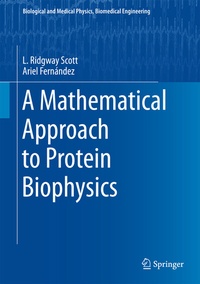
A Mathematical Approach to Protein Biophysics
Description

This book explores quantitative aspects of protein biophysics and attempts to delineate certain rules of molecular behavior that make atomic scale objects behave in a digital way. This book will help readers to understand how certain biological systems involving proteins function as digital information systems despite the fact that underlying processes are analog in nature.
The in-depth explanation of proteins from a quantitative point of view and the variety of level of exercises (including physical experiments) at the end of each chapter will appeal to graduate and senior undergraduate students in mathematics, computer science, mechanical engineering, and physics, wanting to learn about the biophysics of proteins.
L. Ridgway Scott has been Professor of Computer Science and of Mathematics at the University of Chicago since 1998, and the Louis Block Professor since 2001. He obtained a B.S. degree (Magna Cum Laude) from Tulane University in 1969 and a PhD degree in Mathematics from the Massachusetts Institute of Technology in 1973. Professor Scott has published over 130 papers and three books, extending over biophysics, parallel computing and fundamental computing aspects of structural mechanics, fluid dynamics, nuclear engineering, and computational chemistry.
Ariel Fernández (born Ariel Fernández Stigliano) is an Argentinian-American physical chemist and mathematician. He obtained his Ph. D. degree in Chemical Physics from Yale University and held the Karl F. Hasselmann Endowed Chair Professorship in Bioengineering at Rice University. He is currently involved in research and entrepreneurial activities at various consultancy firms. Ariel Fernández authored three books on translational medicine and biophysics, and published 360 papers in professional journals. He holds two patents in the field of biotechnology.
Reviews / Votes
"The book is built in a textbook-like manner, each chapter being followed by exercises to reinforce the concepts presented throughout. Also included is a comprehensive list of references offering multiple options for future reading. The style of the book makes it accessible to a wide range of audiences from students to established researchers. Although written with a specialised audience in mind, the numerous examples make it accessible to researchers with multidisciplinary backgrounds." (Irina Ioana Mohorianu, zbMATH 1390.92003, 2018)More details
Other editions
Additional editions
Persons
L. Ridgway Scott has been Professor of Computer Science and of Mathematics at the University of Chicago since 1998, and the Louis Block Professor since 2001. He obtained a B.S. degree (Magna Cum Laude) from Tulane University in 1969 and a PhD degree in Mathematics from the Massachusetts Institute of Technology in 1973. Professor Scott has published over 130 papers and three books, extending over biophysics, parallel computing and fundamental computing aspects of structural mechanics, fluid dynamics, nuclear engineering, and computational chemistry.
Ariel Fernández (born Ariel Fernández Stigliano) is an Argentinian-American physical chemist and mathematician. He obtained his Ph. D. degree in Chemical Physics from Yale University and held the Karl F. Hasselmann Endowed Chair Professorship in Bioengineering at Rice University. He is currently involved in research and entrepreneurial activities at various consultancy firms. Ariel Fernández authored three books on translational medicine and biophysics, and published 360 papers in professional journals. He holds two patents in the field of biotechnology.
