

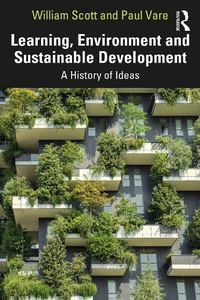
Learning, Environment and Sustainable Development
A History of Ideas
1st Edition
Published on 11. November 2020
214 pages
978-1-000-20796-5 (ISBN)
Description

This book is an introduction to the long history of human learning, the environment and sustainable development - about our struggles with the natural world: first for survival, then for dominance, currently for self-preservation, and in future perhaps, even for long-term, mutually beneficial co-existence. It charts the long arc of human-environment relationships through the specific lens of human learning, putting on record many of the people, ideas and events that have contributed, often unwittingly, to the global movement for sustainable development.
Human learning has always had a focus on the environment. It's something we've been engaged in ever since we began interacting with our surroundings and thinking about the impacts, outcomes and consequences of our actions and interactions. This unique story told by the authors is episodic rather than a connected, linear account; it probes, questions and re-examines familiar issues from novel perspectives, and looks ahead. The book is of particular interest to those studying (and teaching) courses with a focus on socio-economic and environmental sustainability, and non-governmental organisations whose work brings them face-to-face with the general public and social enterprises.
Human learning has always had a focus on the environment. It's something we've been engaged in ever since we began interacting with our surroundings and thinking about the impacts, outcomes and consequences of our actions and interactions. This unique story told by the authors is episodic rather than a connected, linear account; it probes, questions and re-examines familiar issues from novel perspectives, and looks ahead. The book is of particular interest to those studying (and teaching) courses with a focus on socio-economic and environmental sustainability, and non-governmental organisations whose work brings them face-to-face with the general public and social enterprises.
Reviews / Votes
"The beauty of Scott and Vare's co-authored books are their ability to communicate in a concise, clear and clever manner leading the reader to think about environmental teaching from new and potentially 'rebellious' perspectives. Learning, Environment and Sustainable Development: a history of ideas should be essential reading for all educators, regardless of their teaching context, experience or subject specialism, as it challenges us to reflect on the sources of our own values and to re-consider why and how we want to teach in the future." - Dr Melissa Glackin, Senior Lecturer in Science Education, King's College London"I thoroughly enjoyed this book and know that it will impact the way we think about environmental learning. It is cleverly written, crammed full of short, sharp ideas over three periods of the human world. The book is aimed at placing current environmental learning within the context of the past and in so doing explaining the present while envisioning scenarios in the environmental future we face. The book involves the reader and, importantly, invites them to think. Drawing on religion, politics, poetry, music, philosophy and science, this is a highly engaging book with extremely wide appeal." - Dr Kim Walker, Associate Professor in Environmental Education, University of the Sunshine Coast, Australia
"This book offers a great overview of the history of human-environment relationships, focusing on human thinking and learning about the environment. Scott and Vare show that we can learn from the past for thinking about environmental education for the future. This book is a valuable resource for all those involved in environmental education and education for sustainable development." - Professor Marco Rieckmann, University of Vechta, Germany
Brimming with thought-provoking stories, this book follows a remarkable chronology of perspectives by exploring how religion and science, writers, philosophers, sociologists, policy-makers and poets have imagined and re-imagined our relations with nature. This book would be an excellent read for anyone beginning their journey in environmental education as it tells the stories through which environmental education has emerged. It is a book I wish I had read 20 years ago!" - Raichael Lock "The beauty of Scott and Vare's co-authored books are their ability to communicate in a concise, clear and clever manner leading the reader to think about environmental teaching from new and potentially 'rebellious' perspectives. Learning, Environment and Sustainable Development: a history of ideas should be essential reading for all educators, regardless of their teaching context, experience or subject specialism, as it challenges us to reflect on the sources of our own values and to re-consider why and how we want to teach in the future." - Dr Melissa Glackin, Senior Lecturer in Science Education, King's College London
"I thoroughly enjoyed this book and know that it will impact the way we think about environmental learning. It is cleverly written, crammed full of short, sharp ideas over three periods of the human world. The book is aimed at placing current environmental learning within the context of the past and in so doing explaining the present while envisioning scenarios in the environmental future we face. The book involves the reader and, importantly, invites them to think. Drawing on religion, politics, poetry, music, philosophy and science, this is a highly engaging book with extremely wide appeal." - Dr Kim Walker, Associate Professor in Environmental Education, University of the Sunshine Coast, Australia
"This book offers a great overview of the history of human-environment relationships, focusing on human thinking and learning about the environment. Scott and Vare show that we can learn from the past for thinking about environmental education for the future. This book is a valuable resource for all those involved in environmental education and education for sustainable development." - Professor Marco Rieckmann, University of Vechta, Germany
Brimming with thought-provoking stories, this book follows a remarkable chronology of perspectives by exploring how religion and science, writers, philosophers, sociologists, policy-makers and poets have imagined and re-imagined our relations with nature. This book would be an excellent read for anyone beginning their journey in environmental education as it tells the stories through which environmental education has emerged. It is a book I wish I had read 20 years ago!" - Raichael Lock
More details
Edition
1. Auflage
Language
English
Place of publication
London
United Kingdom
Publishing group
Taylor & Francis Ltd
Target group
College/higher education
Illustrations
1 Tables, black and white; 1 Line drawings, black and white
ISBN-13
978-1-000-20796-5 (9781000207965)
Copyright in bibliographic data and cover images is held by Nielsen Book Services Limited or by the publishers or by their respective licensors: all rights reserved.
Schweitzer Classification
Other editions
Additional editions
Book
11/2020
1st Edition
Routledge
€62.90
Shipment within 15-20 days
Book
11/2020
1st Edition
Routledge
€207.50
Shipment within 15-20 days
Persons
William Scott is Emeritus Professor of Education at the University of Bath, UK, and is Chair of Trustees of the UK's National Association for Environmental Education. He was one of the founding editors of the Routledge journal, Environmental Education Research.
Paul Vare is Research Convener for the School of Education at the University of Gloucestershire, UK. He has worked internationally in the voluntary sector, with large corporations and national governments, and the United Nations Economic Commission for Europe (UNECE) on education for sustainable development.
Paul Vare is Research Convener for the School of Education at the University of Gloucestershire, UK. He has worked internationally in the voluntary sector, with large corporations and national governments, and the United Nations Economic Commission for Europe (UNECE) on education for sustainable development.
Content
Section 1 Past Historic 1. Humans Being 2. Playing and Learning in the Mesolithic 3. Earth Mother - Mother Earth 4. In the Beginning 5. Virgil's Georgics 6. How the Greenland Norse Chose 7. Science and the Ecological Imagination 8. Francis Bacon and the Interrogation of Nature 9. Descartes, the World and the Method 10. Rousseau wrote Emile; Pestalozzi made it real 11. The 18th Century (sustainable) Development Goals 12. The English Romantic Poets 13. Public Education and the Industrial Revolution 14. Alexander von Humboldt 15. John Clare's Enclosure 16. Marx in Nature 17. Thoreau and Walden 18. The Significance of John Muir 19. Friluftsliv 20. Patrick Geddes 21. John Dewey and the Ecology of Learning 22. Blud und Boden 23. This Land is your Land Section 2 Present Imperfect 24. Rachel Carson's Silence 25. The Road to Tbilisi 26. Gaia 27. Forest School Origins 28. The Early UN Conferences 29. Prepositions and the Environment 30. How Deep is your Ecology? 31. Environmentally Educated Teachers 32. Are Significance Life Experiences always Significant? 33. Faith, Hope, Charity and the Ecological Crisis 34. The Earth Charter 35. The Behaviour of Models 36. The Coming of ESD 37. Green Still does not Always Mean Go 38. The Beginning of the End or the End of the Beginning? 39. In Competence we Trust 40. Environmental Learning 41. Extinction? Rebellion? Section 3 Future Possible 42. Behind the Cenes: What Stories Shall We Tell? 43. Being Human Appendices 1 A Brief History of Environment and Learning in England 2 A Brief History of Environment and Learning in the USA 3 A Brief History of Environment and Learning in Germany 4 The Sustainable Development Goals
