

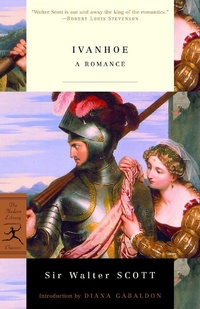
Ivanhoe
Published on 31. October 2000
576 pages
978-0-679-64187-2 (ISBN)
Description

Hailed by Victor Hugo as 'the real epic of our age,' Ivanhoe was an immensely popular bestseller when first published in 1819. The book inspired literary imitations as well as paintings, dramatizations, and even operas. Now Sir Walter Scott's sweeping romance of medieval England has prompted a lavish new television production.
In the twelfth century, Sir Wilfred of Ivanhoe returns home to England from the Third Crusade to claim his inheritance and the love of the lady Rowena. The heroic adventures of this noble Saxon knight involve him in the struggle between Richard the Lion-Hearted and his malignant brother John: a conflict that brings Ivanhoe into alliance with the mysterious outlaw Robin Hood and his legendary fight for the forces of good.
'Scott's characters, like Shakespeare's and Jane Austen's, have the seed of life in them,' observed Virginia Woolf. 'The emotions in which Scott excels are not those of human beings pitted against other human beings, but of man pitted against Nature, of man in relation to fate. His romance is the romance of hunted men hiding in woods at night; of brigs standing out to sea; of waves breaking in the moonlight; of solitary sands and distant horsemen; of violence and suspense.' For Henry James, 'Scott was a born storyteller. . . . Since Shakespeare, no writer has created so immense a gallery of portraits.'
In the twelfth century, Sir Wilfred of Ivanhoe returns home to England from the Third Crusade to claim his inheritance and the love of the lady Rowena. The heroic adventures of this noble Saxon knight involve him in the struggle between Richard the Lion-Hearted and his malignant brother John: a conflict that brings Ivanhoe into alliance with the mysterious outlaw Robin Hood and his legendary fight for the forces of good.
'Scott's characters, like Shakespeare's and Jane Austen's, have the seed of life in them,' observed Virginia Woolf. 'The emotions in which Scott excels are not those of human beings pitted against other human beings, but of man pitted against Nature, of man in relation to fate. His romance is the romance of hunted men hiding in woods at night; of brigs standing out to sea; of waves breaking in the moonlight; of solitary sands and distant horsemen; of violence and suspense.' For Henry James, 'Scott was a born storyteller. . . . Since Shakespeare, no writer has created so immense a gallery of portraits.'
More details
Other editions
Additional editions

Book
07/2001
Modern Library Inc
€16.60
Article exhausted; check different version

Audio
03/1997
Random House Audio Publishing Group
€37.51
Article exhausted; check different version
Person
Sir Walter Scott, the Scotsman who is often credited with inventing the historical novel and who became the most popular author of his day, was born in Edinburgh on August 15, 1771, into a prosperous middle-class family. He was the fourth surviving child of Walter Scott, a staunchly Presbyterian solicitor, and Anne Rutherford, the well-educated daughter of a professor of medicine. Crippled by polio when he was eighteen months old, Scott spent his early childhood convalescing in the Border country southeast of Edinburgh and became fascinated by folklore of the region. At the age of twelve he entered the high school of Edinburgh to study Latin, Greek, and logic; afterward he pursued courses in law and philosophy. Following a five-year apprenticeship in his father's law office, Scott was admitted to the bar in 1792. Five years later he married Charlotte Charpentier, the daughter of a French royalist refugee; they had four children. In 1799 he was named sheriff-depute for the county of Selkirk, and in 1806 he be came a clerk of the Court of Session, two appointments he retained for life.
Scott's literary career dates from 1802, when he published The Minstrelsy of the Scottish Border, a collection of ballads that had never before appeared in print. The book's popularity prompted him to attempt an original work based on Scottish themes, and in 1805 he brought out The Lay of the Last Minstrel, a narrative poem of love, war, and sorcery that, in his words, was 'intended to illustrate the customs and manners which anciently prevailed on the Borders of England and Scotland.' The Lay was an immediate success, and Scott secured fame with two more best-selling 'metrical romances': Marmion (1808) and The Lady of the Lake (1810). Yet in 1813 he declined the offer of Poet Laureatship. A versatile man of letters, Scott also edited The Works of John Dryden (1808) and The Works of Jonathan Swift (1814), two volumes that incorporated biography as a formal component of modern textual scholarship. He also contributed influential essays to the Edinburgh Review and helped found the Tory Quarterly Review.
As the vogue for his poetry waned, Scott turned to other literary forms. Eager to retain both his audience and large income, he hastily revised the draft of an abandoned prose romance and shaped it into the first historical novel. Waverley, Scott's tale of an Englishman who travels to the Scottish Highlands and becomes involved in the Jacobite rebellion of 1745, proved an overnight sensation when it was published anonymously in 1814. The success of Waverley was such that the author's identity soon became common knowledge. Its popularity in England prompted a humorous complaint from Jane Austen: 'Walter Scott has no business to write novels, especially good ones--It is not fair. He has fame and profit enough as a poet and should not be taking the bread out of other people's mouths. I do not mean to like Waverley if I can help it--but I fear I must.'
Over the next eighteen years Scott turned out some two dozen 'Waverley' novels. These so-called 'Scottish novels,' which are now widely considered to be his best work, deal with significant events in that nation's transition from feudalism to modern times. Among the most enduring are Guy Mannering (1815), The Antiquary (1816), The Black Dwarf (1816), Old Mortality (1816), Rob Roy (1818), The Heart of Midlothian (1818), The Bride of Lammermoor (1819), and Redgauntlet (1824). A second series of novels, including Ivanhoe (1819) and Quentin Durward (1823), are concerned with medieval history in England and Europe. A final group, notably Kenilworth (1821) and Woodstock (1826), focus on the Tudor - Stuart era in England.
In recognition of his literary achievements, Scott was awarded a baronetcy in 1818, and the enormous profits realized from his books enabled him to maintain a lavish country estate at Abbotsford. But the financial crash of 1826 forced Scott and his publishing partner James Ballantyne heavily into debt. Refusing to declare bankruptcy Scott labored endlessly to pay off creditors, though his personal liability was roughly ú130,000. He published The Life of Napoleon Buonaparte (1827), a nine-volume work that included a full history of the French Revolution; in 1828 he began preparing a 'Magnum Opus' edition of his works. In addition he turned out four last novels: The Fair Maid of Perth (1828), Anne of Geierstein (1829), Count Robert of Paris (1832), and Castle Dangerous (1832). Sir Walter Scott died at Abbotsford on September 21, 1832, and was buried at Dryburgh Abbey.
Scott's literary career dates from 1802, when he published The Minstrelsy of the Scottish Border, a collection of ballads that had never before appeared in print. The book's popularity prompted him to attempt an original work based on Scottish themes, and in 1805 he brought out The Lay of the Last Minstrel, a narrative poem of love, war, and sorcery that, in his words, was 'intended to illustrate the customs and manners which anciently prevailed on the Borders of England and Scotland.' The Lay was an immediate success, and Scott secured fame with two more best-selling 'metrical romances': Marmion (1808) and The Lady of the Lake (1810). Yet in 1813 he declined the offer of Poet Laureatship. A versatile man of letters, Scott also edited The Works of John Dryden (1808) and The Works of Jonathan Swift (1814), two volumes that incorporated biography as a formal component of modern textual scholarship. He also contributed influential essays to the Edinburgh Review and helped found the Tory Quarterly Review.
As the vogue for his poetry waned, Scott turned to other literary forms. Eager to retain both his audience and large income, he hastily revised the draft of an abandoned prose romance and shaped it into the first historical novel. Waverley, Scott's tale of an Englishman who travels to the Scottish Highlands and becomes involved in the Jacobite rebellion of 1745, proved an overnight sensation when it was published anonymously in 1814. The success of Waverley was such that the author's identity soon became common knowledge. Its popularity in England prompted a humorous complaint from Jane Austen: 'Walter Scott has no business to write novels, especially good ones--It is not fair. He has fame and profit enough as a poet and should not be taking the bread out of other people's mouths. I do not mean to like Waverley if I can help it--but I fear I must.'
Over the next eighteen years Scott turned out some two dozen 'Waverley' novels. These so-called 'Scottish novels,' which are now widely considered to be his best work, deal with significant events in that nation's transition from feudalism to modern times. Among the most enduring are Guy Mannering (1815), The Antiquary (1816), The Black Dwarf (1816), Old Mortality (1816), Rob Roy (1818), The Heart of Midlothian (1818), The Bride of Lammermoor (1819), and Redgauntlet (1824). A second series of novels, including Ivanhoe (1819) and Quentin Durward (1823), are concerned with medieval history in England and Europe. A final group, notably Kenilworth (1821) and Woodstock (1826), focus on the Tudor - Stuart era in England.
In recognition of his literary achievements, Scott was awarded a baronetcy in 1818, and the enormous profits realized from his books enabled him to maintain a lavish country estate at Abbotsford. But the financial crash of 1826 forced Scott and his publishing partner James Ballantyne heavily into debt. Refusing to declare bankruptcy Scott labored endlessly to pay off creditors, though his personal liability was roughly ú130,000. He published The Life of Napoleon Buonaparte (1827), a nine-volume work that included a full history of the French Revolution; in 1828 he began preparing a 'Magnum Opus' edition of his works. In addition he turned out four last novels: The Fair Maid of Perth (1828), Anne of Geierstein (1829), Count Robert of Paris (1832), and Castle Dangerous (1832). Sir Walter Scott died at Abbotsford on September 21, 1832, and was buried at Dryburgh Abbey.
