

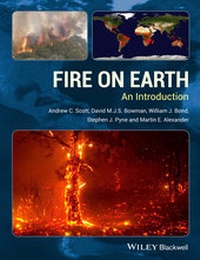
Fire on Earth
Description

Reviews / Votes
"The well-organized and illustrated work can be used as atextbook or a reference source for practitioners. Eachchapter has a list of further readings, and each part has its ownextensive bibliography. This phenomenal contribution willbecome a classic reference for five mangers, students of fireecology and climate, and researchers for years to come. Summing Up: Essential. All levels/libraries." (Choice, 1 October 2014) "Overall, the book provides an excellent,multidisciplinary introduction to fire, authored by leading expertsin their fields, written in a very accessible style and supportedby superb illustrations and extensive references. Hence, I highlyrecommend it to potential readers, who may be upper levelundergraduate students, graduate students, teaching staff andeveryone working, or simply interested, in the area ofenvironmental science." (International Journal ofWildland Fire, 1 August 2014) "Fire and earth scientists, anthropologists,ecol-ogists, resource managers, and especially ad-vancedstudents in natural sciences will find the text, along with itsonline resources, a req-uisite addition to their libraries.Not only is it a pleasure to read, simply put, it sparks theimagination." (Fire Ecology, 1 June 2014) "With wildfire recognised in key government contingencydocuments, not least for climate change, foresters looking forgreater understanding of this future challenge over the comingdecades, should look no further." (CharteredForester, 1 May 2014) "This book is a good example of a multidisciplinaryinvestigation. The writers express the wish that it maystimulate further research into fire processes, both'natural' and induced by humanity. A book worthreading!." (Geological Journal, 29 April2014)More details
Other editions
Additional editions
Persons
Content
Preface xiii
Acknowledgements xv
About the Authors xvii
About the Companion Website xix
PART ONE FIRE IN THE EARTH SYSTEM 1
Preface to part one 2
Chapter 1 What is fire? 3
1.1 How fire starts and initially spreads 3
1.2 Lightning and other ignition sources 4
1.3 The charring process 6
1.4 Pyrolysis products 7
1.5 Fire types 10
1.6 Peat fires 14
1.7 Fire effects on soils 15
1.8 Post-fire erosion-deposition 18
1.9 Fire and vegetation 22
1.10 Fire and climate 26
1.11 Fire triangles 30
1.12 Fire return intervals 30
1.13 How we study fire: satellites 31
1.14 Modelling fire occurrence 38
1.15 Climate forcing 42
1.16 Scales of fire occurrence 44
Further reading 45
Chapter 2 Fire in the fossil record: recognition 47
2.1 Fire proxies: fire scars and charcoal 47
2.2 The problem of nomenclature: black carbon, char, charcoal, soot and elemental carbon 49
2.3 How we study charcoal: microscopical and chemical techniques 51
2.4 Charcoal as an information-rich source 56
2.5 Charcoal reflectance and temperature 56
2.6 Uses of charcoal 58
2.7 Fire intensity/severity 59
2.8 Deep time studies 60
2.9 Pre-requisite for fire: fuel - the evolution of plants 61
2.10 Charcoal in sedimentary systems 62
Further reading 63
Chapter 3 Fire in the fossil record: earth system processes 65
3.1 Fire and oxygen 65
3.2 Fire feedbacks 67
3.3 Systems diagrams 67
3.4 Charcoal as proxy for atmospheric oxygen 69
3.5 Burning experiments - fire spread 69
3.6 Fire and the terrestrial system 70
Further reading 72
Chapter 4 The geological history of fire in deep time: 420 million years to 2 million years ago 73
4.1 Periods of high and low fire, and implications 73
4.2 The first fires 73
4.3 The rise of fire 75
4.4 Fire in the high-oxygen Paleozoic world 77
4.5 Collapse of fire systems 80
4.6 Fire at the Triassic-Jurassic boundary 82
4.7 Jurassic variation 82
4.8 Cretaceous fires 84
4.9 Fire at the Cretaceous-Paleogene (K-P or K-T) boundary 87
4.10 Paleocene fires 88
4.11 Fires across the Paleocene-Eocene thermal maximum (PETM) 88
4.12 Dampening of fire systems 89
4.13 Rise of the grass-fire cycle 89
Further reading 89
Chapter 5 The geological history of fire - the last two million years 91
5.1 Problems of Quaternary fire history 91
5.2 The Paleofire working group: techniques and analysis 93
5.3 Fire and climate cycles 97
5.4 Fire and humans: the fossil evidence 98
5.5 Fire and the industrial society 101
Further reading 101
References for part one 103
PART TWO BIOLOGY OF FIRE 111
Preface to part two 112
Chapter 6 Pyrogeography - temporal and spatial patterns of fire 113
6.1 Fire and life 113
6.2 Global climate, vegetation patterns and fire 113
6.3 Pyrogeography 116
6.4 Fire and the control of biome boundaries 121
6.5 The fire regime concept 125
6.6 Fire ecology 128
6.7 Conclusion 129
Further reading 129
Chapter 7 Plants and fire 131
7.1 Introduction 131
7.2 Fire and plant traits 131
7.3 Fire regimes and the characteristic suite of fire plant traits 137
7.4 Evolution of fire traits 140
7.5 Summary and implications 145
Further reading 145
General reading 146
Chapter 8 Fire and fauna 147
8.1 Direct effects of fire on fauna 147
8.2 The effect of fire regimes on fauna 148
8.3 The landscape mosaic and pyrodiversity 150
8.4 The effect of fauna on fire regimes 152
8.5 Fire and the evolution of fauna 154
8.6 Summary 155
Further reading 155
Chapter 9 Fire as an ecosystem process 157
9.1 Introduction 157
9.2 Fire and erosion 157
9.3 Fire and nutrient cycling 160
9.4 Fire and pedogenesis 163
9.5 Fire and atmospheric chemistry 164
9.6 Fire and climate 165
9.7 Summary 168
Further reading 169
Chapter 10 Fire and anthropogenic environmental change 171
10.1 Introduction 171
10.2 Prehistoric impacts 171
10.3 Prehistoric fire management 174
10.4 Contemporary fire management 176
10.5 Climate change 177
10.6 Fire and carbon management 180
10.7 Fire regime switches: a major challenge for fire ecology 180
10.8 Invasive plants and altered fire regimes 184
10.9 Conclusion 187
Further reading 187
References for part two 189
PART THREE ANTHROPOGENIC FIRE 193
Preface to part three 194
Chapter 11 Fire creature 195
11.1 Early hominins: spark of creation 195
11.2 Aboriginal fire: control over ignition 198
11.3 Cultivated fire: control over combustibles 206
11.4 Ideas and institutions: lore and ritual 220
11.5 Narrative arcs (and equants) 221
Further reading 229
Chapter 12 A new epoch of fire: the anthropocene 231
12.1 The Great Disruption 231
12.2 The pyric transition 232
12.3 Enlightenment and empire 236
12.4 Scaling the transition 238
12.5 After the revolution 245
Further reading 257
Chapter 13 Fire management 259
13.1 Introducing integrated fire management 259
13.2 Two realms: managing the pyric transition 260
13.3 Strategies 261
13.4 Institutions: ordering fire 272
13.5 Ideas: conceptions of fire 277
13.6 Fire management: selected examples 279
Further reading 289
References and further reading for part three 291
PART FOUR THE SCIENCE AND ART OF WILDLAND FIRE BEHAVIOUR PREDICTION 295
Preface to part four 296
Chapter 14 Fundamentals of wildland fire as a physical process 297
14.1 Introduction 297
14.2 The basics of combustion and heat transfer 298
14.3 The wildland fire environment concept 303
14.4 Characterization of wildland fire behaviour 315
14.5 Extreme wildland fire behaviour phenomena 329
14.6 Field methods of measuring and quantifying wildland fire behaviour 336
14.7 Towards increasing our understanding of wildland fire behaviour 337
Further reading 339
Chapter 15 Estimating free-burning wildland fire behaviour 341
15.1 Introduction 341
15.2 A historical sketch of wildland fire behaviour research 342
15.3 Models, systems and guides for predicting wildland fire behaviour 350
15.4 Limitations on the accuracy of model predictions of wildland fire behaviour 359
15.5 The wildland fire behaviour prediction process 363
15.6 Specialized support in assessing wildland fire behaviour 370
15.7 Looking ahead 371
Further reading 372
Chapter 16 Fire management applications of wildland fire behaviour knowledge 373
16.1 Introduction 373
16.2 Wildfire suppression 376
16.3 Wildland firefighter safety 378
16.4 Community wildland fire protection 382
16.5 Fuels management 383
16.6 Prediction of fire effects 388
16.7 Getting on the road towards self-improvement 389
Further reading 390
References for part four 393
Index 405
Chapter 2
Fire in the Fossil Record: Recognition
2.1 Fire Proxies: Fire Scars and Charcoal
While fire may be considered a destructive force, there are a number of ways through which fire history may be interpreted. In the more recent past, an increasingly important method has been to study fire scars as part of a tree ring analysis (Figure 2.1). When a surface fire passes through a forest, the outer part of the trunk may be partially burnt or destroyed in part, but not sufficiently to kill the tree. The tree then will resume its normal growth. In temperate environments where trees exhibit growth rings, this may be very useful. If a tree is felled and a cross-section of a tree made, then the age of the tree may be calculated through counting the rings. However, it is possible to calculate the age of any fire affecting the tree through the occurrence of a fire scar. A single tree may have many scars and, hence, a fire return interval may also be calculated.
Figure 2.1 Tree rings and fire scars.
A. Low severity surface fire, re-igniting within existing fire scar cavity (photo: J. H. Dieterich, reproduced by permission of T. W. Swetnam). B. Fire-scarred ponderosa pine (photo: Chris Baisan, Laboratory of Tree-Ring Research, University of Arizona). Courtesy Chris Baisan.The occurrence of fire scars provides researchers with three important pieces of data (Roos and Swetnam, 2012):
1. The recognition of a fire event that touched the tree. 2. The fire record during the life of the tree. 3. The extent of fires over distinctive time intervals, if several trees have been examined over a wide geographical area.The spatial extent of a fire can be considered at two main scales. If trees are studied within a forested area - perhaps a few square kilometres - then the size of an individual fire might be calculated. If trees are studied over a much larger region - perhaps over hundreds or thousands of square kilometres - then it is possible to interpret high and low fire years (Figure 2.2). Such an approach has been found useful in the study of the relationship between fire and climate (Figure 2.3).
Figure 2.2 Fire scars across an area; south-western US fire scar network. This is a composite of fire scar chronologies from 55 forest and woodland sites in Arizona, New Mexico and northern Mexico, AD 1600 to Present. (From Swetnam et al., 1999). Reproduced by permission of Elsevier.
Figure 2.3 Fire scars and fire history; LMF-3 fire scar sample from Limestones Flats, AZ, USA. 42 fire scars on this one tree. (From Dieterich and Swetnam, 1984). Reproduced by permission of the Society of American Foresters.
In climate studies, the fire scars and tree ring data can be used to link, for example, the occurrence of fire in relation to El Niño and La Niña. This relationship has been proven to be very strong, with more fires occurring in the south-west of the USA during the La Niña years (Swetnam and Betancourt, 1990). In addition, fire records can also be combined with a range of climate records, so that it is possible to demonstrate that more fires occur in warmer years. This relationship between increasing temperature and increasing fire is of particular significance and concern. Recent studies in the western USA have demonstrated an increasing occurrence of larger fires with increasing temperature (Figure 1.27). It should be noted that the effects of El Niño and La Niña would be different in different regions.
Tree-ring fire scar analysis is a very powerful tool in unravelling climate and human impacts. In a detailed study of fires in forests in the south-western USA, using data from trees up to 1500 years old, Roos and Swetnam (2012) were able to show that recent mega-fires in the region were truly unusual. The data from the tree rings provides important information about the climate, and particularly about the occurrence of wet and dry years.
The fire scar data has been used to test whether today's hot-dry climate alone is causing mega-fires that destroy large tracts of forest. The researchers compared fire frequency during hotter and drier periods with that during cooler and wetter periods. Interestingly, they showed that the fire frequencies were similar. However, over the past 100 years, they noted a reduction in fire as a result of human fire suppression.
The historic data has demonstrated that frequent surface fires were important in keeping fuel loads low. The fires were predominantly low-temperature surface fires. The suppression of fire in such forests, however, leads to a build-up of fuel so that, during the increasingly warm arid phase of climate, any fire becomes a devastating high-temperature crown fire that destroys the forest (Figure 2.3).
Many tree-ring/fire scar studies are limited to data from less than 1500 years. In some vegetation types, much longer fire records can be obtained. In the Sequoia redwood forests of north-west USA, fire scar records have been obtained from trees more than 3000 years old (Swetnam, 1993). In addition, a link can be made between data from fire scars and data from charcoal in varved lake sediments (Figure 2.4). In the lake records, there may be less precision of exact fire years, as some charcoal may be reworked. The linkage of fire scar data and charcoal data has proven very important in the interpretation of local and regional fire events (Swetnam et al., 2009).
Figure 2.4 Types of fire data from maps to fire scars to charcoal in varved lake sediments. (from M. Power). Courtesy H. D. Grissino-Mayer.
2.2 The Problem of Nomenclature: Black Carbon, Char, Charcoal, Soot and Elemental Carbon
As discussed in Chapter 1, a range of products is formed as a result of a fire, and one significant problem is that of nomenclature. When plant material is subjected to fire, it undergoes both pyrolysis and combustion. During the initial heat increase, pyrolysis takes place in the absence of oxygen and, for example, wood may be converted to charcoal. This, however, is not a single stage process. The process of charcoalification has been called 'carbonization' by some authors. This may cause some misunderstanding, as this term has also been used to describe the thermal upgrading of coal.
Some authors prefer to refer to a combustion continuum model (Figure 2.5). This considers a continuum ranging from slightly chared biomass through to soot (see Hammes and Abiven (2013), for example).
Figure 2.5 Plate of SEM images - soot to charcoal.
A. Macerated coal in water using dark field microscopy. Note brown megaspores and black charcoal with its silky sheen and fibrous appearance (Pennsylvanian (Carboniferous 320 ma) from coal from Poland). Scale bar 1 mm. (From Scott, 2010). Reproduced by permission of Elsevier. B. Microcharcoal in palynology slide (Pennsylvanian (Carboniferous 315 ma) coal measures of England). (From Glasspool and Scott, 2013). C. Scanning electron micrograph of pine charcoal illustrated in Fig 1.12b. Scale bar 500µm. (From Scott, 2000). Reproduced by permission of Elsevier. D. Scanning electron micrograph of charred flower from the Thursley (2006) fire, Surrey, England. Scale bar 500µm. (From Scott, 2010). Reproduced by permission of Elsevier. E,F. Scanning electron micrograph of fungal sclerotium from the Thursley (2006) fire, Surrey, England. Scale bar 100µm (Photos A. C. Scott). G. Windblown charcoal and soot from the 2002 Hayman wildfire, Colorado. (From Belcher et al., 2005). Reproduced by permission of The Geological Society.This concept is basically a chemical one, reflecting an increase in aromaticity as the charring temperature increases. Plant material may be charred. Some authors distinguish a low temperature char to a higher temperature charcoal, but there is disagreement as to the identification of this transition. A significant problem results from the different methods used to study such material. Geochemists often refer to the spectrum of char to soot as black carbon (BC), but concentrations of such material in sediments may differ considerably, depending on the methods used for their detection (Hammes and Abiven, 2013). In some cases, discrepancies are a result of differing nomenclature. In others, it is the failure to detect some or part of the fire-derived material. In still other cases, over-detection by some methods means that some non-fire derived material is also detected (Masiello, 2004).
Soot (Figure 2.5) has often been included in some definitions of black carbon. It differs from charcoal, for example, in that it represents a condensation product. It may form from the combustion of any fuel - not only vegetation, but also from coal, oil and gas. The abundance of soot in sediment may not, therefore, be solely a function of biomass burning. In other cases (e.g. Bond et al., 2013), the two terms are considered to be synonymous.
Charcoal is the main residue from biomass burning (Figure 2.5; and see Scott, 2010). It is clear that chemical changes occur during the charring process. It has been shown that charcoal may retain the anatomy of the plant, so that it can be recognized visually (Figure...
