

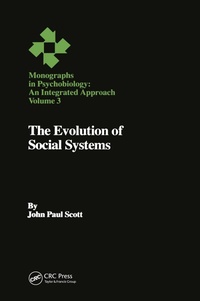
Evolution Of Social System
Published on 2. February 2026
368 pages
978-1-040-89606-8 (ISBN)
Description

In 'The Evolution of Social Systems' J.P. Scott for the first time combines genetic theories of evolution, system theory and theories of behavioural evolution to explain the evolution of social behaviour and organisation. He proposes that caregiving has evolved from self care, to care of fertilised eggs, to developing embryos, to hatchlings. Care may then be extended to adult offspring, collateral relatives and to unrelated others. Humans, Scott shows, ae unique in the degree to which caregiving behaviour is extendable to nonrelated humans, other animals as pets, and even to plants. He concludes that social organisation is based on caregiving as well as processes such as unconscious physiological cooperation, site attachment, sexual behaviour, defensive behaviour, competition and conflict. Competition is thus not the sole mode of evolution. This view challenges some of the conventional sociobiological theories of the evolution of altruism. The book's broad interdisciplinary scope and social relevance has significant import for the general reader as well as for researchers and students in evolution, animal behaviour, ecology, psychobiology, and the human sciences of anthropology, political science and sociology.
More details
Other editions
Additional editions
John Paul Scott
Evolution Of Social System
Book
01/1989
1st Edition
Gordon & Breach Science Publishers SA
€326.83
Shipment within 3-4 weeks
Person
John Paul Scott received a Ph.D. in genetics from the University of Chicago under Sewall Wright and devoted his subsequent career to the study of heredity and the development of social behaviour. For twenty years he directed the research program on genetics and social behaviour at the Jackson laboratory in Bar Harbor, Maine. Afterwards he was a fellow at the Center for Advanced Studies in the Behavioural Sciences at Stanford and is currently Regents Professor of Psychology Emeritus at Bowling Green State University in Ohio. Scott was instrumental in the founding of the Animal Behavior Society and was a co-founders and first president of the International Society for Research on Aggression. He served as president of the International Society for Development Psychobiology and as president of the Behaviour Genetics Association from which he received the 1987 Dobzhansky Award for Eminent Research. Scott has written or edited nine previous books, including Animal Behavior, Aggression, Genetics and the Social Behavior of the Dog (with J.L. Fuller), and Critical Periods.
Content
Preface, Acknowledgements, Chapter I Evolution and Systems Theory, Chapter II The Nature of Genetic Systems, Chapter III Processes of Change in Genetic Systems, Chapter IV Genetic Evolutionary Theories and the Use of Appropriate Models, Chapter V The Evolution of Physiological Systems, Chapter VI On Theories of Organic Evolution and their Relevance to Modern Genetic-Systems Theory, Chapter VII On the Evolution of Behavior, Chapter VIII On Current Theories of the Evolution of Social Behavior and Social Systems: Evolution in Terms of Genetic-Systems Theory, Chapter IX The Evolution of Cooperation and Competition, Chapter X On the Evolution of Social Organization, Chapter XI On Cultural Evolution, Chapter XII On Eco-evolution: Change in Ecosystems, Chapter XIII On the Future of Evolutionary Theories: the Evolution of Evolution, References, Author Index, Subject Index
