

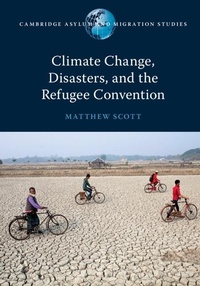
Climate Change, Disasters, and the Refugee Convention
Published on 29. January 2020
978-1-108-78755-0 (ISBN)
Description

Climate Change, Disasters and the Refugee Convention is concerned with refugee status determination (RSD) in the context of disasters and climate change. It demonstrates that the legal predicament of people who seek refugee status in this connection has been inconsistently addressed by judicial bodies in leading refugee law jurisdictions, and identifies epistemological as well as doctrinal impediments to a clear and principled application of international refugee law. Arguing that RSD cannot safely be performed without a clear understanding of the relationship between natural hazards and human agency, the book draws insights from disaster anthropology and political ecology that see discrimination as a contributory cause of people's differential exposure and vulnerability to disaster-related harm. This theoretical framework, combined with insights derived from the review of existing doctrinal and judicial approaches, prompts a critical revision of the dominant human rights-based approach to the refugee definition.
Reviews / Votes
'In this volume, Matthew Scott combines bold arguments with carefully grounded legal analysis to provide a truly original take on one of the most pressing global issues today. This will be an indispensable resource for both practitioners and academics.' Thomas Gammeltoft-Hansen, University of Copenhagen 'As we move further into an increasingly climate-affected century, the question of to whom of those displaced by disasters States owe an obligation to protect under international refugee law looms as one of the most pressing legal questions. This book is therefore both timely and welcome. The exhortation to regard disaster-related displacement as being centred on discriminatory enjoyment of human rights affecting exposure and vulnerability to hazards is well made. Through careful analysis of existing case-law, relevant legal norms and academic commentary, Scott charts the legal 'state of the art' in detail. He identifies areas for further critical reflection on matters of significance both as to claims based on disasters and, more generally, as to the place of risk in the assessment process and the function of discrimination within the refugee definition. I recommend this book to anyone wishing to understand the potential of international refugee law to meet the protection needs of those displaced across borders in the context of disasters and climate change.' Bruce Burson, Senior Member, New Zealand Immigration and Protection Tribunal 'Matthew Scott's book is a very welcome, thought-provoking and significant contribution to the discussion on the protection of persons displaced across borders in the context of disasters and adverse effects of climate change. Highlighting that disasters result from the interaction of natural hazards and social vulnerability rather than just being 'natural', he cogently shows how the refugee definition enshrined in the 1951 Refugee Convention should be interpreted to cover certain categories of individuals who, on account of pre-existing patterns of discrimination, are more vulnerable to the impacts of disasters than others. This is essential reading for everyone interested in exploring the potential of refugee law to address the plight of the growing number of persons forced to flee in the context of drought, flooding, sea-level rise and other forms of environmental degradation.' Walter Kaelin, Universitaet Bern, SwitzerlandMore details
Series
Language
English
Place of publication
Cambridge
United Kingdom
Target group
Professional and scholarly
Illustrations
Worked examples or Exercises; 2 Tables, black and white; 5 Line drawings, black and white
File size
5,69 MB
ISBN-13
978-1-108-78755-0 (9781108787550)
Copyright in bibliographic data and cover images is held by Nielsen Book Services Limited or by the publishers or by their respective licensors: all rights reserved.
Schweitzer Classification
Other editions
Additional editions
Matthew Scott
Climate Change, Disasters, and the Refugee Convention
Book
02/2020
Cambridge University Press
€44.00
Shipment within 15-20 days
Matthew Scott
Climate Change, Disasters, and the Refugee Convention
Book
02/2020
Cambridge University Press
€133.50
Shipment within 15-20 days
Content
1. Introduction; 2. Two disaster paradigms; 3. Jurisprudence on RSD in the context of 'natural' disasters and climate change; 4. Interpreting the refugee definition; 5. The temporal scope of being persecuted; 6. The personal scope of being persecuted: the function of the non-discrimination norm within the refugee definition; 7. Refugee status determination in the context of 'natural' disasters and climate change; Appendix 1. Taxonomy.
