

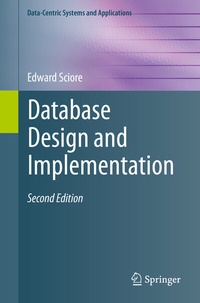
Database Design and Implementation
Second Edition
Published on 27. February 2020
XIII, 458 pages
978-3-030-33836-7 (ISBN)
Description

This textbook examines database systems from the viewpoint of a software developer. This perspective makes it possible to investigate why database systems are the way they are. It is of course important to be able to write queries, but it is equally important to know how they are processed. We e.g. don't want to just use JDBC; we also want to know why the API contains the classes and methods that it does. We need a sense of how hard is it to write a disk cache or logging facility. And what exactly is a database driver, anyway?
The first two chapters provide a brief overview of database systems and their use. Chapter 1 discusses the purpose and features of a database system and introduces the Derby and SimpleDB systems. Chapter 2 explains how to write a database application using Java. It presents the basics of JDBC, which is the fundamental API for Java programs that interact with a database. In turn, Chapters 3-11 examine the internals of a typical database engine. Each chapter covers a different database component, starting with the lowest level of abstraction (the disk and file manager) and ending with the highest (the JDBC client interface); further, the respective chapter explains the main issues concerning the component, and considers possible design decisions. As a result, the reader can see exactly what services each component provides and how it interacts with the other components in the system. By the end of this part, s/he will have witnessed the gradual development of a simple but completely functional system. The remaining four chapters then focus on efficient query processing, and focus on the sophisticated techniques and algorithms that can replace the simple design choices described earlier. Topics include indexing, sorting, intelligent buffer usage, and query optimization.
This text is intended for upper-level undergraduate or beginning graduate courses in Computer Science. It assumes that the reader is comfortable with basic Java programming; advanced Java concepts (such as RMI and JDBC) are fully explained in the text. The respective chapters are complemented by "end-of-chapter readings" that discuss interesting ideas and research directions that went unmentioned in the text, and provide references to relevant web pages, research articles, reference manuals, and books. Conceptual and programming exercises are also included at the end of each chapter. Students can apply their conceptual knowledge by examining the SimpleDB (a simple but fully functional database system created by the author and provided online) code and modifying it.
The first two chapters provide a brief overview of database systems and their use. Chapter 1 discusses the purpose and features of a database system and introduces the Derby and SimpleDB systems. Chapter 2 explains how to write a database application using Java. It presents the basics of JDBC, which is the fundamental API for Java programs that interact with a database. In turn, Chapters 3-11 examine the internals of a typical database engine. Each chapter covers a different database component, starting with the lowest level of abstraction (the disk and file manager) and ending with the highest (the JDBC client interface); further, the respective chapter explains the main issues concerning the component, and considers possible design decisions. As a result, the reader can see exactly what services each component provides and how it interacts with the other components in the system. By the end of this part, s/he will have witnessed the gradual development of a simple but completely functional system. The remaining four chapters then focus on efficient query processing, and focus on the sophisticated techniques and algorithms that can replace the simple design choices described earlier. Topics include indexing, sorting, intelligent buffer usage, and query optimization.
This text is intended for upper-level undergraduate or beginning graduate courses in Computer Science. It assumes that the reader is comfortable with basic Java programming; advanced Java concepts (such as RMI and JDBC) are fully explained in the text. The respective chapters are complemented by "end-of-chapter readings" that discuss interesting ideas and research directions that went unmentioned in the text, and provide references to relevant web pages, research articles, reference manuals, and books. Conceptual and programming exercises are also included at the end of each chapter. Students can apply their conceptual knowledge by examining the SimpleDB (a simple but fully functional database system created by the author and provided online) code and modifying it.
More details
Other editions
Additional editions
Book
02/2020
Springer
€64.19
Shipment within 7-9 days
Person
Edward Sciore
is a recently retired Associate Professor at the Computer Science Department, Boston College. He is the author of numerous research articles on database systems, which span both theory and practice. His favorite activity, however, is to teach database courses to captive students. These teaching experiences, accumulated over a 35-year period, are what led to the writing of this text.
Content
1. Database Systems.- 2. JDBC.- 3. Disk and File Management.- 4. Memory Management.- 5. Transaction Management.- 6. Record Management.- 7. Metadata Management.- 8. Query Processing.- 9. Parsing.- 10. Planning.- 11. JDBC Interfaces.- 12. Indexing.- 13. Materialization and Sorting.- 14. Effective Buffer Utilization.- 15. Query Optimization.
