

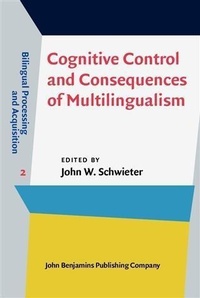
Cognitive Control and Consequences of Multilingualism
Visual Culture, Disability Representations, and the (In)Visibility of Cognitive Difference
1st Edition
Published on 3. August 2016
471 pages
978-90-272-6672-9 (ISBN)
Description

The human mind is a marvelous device that effectively regulates mental activities and facilitates amendable cognitive behaviour across several domains such as attention, memory, and language processing. For multilinguals, the mind also represents and manages more than one language system-a mental exercise which may lead to cognitive benefits. Through an in-depth exploration of these issues, Cognitive Control and Consequences of Multilingualism presents original studies and new perspectives which are cutting-edge and feature traditional and innovative methodologies such as ERPs, fMRIs, eye-tracking, picture- and numeral naming, the Simon, flanker, and oculomotor Stroop tasks, among others. The studies in this book investigate prominent themes in multilingual language control for both comprehension and production and probe the notion of a cognitive advantage that may be a result of multilingualism. The growing number of researchers, practitioners, and students alike will find this volume to be an instrumental source of readings that illuminates how one mind accommodates and controls multiple languages and the consequences it has on human cognition in general.
More details
Other editions
Additional editions
John W. Schwieter
Cognitive Control and Consequences of Multilingualism
Book
08/2016
John Benjamins Publishing Co
€123.50
Shipment within 10-15 days
Content
- Intro
- Cognitive Control and Consequences of Multilingualism
- Editorial page
- Title page
- LCC data
- Table of Contents
- Acknowledgments
- About the editor
- About the contributors
- PART I. Introduction
- Cognitive and neurocognitive implications of language control and multilingualism
- 1. Introduction
- 2. Cognitive control and multilingualism
- 3. Consequences of multilingualism
- 4. Conclusion
- PART II. Cognitive control and multilingualism
- Bilingualism, executive control, and eye movement measures of reading*
- 1. Introduction
- 2. The cognitive demands of knowing more than one language
- 3. Eye movements & bilingual reading
- 3.1 A primer on the use of eye movements to study reading
- 3.2 Eye movement studies of cross-language activation during bilingual reading
- 3.3 The comprehension of language-unique words during bilingual reading
- 3.4 Global aspects of bilingual reading performance
- 4. Are l1/l2 trade-offs in reading performance modulated by l3+ knowledge?
- 5. Does bilingualism vs. Multilingualism matter during reading?: A re-analysis of whitford and ti
- 6. General conclusions
- References
- Listening with your cohort
- 1. Introduction
- 2. The Present Study
- 2.1 Hypothesis
- 3. Experiment 1
- 3.1 Method
- 3.1.1 Articipants
- 3.1.2 Stimuli
- 3.1.3 Procedure
- 3.1.4 Data coding
- 3.2. Results
- 3.2.1 Bilingual recognition study
- 3.2.2 Bilingual priming study
- 3.2.3 Monolingual priming study
- 3.3 Discussion of Experiment 1
- 4. Experiment 2
- 4.1 Method
- 4.1.1 Participants
- 4.1.2 Stimuli and Experimental Design.
- 4.2 Results
- 4.3 Discussion of experiment 2
- 5. General discussion
- 6. Conclusion
- References
- The role of executive function in the perception of L2 speech sounds. in young balanced and unbalanced dual language learners
- 1. Introduction
- 2. Present study
- 2.1 Participants
- 2.2 Procedure
- 2.3 Outside the scanner speech recordings
- 2.4 Stimuli and fMRI task design
- 2.5 Neuroimaging acquisition parameters
- 2.6 FMRI data analysis
- 3. Results
- 3.1 Participant groups
- 3.2 Behavioral data
- 3.3 FMRI Data ROI analyses
- 3.3.1 Unbalanced learners vs. balanced learners
- 3.3.2 Balanced learners vs. unbalanced learners
- 3.3.3 Extension of analyses
- 4. Discussion
- 5. Conclusion
- References
- Are cognate words "special"?
- 1. Introduction
- 2. Bilingual lexical selection and the cognate facilitation effect
- 3. Cognate effects on code-switching and language switching
- 4. Present Study
- 4.1 Method
- 4.2 Participants
- 4.3 Materials
- 4.4 Procedure
- 4.5 Data scoring and analysis
- 4.6 Results and discussion
- 4.6.1 Cognate Status of the Target Word analysis
- 4.6.1.1 L2-Learners. Erroneous responses (6% of the trials) were excluded from the analyses. In the error analyses, the models did not include random slopes. Results showed a significant Type of Trial effect (ß = .090, SE = .037, z-value = 2.435, p = .014
- 4.6.1.2 Bilinguals. Erroneous responses (3.9% of the trials) were excluded from the analyses. In the errors analysis, the Type of Trial (ß = .217, SE =.045, z-value = 4.798, p & .001) and Response Language (ß = -.130, SE = .045, z-value = -2.869, p = .004
- 4.6.1.3 Joined analysis (L2-Learners and Bilinguals). In the errors analysis, the main effects of Language (ß = -.131, SE = .045, z-value = -2.885, p = .003), and Type of Trial (ß = .217, SE = .045, z-value = 4.776, p &.001) were significant. The Type of
- 4.6.2 Cognate Status of the Preceding Word analysis
- 4.6.2.1 L2-Learners. Erroneous responses (6% of the trials) were excluded from the analyses. In the error analyses, the models included a by-item Response Language random slope. Results showed a significant Type of Trial effect (ß = .092, SE = .037, z-val
- 4.6.2.2 Bilinguals. Erroneous responses (3.9% of the trials) were excluded from the analyses. In the errors analysis, only the main effect of Type of Trial was significant (ß = .215, SE = .045, z-value = 4.755, p &.001), revealing that participants made m
- 4.6.2.3 Joined analysis (L2-Learners and Bilinguals). In the errors analysis, the main effects of Language (ß = -.147, SE = .058, z-value = -2.535, p = .011) and Type of trial (ß = .214, SE = .045, z-value = 4.737, p &.001) were significant. The Type of T
- 5. General Discussion
- 5.1 On language-switching patterns and language selection mechanisms
- 5.2 On cognate words and language-switching costs
- 6. Conclusion
- References
- Action speaks louder than words, even in speaking
- 1. Introduction
- 2. Method
- 2.1 Participants
- 2.2 Stimuli and Tasks
- 2.3 Procedure
- 2.4 Design
- 3. Results and discussion
- 3.1 Full-factorial analyses
- 3.1.1 Language-switch costs
- 3.1.2 Formulation processes in trial n
- 3.1.3 Influence of trial n-1
- 3.2 Formulation contrast
- 3.3 Articulation contrast
- 4. General discussion
- 4.1 The role of formulation processes in the reduction of switch costs in trial n
- 4.2 The role of formulation processes in trial n-1 in the occurrence of switch costs in trial n
- 4.3 The role of articulation in trial n-1 in the occurrence of switch costs in trial n
- 5. Conclusion
- References
- Influence of preparation time on language control
- 1. Introduction
- 2. Language proficiency modulates performance
- 3. Trial conditions: Repeat or switch?
- 4. Language proficiency modulates switching costs
- 5. Mixed-language condition: Two trial types in three languages
- 6. Task preparation and preparation time
- 7. Present Study
- 7.1 Predictions
- 7.2 Methods
- 7.2.1 Participants
- 7.2.2 Procedure
- 7.2.3 Data coding and analysis
- 8. Results
- 8.1 Accuracy data
- 8.2 Naming latencies
- 9. Discussion
- 9.1 The role of language proficiency for language switching costs
- 9.2 The role of CSI
- 9.3 CSI × Language
- 9.4 CSI × condition
- 10. Conclusion
- References
- When L1 suffers
- 1. Introduction
- 2. The Present Study
- 3. Experiment 1: L1 slowing after a central L1-L2 switching task
- 3.1 Method
- 3.1.1 Participants
- 3.1.2 Materials
- 3.1.3 Design and procedure
- 3.2 Results
- 3.2.1 Pre- and posttest
- 3.2.2 Switching task
- 3.3 Discussion
- 4. Experiment 2. Scope and duration of L1 slowing
- 4.1 Method
- 4.1.1 Participants
- 4.1.2 Materials
- 4.1.3 Design and procedure
- 4.2 Results
- 4.2.1 Generality of L1 slowing: Presentation conditions A and B before and after switching
- 4.2.2 Generality of L1 slowing: Condition C, naming a new set of pictures
- 4.2.3 Duration of L1 slowing: posttest versus post-posttest
- 4.2.4 Switching task
- 4.3 Discussion
- 5. General discussion
- 6. Conclusion
- References
- Effects of cognitive control, lexical robustness, and frequency of codeswitching on language switching
- 1. Introduction
- 2. Background
- 3. Present study
- 3.1 Research questions
- 3.2 Participants
- 3.3 Procedure
- 3.3.1 Simon task
- 3.3.2 Verbal fluency measure
- 3.3.3 Picture-naming task
- 3.3.4 Data analyses
- 4.0 Results
- 4.1 Analyses of cognitive control
- 4.2 Analyses of lexical robustness
- 4.2.1 L1 lexical robustness
- 4.2.2 L2 lexical robustness
- 4.2.3 L3 lexical robustness
- 4.3 Analyses of frequency of codeswitching
- 5.0 Discussion
- 6. Conclusion
- References
- The locus of cross-language activation
- 1. Introduction
- 2. Background
- 2.1 The locus of cross-language activation
- 2.2 The mechanism of lexical selection in bilingual language production
- 2.3 Cross-language activation in different-script bilinguals
- 3. The present study
- 3.1 Methods
- 3.1.1 Participants in Experiment 1
- 3.1.2 Participants in Experiment 2
- 3.2 Materials
- 3.2.1 Experiment 1
- 3.2.2 Experiment 2
- 3.3 Procedure
- 3.3.1 Experiment 1
- 3.3.2 Experiment 2
- 3.4 EEG Recordings and Analyses
- 3.4.1 Experiment 1
- 3.4.2 Experiment 2
- 4. Results
- 4.1 Behavioral Data Experiment 1
- 4.2 Electrophysiological Data from Experiment 1
- 4.3 Behavioral Data from Experiment 2
- 4.4. Electrophysiological Data from Experiment 2
- 5. Discussion
- References
- Syntactic interference in bilingual naming during language switching
- 1. Introduction
- 2. Situating the present study in the literature
- 3. Materials and method
- 3.1 Participants
- 3.2 Stimuli
- 3.3 Design
- 3.4 ERP recording and data analysis
- 4. Results
- 4.1 Behavioral data
- 4.2 Event-related brain potentials
- 4.3 Switching analysis
- 5. Discussion
- 6. Conclusion
- References
- Multi-component perspective of cognitive control in bilingualism
- 1. Introduction
- 2. Language Selection and Control in Bilingualism
- 3. Bilingualism and Inhibitory Control
- 4. The Dynamic Nature of Cognitive Control Processes: Beyond A Single-Component Approach
- 5. Different Bilingual Experiences Engage Different Cognitive Resources
- 6. Conclusion and Future Research Questions
- References
- PART III. Consequences of multilingualism
- The bilingual advantage in the auditory domain
- 1. Attention and interference control in research on bilingualism
- 2. The bilingual advantage in executive function: Studies using visual paradigms
- 3. Current interpretation of the bilingual advantage
- 4. Bilingualism and the auditory domain
- 4.1 Speech comprehension in noise
- 4.2 Is there a bilingual advantage in control of auditory interference?
- 5. Methodological strengths of recent research on interference in sentence comprehension
- 6. Future directions in bilingualism research focusing on the auditory domain
- 6.1 Extension to control of non-verbal interference
- 7. Conclusion
- References
- Executive functions in bilingual children
- 1. Introduction
- 2. Background
- 2.1 Inhibition
- 2.2 Shifting
- 2.3 Balance and proficiency
- 3. The present study
- 3.1 Experiment 1: Pre-school children
- 3.1.1 Participants
- 3.1.2.1 General ability. Raven's Coloured Matrices (Raven, Raven, & Court, 1976). In this test, the participant has to match one of six graphic patterns with a visual array. The 36 items are presented in three sets of 12, in increasing order of difficult
- 3.1.2.2 Vocabulary measures. Two vocabulary tests were carried out in order to provide a measure of the receptive and expressive vocabulary knowledge of the children. Bilingual children's vocabulary was assessed in both languages.
- 3.1.2.3 Language balance. In order to distinguish between balanced and unbalanced bilinguals (Luk & Bialystok, 2013
- Barac & Bialystok, 2012), we calculated the number of correct answers in the vocabulary tasks in both languages, and then subtracted the p
- 3.1.2.4 Executive functions measure. Flanker fish task (Schonert-Reichl et al., 2015). In this task, the participant has to focus on one stimulus and ignore distracting stimuli. The stimuli were presented in three different blocks (two single blocks and a
- 3.1.2 Tasks
- 3.1.3 Procedure
- 3.1.4 Results
- 3.1.4.1 Inhibition. Inhibitory abilities were examined by comparing performance in congruent and incongruent trials from the two single task blocks (central target and peripheral target). We analyzed median RTs to correct trials, and accuracy rates as dep
- 3.1.4.2 Shifting
- DCCS task
- 3.2 Experiment 2: Sixth Graders
- 3.2.1 Participants
- 3.2.2 Design and Procedure
- 3.2.2.1 Peabody Picture Vocabulary Test (PPVT
- Dunn, 1965). Adapted in Russian (Schwartz, 2006) and in Hebrew (Nevo, 1979) was used to test receptive vocabulary knowledge. The test assesses the child's ability to match pictures to spoken words by pointin
- 3.2.2.2 General ability test. As in Experiment 1, we used the Raven's Coloured Matrices (Raven, Raven, & Court, 1976,) to measure non-verbal abilities. In this task, participants matched one of six graphic patterns to a visual array. There was a total of
- 3.2.2.3 Executive Function test. Participants performed a variant of the Flanker Fish task (Schonert-Reichl et al., 2015) similar to that described in Experiment 1. However, given the older age of the children the experimental blocks included a slightly l
- 3.2.3 Results
- 3.2.3.1 Inhibition. Similarly to Experiment 1, inhibitory abilities were examined by comparing performance in congruent and incongruent trials from the two single task blocks (central target and peripheral target). We analyzed median RTs to correct trials
- 3.2.3.2 Shifting. Children's facility in mental shifting was examined by comparing performance in the single task blocks (central and peripheral target) with their performance in the mixed task blocks. Thus, we analyzed median RTs to correct trials, and a
- 4. Discussion
- 5. Conclusion
- References
- Home language usage and executive function in bilingual preschoolers
- 1. Introduction
- 2. Background
- 2.1 Executive Function Development
- 2.2 Bilingual Experience and Executive Function
- 3. The Current Study
- 3.1 Methods
- 3.1.1 Participants
- 3.1.2 Procedures and Materials
- 4. Results
- 4.1 T1 Child ANT and Child Age
- 4.2 T1 Child ANT and Bilingual Language Use
- 4.3 Changes in Child ANT Accuracy
- 5. Discussion
- References
- Cognitive mechanisms underlying performance differences between monolinguals and bilinguals
- 1. Introduction
- 2. Language control
- 3. Executive functions
- 4. Disengagement of attention
- 5. Conclusions and future directions
- References
- Time course differences between bilinguals and monolinguals in the Simon task
- 1. Introduction
- 2. Present study
- 2.1 Experiment 1: Modelling button press latencies
- 2.1.1 Participants
- 2.1.2 Test Materials
- 2.1.3 Procedure
- 2.1.4 Results
- 2.1.4.1 Accuracy (%) The ANOVA analysis revealed a significant main effect of trial type, F (2, 76) = 43.91, p & 0.001, ?p2 = 0.32. Further, we carried out pairwise t-tests with Bonferroni correction in order to investigate the main effect of trial type.
- 2.1.4.2 Reaction time (ms). Trials in which responses were too fast (less than 100ms) or too slow (greater than 1000ms) were excluded from analyses (resulting in 7.03% of the trials removed) (Proctor, Yamaguchi, & Vu, 2007). The ANOVA results revealed a s
- 2.1.4.3 Linear Ballistic Accumulator (LBA) model
- 2.2 Experiment 2: Reach-to-touch Paradigm
- 2.2.1 Procedure
- 2.2.2 Data analysis
- 2.2.3 Statistical analyses
- 2.2.4 Results
- 2.2.4.1 Accuracy (%). The accuracy rates were very high in all the three trial types, which is presumed to be due to the relatively long duration of the reaching response, which provides participants an opportunity to recognize and correct mistakes they m
- 2.2.4.2 Initial x-velocity profile. The results revealed a significant main effect of trial type suggesting higher initial x-velocity on congruent trials relative to neutral trials (b = -5.19, SE = 0.39, t = -13.25) and incongruent trials (b = -14.67, SE
- 2.2.4.3 Using pairwise comparisons to look at the time course of the Simon effect in bilinguals and monolinguals. In our first pairwise comparison, we investigated when in stimulus processing time the difference emerged between congruent and incongruent
- 2.2.4.4 Using pairwise comparisons to look at the time course of the trial type (congruent, neutral, incongruent) in bilinguals and monolinguals. In our second set of comparisons, we investigated the point in stimulus viewing time when the initial x-veloc
- 3. Discussion
- 4. Conclusion
- References
- Top down influence on executive control in bilinguals
- 1. Introduction
- 2. Background
- 2.1 Language proficiency and executive control in bilinguals
- 2.2 Eye movements as a response system
- 2.3 Working memory and attention capture
- 3. Present Study
- 3.1. Experiment 1: Stroop with working memory interference (colour)
- 3.1.1 Participants
- 3.1.2 Stimuli
- 3.1.3 Procedure
- 3.1.4 Data analysis
- 3.1.5 Results
- 3.1.5.1 Error analysis
- 3.1.6 Discussion of Experiment 1
- 3.2 Experiment 2: WM Stroop Location
- 3.2.1 Participants.
- 3.2.2 Stimuli
- 3.2.3 Procedure
- 3.2.4 Results
- 3.2.4.1 Error analysis. The main effect of congruency was found significant, F(2, 96) = 95.4, p = .001, showing higher percentage of errors for incongruent condition (8.7, SE = 7.4) as compared to the congruent (3.6, SE = .48) and neutral (6.3, SE = .55)
- 3.2.5 Discussion of Experiment 2
- 4. General discussion
- References
- Index
