

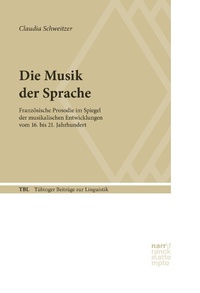
Die Musik der Sprache
Französische Prosodie im Spiegel der musikalischen Entwicklungen vom 16. bis 21. Jahrhundert
1st Edition
Published on 22. November 2021
201 pages
978-3-8233-0343-5 (ISBN)
Description

Die Verwandtschaft von Sprache und Musik ist tiefgreifend. Beide werden ausdrucksstark durch dieselben Parameter, die wir als prosodisch oder musikalisch bezeichnen. Diese "Musik der Sprache" wird immer dann deutlich, wenn Sprache klingt, sei es in gesprochener oder in gesungener Form.
Dieser Band zeigt erstmals, wie in Frankreich seit dem 16. Jahrhundert prosodisches Wissen konstruiert wurde und welche Rolle dabei die Musik spielt. Die aufgezeigten theoretischen Grundlagen werden durch konkrete Beispiele verschiedener Jahrhunderte und Disziplinen (Linguistik, Poesie, Musik) verdeutlicht.
Dieser Band zeigt erstmals, wie in Frankreich seit dem 16. Jahrhundert prosodisches Wissen konstruiert wurde und welche Rolle dabei die Musik spielt. Die aufgezeigten theoretischen Grundlagen werden durch konkrete Beispiele verschiedener Jahrhunderte und Disziplinen (Linguistik, Poesie, Musik) verdeutlicht.
More details
Other editions
Additional editions
Claudia Schweitzer
Die Musik der Sprache
Französische Prosodie im Spiegel der musikalischen Entwicklungen vom 16. bis 21. Jahrhundert
Book
11/2021
1st Edition
Narr Francke Attempto
€58.00
Shipment within 5-7 days
Person
Dr. Dr. Claudia Schweitzer ist Forscherin am Institut Praxiling (UMR 5267 CNRS) an der Universität Paul-Valéry, Montpellier 3.
Content
1Prosodie und Musik: eine lange gemeinsame Geschichte
1.1 Prosodie und stimmlicher Ausdruck
1.2 Das musikalische Ausdruckspotential der Sprechstimme
1.3 Notation von Prosodie und Musik
2Sprache und Musik: Ästhetische Wandel im Laufe der Jahrhunderte
2.1 Der Begriff "Ästhetik"
2.2 Die Renaissance: Rückkehr zur Antike
2.3 Der französische Barock: Eine musikalische Deklamation
2.4 Das klassische Zeitalter und die Lumières
2.5 Die Romantik: Traumwelten und wissenschaftliche Genauigkeit
2.6 Die Moderne: Wissenschaft und Emotionserforschung
2.7 Korpus
3Vorteile und Problemfelder der gemeinsamen Metasprache
3.1 Die Bedeutung des Begriffs "quantité"
3.2 Der "Ton" in Sprache und Musik
3.3 Prosodie zwischen Poesie und Prosa
3.4 Beispiele der verwendeten Metasprache
4Rhythmus und Metrum im Wandel der Zeit
4.1 Vom Lateinischen zum Französischen
4.2 Quantifizierung in französischer Poesie und Musik
4.3 Quantität als relative Größe
4.4 Der "Flow" des Slams
5Melodie und Intonation
5.1 Kurze Methodengeschichte der Melodie- und Intonationsforschung
5.2 Von der Analyse der Melodie zur Analyse der Intonation
5.3 Intonation und Struktur
5.4 Intonation und Emotion
5.5 Melodie, Ton, Intonation und Akzent
6Akzent und Akzentuierung: eine französische Besonderheit
6.1 Probleme der Wahrnehmung
6.2 Subjektive Wahrnehmung und objektive Messung
6.3 Akzent und Ausdruck
Zum Schluss
Bibliographie
Index nominum
1.1 Prosodie und stimmlicher Ausdruck
1.2 Das musikalische Ausdruckspotential der Sprechstimme
1.3 Notation von Prosodie und Musik
2Sprache und Musik: Ästhetische Wandel im Laufe der Jahrhunderte
2.1 Der Begriff "Ästhetik"
2.2 Die Renaissance: Rückkehr zur Antike
2.3 Der französische Barock: Eine musikalische Deklamation
2.4 Das klassische Zeitalter und die Lumières
2.5 Die Romantik: Traumwelten und wissenschaftliche Genauigkeit
2.6 Die Moderne: Wissenschaft und Emotionserforschung
2.7 Korpus
3Vorteile und Problemfelder der gemeinsamen Metasprache
3.1 Die Bedeutung des Begriffs "quantité"
3.2 Der "Ton" in Sprache und Musik
3.3 Prosodie zwischen Poesie und Prosa
3.4 Beispiele der verwendeten Metasprache
4Rhythmus und Metrum im Wandel der Zeit
4.1 Vom Lateinischen zum Französischen
4.2 Quantifizierung in französischer Poesie und Musik
4.3 Quantität als relative Größe
4.4 Der "Flow" des Slams
5Melodie und Intonation
5.1 Kurze Methodengeschichte der Melodie- und Intonationsforschung
5.2 Von der Analyse der Melodie zur Analyse der Intonation
5.3 Intonation und Struktur
5.4 Intonation und Emotion
5.5 Melodie, Ton, Intonation und Akzent
6Akzent und Akzentuierung: eine französische Besonderheit
6.1 Probleme der Wahrnehmung
6.2 Subjektive Wahrnehmung und objektive Messung
6.3 Akzent und Ausdruck
Zum Schluss
Bibliographie
Index nominum
