

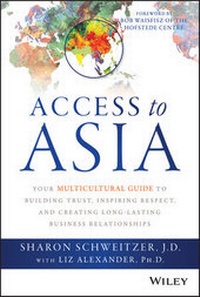
Access to Asia
Description

Access to Asia presents a deeply insightful framework fortoday's global business leaders and managers, whether travelingfrom Toronto to Taipei, Baltimore to Bangalore, or San Francisco toShanghai. Drawing from her extensive experience and globalconnections, author Sharon Schweitzer suggests that irrespective oftheir industry, everyone is essentially in the relationshipbusiness. Within Asia, building trust and inspiring respect arevital steps in developing business relationships that transcendbasic contractual obligations. Readers will find in-the-trenchesadvice and stories from 80 regional experts in 10 countries,including China, Hong Kong, India, Japan, and Korea.
* Discover the unique eight-question framework that provides richinterview material and insight from respected cultural experts
* Track cultural progress over time and highlight areas in needof improvement with the Self-Awareness Profile
* Learn the little-known facts, reports, and resources that helpestablish and strengthen Asian business relationships
Effective cross-cultural communication is mandatory for today'ssuccessful global business leaders. For companies and individualslooking to engage more successfully with their counterparts inAsia, Access to Asia showcases the critical people skillsthat drive global business success.
All prices
More details
Other editions
Additional editions
Persons
LIZ ALEXANDER, PhD, is the multiple awards-winning author of 15 books and acts as book strategist and consulting co-author to business leaders, entrepreneurs, and consultants worldwide. She is also co-founder of boutique consulting firm Leading Thought, directing her gifts and passion to helping aspiringthought leaders harness strategically valuable, actionable insights to grow their businesses and boost revenue. She can be reached at liz@drlizalexander.com.
Content
About the Authors xvii
Acknowledgments xix
Introduction xxi
A Journey of Passion xxii
From Etiquette to Intercultural Exchange xxii
A Questioning Framework xxiii
Why These Asian Countries? xxiii
How This Book Is Structured xxiv
Self-Awareness Profiles xxiv
Business Is Relationships xxv
From Theory to Practice xxv
Chapter 1 A Question of Culture 1
Why This? Why Now? 6
Who Are "Americans"? 7
Chapter 2 Exploring Country Cultures 9
Thinking Is Not Universal 11
Relationships Are Dynamic 12
Chapter 3 United States of America 27
Introduction 28
Quiz 28
Country Basics 29
Business Culture, Etiquette, and Customs 34
Eight-Question Framework 43
Cultural Summary 52
Self-Awareness Profile 52
The Journey Continues . . . 53
Chapter 4 Overview of Concepts and Terms 55
Chapter 5 China 67
Introduction 68
Quiz 69
Country Basics 69
Business Culture, Etiquette, and Customs 75
Eight-Question Framework 84
Cultural Summary 93
Self-Awareness Profile 93
Chapter 6 Hong Kong 97
Introduction 98
Quiz 99
Country Basics 99
Business Culture, Etiquette, and Customs 104
Eight-Question Framework 113
Cultural Summary 120
Self-Awareness Profile 121
Chapter 7 India 123
Introduction 124
Quiz 125
Country Basics 125
Business Culture, Etiquette, and Customs 131
Eight-Question Framework 139
Cultural Summary 147
Self-Awareness Profile 147
Chapter 8 Japan 151
Introduction 152
Quiz 153
Country Basics 153
Business Culture, Etiquette, and Customs 159
Eight-Question Framework 167
Cultural Summary 177
Self-Awareness Profile 177
Chapter 9 Malaysia 181
Introduction 182
Quiz 182
Country Basics 183
Business Culture, Etiquette, and Customs 188
Eight-Question Framework 198
Cultural Summary 205
Self-Awareness Profile 206
Chapter 10 Myanmar 209
Introduction 210
Quiz 211
Country Basics 211
Business Culture, Etiquette, and Customs 217
Eight-Question Framework 225
Cultural Summary 233
Self-Awareness Profile 233
Chapter 11 The Philippines 237
Introduction 238
Quiz 239
Country Basics 239
Business Culture, Etiquette, and Customs 245
Eight-Question Framework 252
Cultural Summary 258
Self-Awareness Profile 259
Chapter 12 Singapore 261
Introduction 262
Quiz 262
Country Basics 263
Business Culture, Etiquette, and Customs 269
Eight-Question Framework 276
Cultural Summary 282
Self-Awareness Profile 283
Chapter 13 South Korea 285
Introduction 286
Quiz 287
Country Basics 287
Business Culture, Etiquette, and Customs 293
Eight-Question Framework 303
Cultural Summary 309
Self-Awareness Profile 310
Chapter 14 Taiwan 313
Introduction 314
Quiz 315
Country Basics 315
Business Culture, Etiquette, and Customs 321
Eight-Question Framework 329
Cultural Summary 336
Self-Awareness Profile 336
Chapter 15 Summary 339
Bibliography 343
Books 343
Online Resources 348
Contributors 351
Index 359
Introduction
In the world of high-speed motor brands dominate-Formula One and NASCAR. Both require skill, strategy, and intense focus. In all other respects, they couldn't be more different.
Formula One is the racing equivalent of a Louis Vuitton store: high class, with European roots and international appeal. Formula One races, known as Grand Prix, showcase technologically sophisticated, single-seat, purpose-built cars driven by men like Prost, Villeneuve, and Schumacher with engines designed by world-class talent at Alfa Romeo, Ferrari, Maserati, Lotus, and Mercedes-Benz. The only two U.S. Americans who have won in Formula One's 62-year history are Phil Hill in 1961 and Mario Andretti in 1978.
NASCAR (the National Association for Stock Car Auto Racing), on the other hand, is an all-American phenomenon whose heroes have first names such as Denny, JJ, and Kyle. Stock cars are almost indistinguishable from those you'd find in a Chevrolet, Ford, or Dodge showroom. In contrast to Formula One, almost all NASCAR Sprint Cup Series winners have been U.S. Americans. Whereas attendees at Formula One races can enjoy four-star hotels, expensive restaurants, suites and grandstand seats, NASCAR fans tend to prefer an RV, eat BBQ, and drink beer.
When Formula One announced that it would race again in the U.S. at the purpose-built track named Circuit of the Americas in Austin, Texas, many were surprised. Other U.S. venues were under consideration to host the race. However, misperceptions of Texas as a state with cactus, men in cowboy hats, and armadillo were shown to be wrong. Austin's reputation as the Live Music Capital of the World is just one indication of the city's culture of inclusiveness, sophistication, and willingness to embrace new experiences. Formula One held its inaugural race in Austin in 2012 and given its ten-year contract with Texas, racing is expected through 2022 and beyond.
The awareness, flexibility, understanding, and a willingness to adapt are similarly essential when conducting business across different world cultures. If you have ever traveled to China, India, Japan, or any of the other Asian countries explored in this book, you will appreciate how important it is to travel with an open mind and not to expect that domestic business practices are understood elsewhere.
Where there are cultural differences, there is the potential for misunderstanding. That is why the overarching question at the heart of this book is: What do I need to know, think, and do to build trust, inspire respect, and create long-lasting business relationships in Asia?
A Journey of Passion
As the daughter of a military officer, Sharon has spent her life exposed to different cultures-she's a real "third culture kid."1 Her passion for helping others professionally benefit from enhanced cross-cultural relationships began in 1989, the year she graduated from law school. After spending a month that summer experiencing China, Hong Kong, and Thailand with a fellow summer associate, she wrote in her journal: "I need to be doing something where I'm traveling and working with people in different cultures."
Nevertheless, back in the U.S., Sharon did what most recently-graduated lawyers do: She joined a law firm. Two years later, she began working for the Texas Attorney General's office, which reignited her fascination with the way different mindsets and priorities impact how people communicate and resolve conflict.
By early 2008, Sharon had visited all seven continents and over 30 countries, and had gained a professional understanding of how to bridge the gap between people from different cultures. Taking a two-year sabbatical from the law, she visited the Czech Republic and immersed herself in family and culture. Then she embarked on a series of courses at the Protocol School of Washington to emerge as a newly minted corporate-etiquette and international-protocol consultant, and a protocol officer.
From Etiquette to Intercultural Exchange
For the first six years after launching Protocol and Etiquette Worldwide, Sharon was influenced by experts in the field of international etiquette and intercultural awareness. What she found was that her clients wanted more than third-hand advice. They were hungry for realistic, practical, and implementable guidance that would enable them to be more successful in our globalized economy. They wanted to hear Sharon's experiences and stories!
In 2012, the city of Austin asked Sharon to present on cross-cultural awareness in readiness for the inaugural Formula One races. Her interest in the research of social psychologist Geert Hofstede and his son (Gerte Jan), as well as that of cross-communication consultants Fons Trompenaars and Charles Hampden-Turner deepened. Sharon's lifelong cross-cultural experience, training, and research have been funneled into this book.
From our great personal love of Asia, and in light of the increased interest worldwide in doing business across that continent, we chose to focus this book on Asia. By crafting material that engages, educates, and entertains, we intend to take you on a personally fulfilling journey.
A Questioning Framework
As the eighteenth-century French philosopher Voltaire said, "Judge a man by his questions rather than his answers." After interviewing over 100 international professionals for this book, we noticed a pattern emerging: eight core questions whose answers were essential in attracting and building the relationships upon which today's successful businesses depend. Having researched many of the models offered by cultural gurus such as Edward Hall, Florence Kluckhohn, Fred Strodtbeck, Geert Hofstede, Fons Trompenaars and Charles Hampden-Turner, George Simons, Janet Bennett, and Milton Bennett, we found these eight questions reflect topics vitally important for culturally aware businesspeople.
Why These Asian Countries?
To counter the desire to cover every country as if they were equally important to U.S. business interests, Sharon engaged the global intelligence firm Stratfor, asking them to produce a report on U.S. American business travel to Asia in order to identify the current and future top-ranking countries for U.S. investment and travel.2 Six countries-China, Hong Kong,3 Japan, India, South Korea, and Taiwan-accounted for over 70 percent of all U.S. business travel to Asia and represented the top U.S. regional trade partners, as well as key destinations for U.S. investment. According to Stratfor, business travel to these countries, with the possible exception of Taiwan, is not expected to decline significantly over the next two decades.
However, we also wanted to include countries that were likely to emerge as increasingly important destinations for U.S. business travelers over the next 20 years. Among these top-ranking countries are Singapore, the Philippines, and Malaysia. Finally, it was Sharon's personal fascination with the mysterious Myanmar, formerly known as Burma, which led to our inclusion of that country here.
How This Book Is Structured
This book opens with an overview on culture, which explains why cultural awareness is important to establishing successful relationships, followed by an introduction to our eight-question framework. For all readers who seek an understanding of the United States, in addition to the 10 Asian countries, we have included a chapter on U.S. culture. U.S readers will gain a better self-awareness and understanding of their own culture. Overview of Concepts and Terms, offers an alphabetical collection of key concepts. Please contact Sharon at sharon@sharonschweitzer.com with your suggestions and insights for improving this list.
Each of the 10 country chapters that follow help expand your knowledge through the eight-question framework. Topics in these chapters include
- A brief historical overview
- The names of heroes and sports figures
- An explanation of etiquette and protocol
- Insider tips on socializing
- Fiscal calendars and a list of important holidays
There is also a quiz in each chapter together with a Self-Awareness Profile.
Self-Awareness Profiles
This simple exercise prompts you to self-identify where you currently stand on topics related to the eight-question framework. This visual comparison will help you discover your current mindset and behavior to help develop more robust business relationships in each country. You will find these graphics after the eight-questions section and the cultural summary within each country chapter. We suggest photocopying the graphics or using a pencil within the book so that you can see, over time, how you have adjusted your mindset.
Here is an example, concerning formality within Japanese business:
Example
How formal do the Japanese tend to be in business? (Note: numbers set in bold indicate the prevailing cultural preference.)
Very informal Highly...