

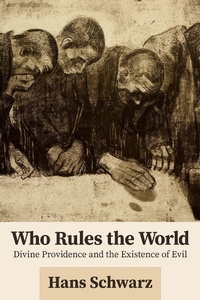
Who Rules the World
Description

Over a career spanning more than fifty years, Hans Schwarz has grappled with nearly all of Christianity's major theological questions. In this latest volume, Schwarz tackles the perennial problem of evil. How is it possible to reconcile the manifest evil and pain in the world with the biblical promise of hope and redemption? Are we, in fact, "lonely wanderers in the immensity of the universe about whom nobody cares," or is there something above and beyond us in which we can trust?
To this perennial question Schwarz brings his signature blend of pastoral sensitivity and scholarly acumen. Informed by decades in the classroom, Schwarz offers a sweeping survey of views of the problem of evil, beginning with the world's major religious traditions before focusing on the major views across the broad span of Christian history.
The book aims to help readers interested in the problem of evil understand the broad sweep of human thought about the problem, and make informed assessments of the issue for themselves.
More details
Other editions
Additional editions
Person
Content
- Cover Page
- Title Page
- Copyright Page
- Contents
- Preface
- Abbreviations
- Introduction
- 1: Good and Evil in the History of Religions
- The Dualistic Approach
- The Fatalistic Approach
- 2: Evil in the Judeo-Christian Scriptures
- God and Evil in the Old Testament
- The New Testament
- 3: The Early Church
- Irenaeus: Humans Are Created in the Image of God
- Augustine: God's Providence and the Existence of Evil
- 4: Middle Ages and the Reformation Period
- Thomas Aquinas: The Goodness of God and the Deficiency of Evil
- John Calvin: The World Is Governed in All of Its Parts by Divine Providence
- Martin Luther: Though There Is Turmoil God Rules Supreme
- 5: The Enlightenment
- Gottfried Wilhelm Leibniz: The Necessity of Evil
- Voltaire: Where Is God?
- Kant: A Theodicy Eludes Human Reason
- Hume: Between Skepticism and Faith
- 6: The Nineteenth and Twentieth Centuries
- Hegel: History as a Justification of the Ways of God
- Paley and Darwin: Goodness or Cruelty?
- Barth: The Overpowering Goodness of God
- Rahner: The Incomprehensibility of Suffering
- Sölle and Rubenstein: The Weakness of God and the Holocaust
- Moltmann: Theodicy as the Open Wound of Life in This World
- 7: The Present Situation
- Process Thought: The Emerging God
- The Irenaean Theodicy of John Hick
- The Openness of God
- Excursus: Open Theism and Process Theology
- 8: The God Who Cares
- Who or What Is God?
- God's Providential Care
- God's Special Providence
- 9: Under God's Guidance
- God the Creator, Sustainer, and Redeemer
- Anticipation of a New Creation
- Discerning the Mind of God
- Selected Bibliography
- Index of Subjects
- Index of Names
- Biblical References
