

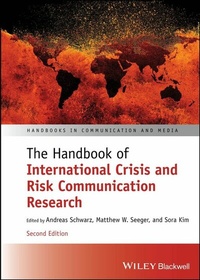
The Handbook of International Crisis and Risk Communication Research
Description

Global Insights on Navigating Today's Complex Crises
Now in its second edition, The Handbook of International Crisis and Risk Communication Research offers a timely and comprehensive exploration of the methods, challenges, and innovations in managing present-day global crises and risks. Bringing together expert insights from across the fields of communication, public relations, and social sciences, this interdisciplinary volume examines crisis and risk communication through an international lens. Each chapter presents unique cultural, theoretical, and methodological perspectives for managing risk, mitigating crises, and fostering resilience.
Amid growing transnational issues such as public health emergencies, climate-induced disasters, and political upheavals, the Handbook emphasizes the role of communication in crisis awareness, recovery, and renewal. Contributions by leading scholars and practitioners investigate vital issues such as the impact of misinformation, digital technologies, and media dynamics in shaping public perception and policy response. This revised and expanded edition also reflects recent global threats, including climate change, the COVID-19 pandemic, the war in Ukraine, and other cross-border crises.
Equipping readers with the knowledge and frameworks necessary to navigate an increasingly complex and interconnected world, The Handbook of International Crisis and Risk Communication Research is perfect for advanced graduate courses and PhD programs in crisis and risk communication, as well as crisis managers, public relations consultants, communication officers, and scholars in risk management and communication.
More details
Other editions
Additional editions

Persons
Andreas Schwarz is Senior Researcher in Risk and Crisis Communication at Technische Universität Ilmenau, Germany, and Co-Director of the International Research Group on Crisis Communication. He served as the founding Chair of the Crisis Communication Section of ECREA. Schwarz has led multiple studies on crisis communication, including COVID-19 risk communication, and has consulted for government and nonprofit organizations.
Matthew W. Seeger is Distinguished University Professor of Communication and co-director of the Center for Emerging and Infectious Diseases at Wayne State University. A prominent researcher in crisis and risk communication, Seeger has published nine books, including Narratives of Crisis: Telling Stories of Ruin and Renewal and Theorizing Crisis Communication. He has worked extensively with the CDC and WHO on crisis response and communication ethics.
Sora Kim is Professor at the Chinese University of Hong Kong, where she directs the Corporate Communication program and the CSRCom & Sustainability Hub. An expert in CSR and crisis communication, Kim has over 130 publications in leading communication and business journals. Her work explores sustainability, risk, and crisis communication across corporate and societal contexts.
Content
List of Contributors x
Preface and Acknowledgments xiv
Part I History, Status Quo, and Trends in Global Crisis and Risk Communication Research 1
1. Global Threats and the Significance of International Risk and Crisis Communication Research: Advancing Integration, Diversity, and Complexity 3
Andreas Schwarz
2. History of Crisis and Risk Communication: The Development of a Global Community of Multi- Disciplinary Research, Theory and Practice 15
Matthew W. Seeger
3. Beyond Borders and Bridging Worlds: Unveiling Cultural Dynamics in International Risk and Crisis Communication 28
Sora Kim
Part II Strategic and Institutional Communicators in International Crises and Risks 41
4. Military, Government, and Media Management in Wartime 43
Kathrin Schleicher
5. Crisis Communication in the Context of Terrorism: Process Approach to Complex Crises 55
Aino Ruggiero and Minttu Tikka
6. Paradigms of Risk and Crisis Communication and the Threat of Misinformation and Disinformation 70
Michael J. Palenchar and Robert L. Heath
7. Strategic Communication in Global Health Crises: Are (Trans) National Institutions Up to the Task? 80
Martin Löffelholz and Yi Xu
8. International Organizational Crisis Communication: A Simple Rules Approach to Managing Crisis Complexity 94
Andrew S. Pyle, Ryan P. Fuller, and Robert R. Ulmer
9. Political Crises 108
Bengt Johansson and Orla Vigsø
Part III The Role of Legacy Media and Social Media in International Crises and Risks 119
10. War Reporting in an Evolving Media Landscape: Perspectives and Prospects 121
Aynur Sarisakalog¿lu and Pauline Gidget Estella
11. Terrorism, Lone Wolf Shootings, School Shootings, and the Role of (Social) Media 135
Liane Rothenberger and Melanie Verhovnik- Heinze
12. Environmental Risk Communication: The Challenges to Progressively Affecting Behavior 144
Michael J. Palenchar and Carla White
13. Missed Risk and Crisis Communication Opportunities During the COVID- 19 Pandemic 155
Brooke Fisher Liu and Cynthia Baur
14. The Role of Legacy Media and Social Media in International Organizational Risk and Crisis Communication 168
Yan Jin and Toni G.L.A. van der Meer
15. Political Crisis Communication and the Rhetorical Arena: An Analysis of President Zelensky's War Addresses and Social Media Use 180
Elin Strand Larsen and Øyvind Ihlen
Part IV The Role of Audiences, Citizens, and Victims in International Crises and Risks 193
16. War, Media, and Public Opinion: A Battle for Hearts and Minds 195
Michel M. Haigh
17. Communicating Terrorism: Meaning-Making and Crisis 205
Ruth DeFoster
18. Reoccurring Challenges and Emerging Threats: Crises and the New Millennium 216
Patric R. Spence and Kenneth A. Lachlan
19. The Role of Audiences, Citizens, and Victims in International Crises: Addressing Public Health Crises and Pandemics 228
Annemarie Wiedicke and Constanze Rossmann
20. Domestic and International Audiences of Organizational Risk and Crisis Communication: State of the Art and Cross-Cultural Implications 244
An-Sofie Claeys and Andreas Schwarz
21. Reputational Crisis in Politics 259
Sergei A. Samoilenko and Greg Simons
Part V The State of Crisis and Risk Communication Research Around the Globe 273
Crisis and Risk Communication Research in Africa 275
22. Crisis Communication in East Africa: The State of Research and Implications for Practice 277
Angella Napakol, Aisha Sembatya Nakiwala, and Marjorie Kyomuhendo
23. The Role of Customary Crisis Communication Mechanisms in Ethiopia 293
Tariku Abas and Zenebe Beyene
24. Culture, Ethnicity, and Religion: A Combustible Mix in Crisis Communication in Nigeria 306
Amiso M. George and Wole Adamolekun
Crisis and Risk Communication Research in Asia 319
25. Crisis Communication Research in South Korea 321
Soo-Yeon Kim and Sora Kim
26. Risk and Crisis Communication Research in Singapore 333
Augustine Pang, Jerena Ng, and Jason Shi-yang Lim
27. Risk and Crisis Communication Research in China 347
Yingru Ji and Chang Wan
28. Risk and Crisis Communication Research in India 363
Krishnamurthy Sriramesh and Ganga S. Dhanesh
29. Risk Communication Research and Practice in Japan 375
Mihoko Sakurai
Crisis and Risk Communication Research in the Middle East 387
30. Crisis and Risk Communication Research in Israel 389
Eytan Gilboa, Clila Magen, and Ester Cohen-Rinski
31. Risk and Crisis Communication Research: Contextual Characteristics and Perspectives from the GCC Countries 402
Ilhem Allagui
Crisis and Risk Communication Research in Europe 417
32. Crisis and Risk Communication Research in Germany 419
Andreas Schwarz
33. Risk and Crisis Communication Research in the Nordic Countries 435
Finn Frandsen and Winni Johansen
34. Revisiting the Challenges of Crisis Management and Crisis Communication Research in Russia 449
Sergei A. Samoilenko and Greg Simons
35. Risk and Crisis Communication Research in Romania 463
Corina Buzoianu, Monica Bîrä, and Alina Bârgaoanu
36. Crisis and Risk Communication Research in Eastern Europe 477
Katerina Tsetsura, Marta N. Lukacovic, and Iuliia Dolmatova
Crisis and Risk Communication Research in the Americas 493
37. Risk and Crisis Communication Research in North America 495
Shari R. Veil
38. Risk and Crisis Communication in Latin America 506
Jesús Arroyave and Ana María Erazo-Coronado
39. Risk and Crisis Communication Research in Brazil 517
Rodrigo Soares, Rozália Del Gáudio Soares, and Paulo Henrique Soares
40. Crisis, Risk, and Media Cases in Argentina 528
Damián Fernández Pedemonte
Crisis and Risk Communication Research in Australia and Oceania 539
41. Risk and Crisis Communication in Australia and New Zealand 541
Christopher Galloway and Theodore E. Zorn
Part VI Emerging Topics, Challenges, Theory, and Methods 553
Conceptual and Theoretical Developments and Challenges in Crisis and Risk Communication 555
42. International Crises as Wicked Problems and Mega-crises: Opportunities for Building Crisis Communication Theory on an International Level 557
Rodrigo Soares and Timothy L. Sellnow
43. Instructional Communication Theories, Models, and Constructs in Risk/Mega-Risk and Crisis/Mega- Crisis 566
Deanna D. Sellnow
44. Risk- based Approaches to Crisis Management and Communication 580
Frederic Bouder
Methodological Developments and Challenges in Crisis and Risk Communication Research 595
45. Aligning the Field: Embracing the Interdisciplinary, Conceptually Divergent, and Methodological Diverse Reality of Good Research in Risk and Crisis Communication 597
Audra Diers-Lawson
46. Opportunities and Pitfalls of Computational Communication Science for International Risk and Crisis Communication Research 615
Daniel Vogler
47. Methodological Challenges of International Crisis Communication Research 626
W. Timothy Coombs
Technologies and Practices in International Crisis and Risk Communication 637
48. Technologies in Crisis Communication: Tools, Systems, and Infrastructures 639
Rob Grace
49. Preparing for International and Cross- Cultural Crises: The Challenges of Research in Action, Competing Voices, Inclusivity, and the Interplay of Responsibility in Global Organizations 656
Ben Duncan and Audra Diers-Lawson
Summing Up & Looking Ahead: The Future of International Risk & Crisis Communication Research 675
50. The Expanding and Dynamic Field of Crisis and Emergency Risk Communication: Summary, Implications, and Outlook 677
Andreas Schwarz, Matthew W. Seeger, and Sora Kim
Index 690
List of Contributors
Tariku Abas
Loyola Marymount University, Marymount Institute-TSEHAI Publishers, Los Angeles, CA, USA
Wole Adamolekun
Department of Mass Communication, Elizade University, Ilara-Mokin, Nigeria
Ilhem Allagui
Journalism and Strategic Communication Program, Northwestern University, Doha, Qatar
Jesús Arroyave
Departamento de Comunicación Social, Universidad del Norte, Barranquilla, Colombia
Alina Bârgaoanu
National University of Political Studies and Public Administration (SNSPA), European Digital Media Observatory (EDMO), Bucharest, Romania
Cynthia Baur
Department of Behavioral and Community Health, Horowitz Center for Health Literacy, School of Public Health, University of Maryland, College Park, MD, USA
Zenebe Beyene
University of Mississippi, Media & Communication, Oxford, MS, USA
Monica Bîra
National University of Political Studies and Public Administration (SNSPA), Bucharest, Romania
Frederic Bouder
Faculty of Science and Technology, Department of Safety, Economic and Planning, University of Stavanger, Stavange, Norway
Corina Buzoianu
National Univeristy of Political Studies and Public Administration (SNSPA), Bucharest, Romania
An-Sofie Claeys
Department of Translation, Interpreting and Communication, Ghent University, Gent, Belgium
Ester Cohen-Rinski
School of Communication, Bar Ilan University, Ramat Gan, Israel
Ruth DeFoster
Hubbard School of Journalism and Mass Communication, University of Minnesota, Minneapolis, MN, USA
Ganga S. Dhanesh
Department of Communication, University of Maryland, College Park, MD, USA
Audra Diers-Lawson
Institute for Communication, Kristiania University of Applied Sciences, Oslo, Norway
Iuliia Dolmatova
Gaylord College of Journalism and Mass Communication, University of Oklahoma, Norman, OK, USA
Ben Duncan
Self-employed crisis and risk communication consultant, Consultant to WHO Health Emergencies Programme, Brussels, Belgium
Ana María Erazo-Coronado
Dirección Especialización Endodoncia, Universidad Metropolitana, Barranquilla, Colombia
Pauline Gidget Estella
Department of Media Studies, Institute of Media and Communication Science, Technische Universität Ilmenau, Ilmenau, Germany
Finn Frandsen
Department of Management, Aarhus School of Business and Social Sciences, Aarhus University, Denmark
Ryan P. Fuller
Department of Management & Organizations, College of Business, California State University-Sacramento, Sacramento, CA, USA
Christopher Galloway
Massey Business School, Massey University, Auckland, New Zealand
Rozália Del Gáudio Soares
Inspiria 3 Consulting, São Paulo, SP, Brazil
Amiso M. George
Department of Strategic Communication, Bob Schieffer College of Communication, Texas Christian University, Fort Worth, TX, USA
Eytan Gilboa
School of Communication, Bar Ilan University, Ramat Gan, Israel
Rob Grace
University of Cincinnati, School of Information Technology, Cincinnati, OH, USA
Michel M. Haigh
School of Journalism and Mass Communication, Texas State University, San Marcos, TX, USA
Robert L. Heath
Valenti School of Communication, University of Houston, Houston, TX, USA
Øyvind Ihlen
Department of Media and Communication, Faculty of Humanities, University of Oslo, Oslo, Norway
Yingru Ji
College of Media and International Culture, Zhejiang University, Hangzhou, China
Yan Jin
Grady College of Journalism and Mass Communication, University of Georgia, Athens, GA, USA
Amsterdam School of Communication Research (ASCoR), University of Amsterdam, Amsterdam, The Netherlands
Winni Johansen
Department of Management, Aarhus School of Business and Social Sciences, Aarhus University, Denmark
Bengt Johansson
Department of Journalism, Media, and Communication, University of Gothenburg, Gothenburg, Sweden
Soo-Yeon Kim
College of Media, Arts, and Science, Sogang University in Seoul, Seoul, Korea
Sora Kim
School of Journalism and Communication, Chinese University of Hong Kong, Shatin, Hong Kong
Marjorie Kyomuhendo
Department of Journalism and Communication, Makerere University, Kampala, Uganda
Kenneth A. Lachlan
University of Connecticut, Storrs, CT, USA
Elin Strand Larsen
Department of Computer Science and Communication, Faculty of Computer Science, Engineering and Economics, Østfold University College, Halden, Norway
Jason Shi-yang Lim
Lee Kong Chian School of Business, Singapore Management University, Singapore, Singapore
Brooke Fisher Liu
Department of Communication, University of Maryland, College Park, MD, USA
Martin Löffelholz
Institut für Medien und Kommunikationswissenschaft, Technische Universität Ilmenau, Ilmenau, Germany
Marta N. Lukacovic
Department of Communication and Mass Media, Angelo State University, San Angelo, TX, USA
Clila Magen
School of Communication, Bar Ilan University, Ramat Gan, Israel
Toni G.L.A. van der Meer
Grady College of Journalism and Mass Communication, University of Georgia, Athens, GA, USA
Amsterdam School of Communication Research (ASCoR), University of Amsterdam, Amsterdam, The Netherlands
Aisha Sembatya Nakiwala
Department of Journalism and Communication, Makerere University, Kampala, Uganda
Angella Napakol
School of Journalism, Media and Communication, Uganda Christian University, Mukono, Uganda
Jerena Ng
Lee Kong Chian School of Business, Singapore Management University, Singapore, Singapore
Michael J. Palenchar
Tombras School of ADPR, University of Tennessee, Knoxville, TN, USA
Augustine Pang
Lee Kong Chian School of Business, Singapore Management University, Singapore, Singapore
Damián Fernández Pedemonte
Universidad Austral, Graduate School of Communication, Buenos Aires, Argentina
Andrew S. Pyle
Department of Communication, Clemson University, Clemson, SC, USA
Constanze Rossmann
Department of Media and Communication, University of Munich, Munich, Germany
Liane Rothenberger
School of Journalism, Catholic University of Eichstätt-Ingolstadt, Eichstätt, Germany
Aino Ruggiero
Humanitarian Logistics and Supply Chain Research Institute, Department of Marketing, Hanken School of Economics, Helsinki, Finland
Mihoko Sakurai
Graduate School of International Management, International University of Japan, Niigata, Japan
Sergei A. Samoilenko
Department of Communication, George Mason University, Washington, Fairfax, VA, USAAynur Sarısakaloglu
Department of Media Studies, Institute of Media and Communication Science, Technische Universität Ilmenau, Ilmenau, Germany
Kathrin Schleicher
Institute of Media and Communication Science, Technische Universität Ilmenau, Ilmenau, Germany
Andreas Schwarz
Institute of Media and Communication Science, Technische Universität Ilmenau, Ilmenau, Germany
Matthew W. Seeger
Center for Emerging and Infectious Diseases, Wayne State University, Detroit, MI, USA
Deanna D. Sellnow
Department of Communication, Clemson University, Clemson, SC, USA
Timothy L. Sellnow
Department of Communication, Clemson University, Clemson, SC, USA
Greg SimonsDepartment of Journalism, Media & Communication, Daffodil International University in Dhaka, Bangladesh
Paulo Henrique Soares
Brazilian Mining Institute, Belo Horizonte, MG, Brazil
Rodrigo Soares
University of Vermont, Department of Agriculture, Landscape & Environment, Burlington, VT, USA
Patric R. Spence
University of Central Florida, Orlando, FL, USA
Krishnamurthy Sriramesh
Advertising, Public Relations, and Design, University of Colorado, Boulder, CO, USA
Minttu Tikka
Faculty of Social Sciences, University of Helsinki, Helsinki, Finland
W. Timothy CoombsCentre for Crisis and Risk Communications, Calgary, Canada
Katerina Tsetsura
Gaylord College of Journalism and Mass Communication, University of Oklahoma, Norman, OK, USA
Robert R. Ulmer
Greenspun College of Urban Affairs, University of Nevada Las Vegas, Las Vegas, NV, USA
Shari R. Veil
College of Journalism and Mass Communications, University of Nebraska-Lincoln, Lincoln, NE, USA
Melanie Verhovnik-Heinze
Faculty of Business, Ansbach University of Applied Science, Ansbach, Germany
Orla Vigsø
Department of Journalism, Media, and Communication, University of Gothenburg, Gothenburg, Sweden
Daniel Vogler
Research Center for the Public Sphere and Society (fög), University of Zurich, Zurich, Switzerland
Chang Wan
College of Media and International Culture, Zhejiang University, Hangzhou, China
Carla White
Tombras School of ADPR,...
