

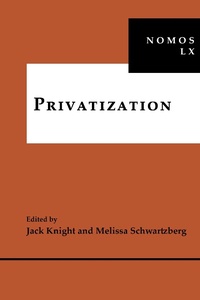
Privatization
NOMOS LX
Published on 11. December 2018
277 pages
978-1-4798-9648-6 (ISBN)
Description

A distinguished group of scholars explore the moral values and political consequences of privatization
The 21st century has seen a proliferation of privatization across industries in the United States, from security and the military to public transportation and infrastructure. In shifting control from the state to private actors, do we weaken or strengthen structures of governance? Do state-owned enterprises promise to be more equal and fair than their privately-owned rivals? What role can accountability measures play in mediating the effects of privatization; and what role does coercion play in the state governance and control? In this latest installment from the NOMOS series, an interdisciplinary group of distinguished scholars in political science, law, and philosophy examine the moral and political consequences of transferring state-provided or state-owned goods and services to the private sector.
The essays consider how we should evaluate the decision to privatize, both with respect to the quality of outcomes that might be produced, and in terms of the effects of privatization on the core values underlying democratic decision-making. Privatization also affects the structure of governance in a variety of important ways, and these essays evaluate the consequences of privatization on the state. Privatization sheds new light on these highly salient questions of contemporary political life and institutional design.
The 21st century has seen a proliferation of privatization across industries in the United States, from security and the military to public transportation and infrastructure. In shifting control from the state to private actors, do we weaken or strengthen structures of governance? Do state-owned enterprises promise to be more equal and fair than their privately-owned rivals? What role can accountability measures play in mediating the effects of privatization; and what role does coercion play in the state governance and control? In this latest installment from the NOMOS series, an interdisciplinary group of distinguished scholars in political science, law, and philosophy examine the moral and political consequences of transferring state-provided or state-owned goods and services to the private sector.
The essays consider how we should evaluate the decision to privatize, both with respect to the quality of outcomes that might be produced, and in terms of the effects of privatization on the core values underlying democratic decision-making. Privatization also affects the structure of governance in a variety of important ways, and these essays evaluate the consequences of privatization on the state. Privatization sheds new light on these highly salient questions of contemporary political life and institutional design.
More details
Series
Language
English
Place of publication
New York
United States
Target group
Professional and scholarly
ISBN-13
978-1-4798-9648-6 (9781479896486)
Copyright in bibliographic data and cover images is held by Nielsen Book Services Limited or by the publishers or by their respective licensors: all rights reserved.
Schweitzer Classification
Other editions
Additional editions
Book
12/2018
New York University Press
€91.80
Shipment within 10-20 days
Persons
Melissa Schwartzberg is Silver Professor of Politics at New York University. She is the author of Counting the Many: The Origins and Limits of Supermajority Rule and Democracy and Legal Change.
Jack Knight is the Frederic Cleaveland Professor of Law and Political Science at Duke University. His primary areas of interest lie at the intersection of law and politics. His major research focuses on issues in modern social and political theory, law and legal theory, and the political economy of institutions. His publications include Institutions and Social Conflict, The Choices Justices Make (with Lee Epstein), and The Priority of Democracy (with James Johnson).
Jack Knight is the Frederic Cleaveland Professor of Law and Political Science at Duke University. His primary areas of interest lie at the intersection of law and politics. His major research focuses on issues in modern social and political theory, law and legal theory, and the political economy of institutions. His publications include Institutions and Social Conflict, The Choices Justices Make (with Lee Epstein), and The Priority of Democracy (with James Johnson).
