

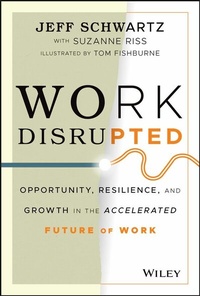
Work Disrupted
Description

The future of work swept in sooner than expected, accelerated by Covid-19, creating an urgent need for new maps, new mindsets, new strategies-- and most importantly, a trusted guide to take us on this journey. That guide is Jeff Schwartz. A founding partner of Deloitte Consulting's Future of Work practice, Schwartz brings clarity, humor, wisdom, and practical advice to the future of work, a topic surrounded by misinformation, fear, and confusion. With a fundamental belief in the power of human innovation and creativity, Schwartz presents the key issues, critical choices, and potential pitfalls that must be on everyone's radar.
* If you're anxious about robots taking away your job in the future, you will take comfort in the realistic perspective, fact-based insights, and practical steps Schwartz offers.
* If you're not sure where to even begin to prepare, follow his level-headed advice and easy-to-follow action plans.
* If you're a business leader caught between keeping up, while also being thoughtful about the next moves, you will appreciate the playbook directed at you.
* If you're wondering how Covid-19 will change how and where you will work, Work Disrupted has you covered.
Written in a conversational style by Schwartz, with Suzanne Riss, an award-winning journalist and book author, Work Disrupted offers a welcome alternative to books on the topic that lack a broad perspective or dwell on the problems rather than offer solutions. Timely and insightful, the book includes the impact of Covid-19 on our present and future work. Interviews with leading thinkers on the future of work offer additional perspectives and guidance.Cartoons created for the book by leading business illustrator Tom Fishburne bring to life the reader's journey and the complex issues surrounding the topic.
Told from the perspective of an economist, management advisor, and social commentator, Work Disrupted offers hope--and practical advice--exploring such topics as:
How we frame what lies ahead is a critical navigational tool. Discover the signposts that can serve as practical guides for individuals who have families to support, mortgages to pay, and want to stay gainfully employed no matter what the future holds.
The importance of recognizing the rapidly evolving opportunities in front of us. Learn how to build resilience--in careers, organizations, and leaders--for what lies ahead.
Why exploring new mental models helps us discover the steps we need to take to thrive. Individuals can decide how to protect their livelihood while businesses and public institutions can consider how they can lead and support workforces to thrive in twenty-first-century careers and work.
"Jeff's marvelous book is a roadmap for the new world of work with clear signposts. His insights will help readers discover opportunities, take action, and find hope in uncertain times. The ideas are fresh, beautifully crafted, and immediately applicable. This is not only a book to be read, but savored and used."
--Dave Ulrich, Rensis Likert Professor, Ross School of Business, University of Michigan; Partner, the RBL Group; Co-author Reinventing the Organization
More details
Other editions
Additional editions
Persons
SUZANNE RISS is a storyteller, content strategist, and the author of two previous books. During her tenure as editor-in-chief of Working Mother, the magazine received four Folio awards for excellence. Her expertise in work/life trends has been tapped for interviews with The New York Times, The Wall Street Journal, Good Morning America, and CNN. Suzanne has held marketing and communications roles at JPMorgan Chase and, currently, at Knopman Marks.
TOM FISHBURNE, Illustrator: From a student cartoon strip at Harvard Business School, Tom Fishburne's Marketoonist cartoon series has grown by word of mouth to reach a few hundred thousand readers a week. Tom draws (literally and figuratively) from 20 years of marketing roles at HotelTonight, Method, General Mills, Nestlé, and his own agency. Tom currently works with businesses to tell stories with cartoons and help drive organizational change through humor.
Content
Introduction xv
1 From Fear to Growth: Mindsets and Playbooks for Twenty-first-century Careers and Work 1
Part I Find Opportunity in a Time of Accelerated Change: Redesigning Work, Workforces, and Workplaces 21
2 People and Machines Working Together: Integrating AI and Workers on Every Team, in Every Job 23
3 Making Alternative Work a Meaningful Opportunity: The Workforce Will Include More Part-time, Contract, Freelance, Gig, and Crowd Workers 39
4 Working from Almost Anywhere: Redesign Workplaces from Where We Work to How We Work: Onsite, Online, and Everything in Between 51
Part II Build Long-Term Resilience for Uncertain Futures: Reimagining Careers, Organizations, and Leadership 63
5 Plan for Many Careers, Not One: Realistic and Energizing Transition Strategies for Multichapter Lives 65
6 The Rise of Teams: Reinvent Organizations, from Individuals and Hierarchies to Teams and Networks 83
7 Leaders as Coaches and Designers: Moving Beyond Managing Workflows and Controlling Direct Reports to Creating, Influencing, and Building 95
Part III Playbooks for Growth: Charting Paths Forward for Individuals, Leaders, Citizens, and Society 111
8 Carpe Diem: As Individuals, Strengthen Adaptability and Choice to Face Great Opportunities and Disproportionate Responsibilities 113
9 Create Opportunity: As Business Leaders, Unlock Value by Reimagining Jobs and Partnering with Workers to Build Resilience and Dynamic Careers 131
10 Set New Agendas: As Citizens and Communities, Reset Education, Labor Regulations, Job Transitions, and Societal Norms to Reflect Our Values 151
Acknowledgments 169
Notes 171
About the Authors 199
Index 201
Introduction
The difficulty is not so much in developing new ideas as in escaping from old ones.
-John Maynard Keynes
I've been traveling somewhere in the world for my work every month-often every week-for the past 20 years; that is, until Covid-19 stopped me in my tracks. Suddenly, I had to pause. All at once, the packing, the rushing, and the business travel ended. I had no idea that my trip to Israel in early March, leading a global panel on the future of work, would be the last time I would board an international flight in 2020. A few days after returning home to New York City from Tel Aviv on March 3, my workplace relocated from the Deloitte Consulting offices at Rockefeller Center to my small home office on the Upper West Side of Manhattan. As I sheltered in place, along with the rest of the world, tracking the sobering devastation wrought by the pandemic, I had the chance-perhaps for the first time in my career-to stay in one place for longer than a few weeks and reflect on the changes underfoot and ahead.
My work on this book had been well underway before the global pandemic took hold in early 2020. However, there's no doubt that it brought a new sense of urgency to my exploration of the future of work that had begun seven years earlier. The need to shift to new ways of working, new frames, new expectations, and new possibilities was accelerated by the pandemic. At a time that technologies, including artificial intelligence, are ubiquitous, and, to some, represent a threat to jobs and livelihoods, we have also witnessed our fundamental vulnerability as humans exposed by a virus that has already killed more people in the United States than all wars since World War II. What I have discovered about the future of work, as a global and U.S. pioneer and leader for the Future of Work practice with Deloitte Consulting, in interviews with dozens of leading experts in the field, and in my conversations with business leaders across the globe, is that, above all else, it celebrates our essential human capabilities-innovation, creation, ingenuity, entrepreneurship, empathy, caring, and relationships.
Though the future of work is shorthand for some for "the robots are taking our jobs," what has emerged for many is a growing belief that innovation and creativity will indeed rule the day. We can only automate processes, reduce costs, and increase speed so much-eventually we will need to create something new. We will need to innovate. And that's what many of us did, in ways small and large, during the Covid-19 outbreak. I continued to work with clients and colleagues around the world, no longer in person but over Zoom, WebEx, and similar platforms, while spending every evening and weekend researching and writing this book. This was a time to take stock, feel the discomfort of uncertainty, adapt, and seek out opportunities to do things in new ways. Very quickly, with my colleagues at Deloitte, we figured out how to continue to do our work, remotely, and better. As with the adoption of any new technology, we started by lifting and shifting what we'd done before, to Zoom, Teams, Slack, and other collaborative technologies. Then we saw we could do more. Things we thought we could never do remotely, we did, such as launching large technology systems for organizations without having hundreds of consultants onsite. We discovered we could deliver successful, interactive, online workshops with breakout groups; collaborate on virtual whiteboards; and even brainstorm virtually. We also learned more about each other as we worked from our homes. As I would share with my teams, if we don't hear children and dogs in the background, something is missing. Our lives should be evident in the flow of our work. That's something we don't want to lose as we move into our new normal.
Our Collective Pause
The pause, the uncertainty, the need to adapt remind us that our lives are stories of disruption, adaptability, and survival. I was born the year after the first satellite launched from Earth (Sputnik by the Soviet Union in 1957), watched the first men walking on the moon when I was 11 (the United States in 1969), and witnessed the first commercial space launches to the International Space Station in 2020. My career has extended across stock market crashes, Y2K, 9/11, the Great Recession, and pandemics (H1NI, Ebola, and Covid-19). And, yes, technology. I wrote my college papers on electric typewriters, before welcoming tablets with the processing power of supercomputers. I've worked as a researcher, teacher, banker, government agency program director, consultant, writer, and professor. I've lived in the United States, Nepal, Sri Lanka, Kenya, Russia, Belgium, India, and Israel. I realize that I've been learning lessons in adaptability throughout my career. I've shifted my expectations and adjusted to what was occurring, not what I'd imagined would come next.
My daughters received similar lessons in adaptability when Covid-19 upended their routines. My daughter Rachel, 28, a graduate MBA student at Emory University in Atlanta, shifted to virtual learning for the second half of the semester, along with 1.6 billion other college students around the world, and then she took a virtual summer internship. My younger daughter, Bizzie, 25, was three weeks into training as a U.S. Peace Corps volunteer in Madagascar, when she, along with 7,000 volunteers and trainees around the world, evacuated back to the United States. This was the first time since its founding in 1961 that the entire U.S. Peace Corps returned home. I watched my daughters accept the shifts and grow more resilient.
Our Long and Winding Careers
I learned lessons in adaptability early in my career. In fact, the start of many of my jobs coincided with major world events. After graduate school, I was in the middle of onboarding training for a position as a corporate finance associate at Chemical's Investment Bank, now part of JPMorgan Chase, in October 1987, when the stock market experienced its largest one-day percentage drop since the Great Depression. A few years later, after the fall of the Berlin Wall in 1989, I took a leave from my "business" life to become one of the first associate directors of the U.S. Peace Corps as it launched in Russia, following the dissolution of the former Soviet Union. I joined Deloitte on September 1, 2001, just days before the 9/11 attacks. Seven years later, we lived through the Great Recession and the global financial crisis.
The challenges were offset by career high points. These include leading the consulting practices for Deloitte in India, both global delivery teams and professionals working with some of India's largest companies. I worked for Reliance Industries from 2011 to 2016, as the company launched Jio (which means "live life" in Hindi), now the largest 4G and mobile company in India. The company introduced its customer operations in September 2016, and by the summer of 2020 had almost 400 million customers, becoming India's largest telecom company with a focus on mobile 4G connectivity. During this time, India was a country in transition-both in its domestic economy and its relationship with the global economy. I was able to contribute in a small way to the creation of the world's second largest 4G telecom company and the rapid introduction to India of smart mobile and app services.
Our Frame
I didn't study the future of work or adaptability in school-nobody does. In retrospect, I see that I've been remarkably prepared to help business leaders understand the future world of work in part because of what I learned as an undergraduate and graduate student studying history, philosophy, and government, and then business and economics, and, perhaps most of all, as a result of experiences exposing and preparing me for the breadth of what has been unfolding during our lifetimes. In 1983 I was completing my service as a Peace Corps teacher in Nepal, one of the world's most beautiful and poorest countries, where I taught math and science in a village with no running water or electricity, a village that was a day's walk to a road. Two years later, in the summer of 1985, I was a summer associate in corporate finance on Park Avenue in New York. Somewhere between Nepal and New York City, I'd been lucky to have been exposed to vastly different faces of the human experience.
What I continue to learn, and what I hope my daughters are learning, is that how we frame the world, what we think is relevant and possible, shapes what we can do and what we actually do. New times and new conditions create new opportunities. Unless we reshape our views-our time horizons, relationships, speed-we will miss opportunities. For us as individuals, and as organizations and communities, Covid-19 has indeed been an accelerator to the future. But the future was already underway, with opportunities for people and machines to work together, and careers composed of chapters of reinvention. To embrace all that's possible, a new mindset-a growth mindset-is critical.
The concept of a growth mindset, developed by psychologist Carol Dweck, speaks to our capacity for change and growth. She contrasts a growth mindset with a limiting view, what she calls a fixed mindset. Her research demonstrates that much of what we think we understand about ourselves and what we can do comes from our mindset. This can either propel us forward or prevent us from fulfilling our potential. According to Dweck,...
