

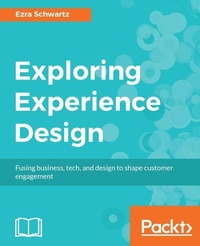
Exploring Experience Design
Fusing business, tech, and design to shape customer engagement
Published on 8. July 2025
400 pages
978-1-78712-011-2 (ISBN)
Description

No detailed description available for "Exploring Experience Design".
More details
Edition
Digital original
Language
English
Place of publication
Birmingham
United Kingdom
Target group
Professional and scholarly
US School Grade: College Graduate Student
Edition type
Digital original
File size
160,60 MB
ISBN-13
978-1-78712-011-2 (9781787120112)
Copyright in bibliographic data and cover images is held by Nielsen Book Services Limited or by the publishers or by their respective licensors: all rights reserved.
Schweitzer Classification
Other editions
Additional editions
Ezra Schwartz
Exploring Experience Design
Book
08/2017
Packt Publishing
€51.90
Shipment within 3-4 weeks
Person
Schwartz Ezra :
Ezra Schwartz is a multidisciplinary design leader with a holistic approach to experience strategy and design. He led projects in diverse settings, from Fortune 50 companies to start-ups in finance, healthcare, aviation, manufacturing, education, research, and other industries, and is the author of two books on prototyping. Throughout his career, Ezra has been devising and refining qualitative and quantitative design methods, advancing rapid interactive prototyping techniques, streamlining iterative design guided by continuous user feedback, advocating for accessible design, and mentoring junior practitioners. Ezra lives in Hyde Park, Chicago, where he draws serenity and often conceives design solutions while running along the shores of the magnificent Lake Michigan.
Ezra Schwartz is a multidisciplinary design leader with a holistic approach to experience strategy and design. He led projects in diverse settings, from Fortune 50 companies to start-ups in finance, healthcare, aviation, manufacturing, education, research, and other industries, and is the author of two books on prototyping. Throughout his career, Ezra has been devising and refining qualitative and quantitative design methods, advancing rapid interactive prototyping techniques, streamlining iterative design guided by continuous user feedback, advocating for accessible design, and mentoring junior practitioners. Ezra lives in Hyde Park, Chicago, where he draws serenity and often conceives design solutions while running along the shores of the magnificent Lake Michigan.
Content
- Cover
- Title Page
- Copyright
- Credits
- About the Author
- Acknowledgements
- About the Reviewers
- www.PacktPub.com
- Customer Feedback
- Dedication
- Table of Contents
- Preface
- Chapter 1: Experience Design - Overview
- A day in the life and experiences of M
- The importance of usability
- Less can be more
- Task density
- Evolution of Design
- Summary
- Chapter 2: The Experience Design Process
- Processes and change
- Evolving roles and processes
- Early models of design process
- Design, process, and the internet
- Browsers, search, and design
- From eye candy to user experience
- Needs to roles to processes
- Unified design process - experience is the product
- Unified experience design process model
- Summary
- Chapter 3: Business and Audience Context
- Defining the business context
- Business needs - research activities
- Stakeholder and subject-matter expert interviews
- Product expert reviews
- Competitive research and analysis
- Defining the product - audience context
- Features versus experience
- Audience Research
- Audience segments and their characteristics
- Audience needs - research activities
- Online surveys
- Survey examples
- Summary
- Chapter 4: The User and Context of Use
- Thinking about user needs and desires
- User research
- Card sorting
- Why use it in experience design?
- How to use it in experience design
- Pros
- Cons
- Contextual inquiries (CI)
- Why use it in experience design?
- How to use it in experience design?
- Pros
- Cons
- The diary or log method
- Why use it in experience design?
- How to use it in experience design?
- Pros
- Cons
- Focus groups and visioning workshops
- Why use it in experience design?
- How to use it in experience design?
- Pros
- Cons
- Surveys
- Why use it in experience design?
- How to use it in experience design?
- Pros
- Cons
- Web analytics and customer support logs
- Why use it in experience design?
- Pros
- Cons
- Establishing the context of use
- Personas
- Persona development workshops
- Task Analysis
- Scenarios and user stories
- Journey mapping
- Journey mapping workshops
- Summary
- Chapter 5: Experience - Perception, Emotions, and Cognition
- The senses
- Vision and visual perception
- Expressions
- Gestures
- From seeing to making meaning
- Hearing and sound
- The power of sound
- Touch - The tactile sense
- Touch and texture
- Time
- Emotions and executive functions
- Individual and social
- Summary
- Chapter 6: Experience Design Disciplines
- Mapping the disciplines
- Mapping common design themes
- Form and function
- Needs, function, and form
- Science fiction reality
- 2D surfaces and meaning
- Exterior and interior spaces - architecture
- Clothes, fabrics, and fashion
- Human factors (ergonomics)
- Time-based design disciplines
- Engineering and science in Experience Design
- Summary
- Chapter 7: The Design Team
- Role of the designer
- The relationship designer
- Team configurations
- Meet an experience design practitioner
- Marlys Caceres - Visual Designer
- Eddie Chen - UX Engagement Lead
- About my work
- Dino Eliopulos - Design Leader
- Advice to those who consider a career in design
- How do you see the evolution of XD in general?
- Jay Kaufmann - Design Manager
- A career found me
- Management brought it together
- The work - designing design
- The profession - paying it forward
- Ritch Macefield, PhD - UX and IT Consultant
- The present
- The future
- Saikat Mandal - Architect, Experience Designer
- Christine Marriott, PhD - Architect
- Ross Riechardt - UX Designer
- Just start
- Derik Schneider - UI/UX Artist/Designer/Developer
- Young professional lone wolf
- Solid foundations and learning experiences
- Things have changed
- The degrees
- Wrap up
- Ginger Shepard - Product Manager
- Key activities
- Courtney Skulley - Visual Designer
- Key activities
- Artifacts
- Advice to those who consider a career in visual design
- Ken Stern, PhD - User Research Practice Lead
- Advice to someone who considers a career in experience design
- John Tinman - UX Designer
- My design process and key activities
- My advice and where I see this profession evolving
- Richard Tsai - UX Architect
- Summary
- Chapter 8: Delight and Engagement
- Overview
- Functional and emotional design
- Visual and auditory experiences
- Visual design trends
- Skeuomorphic design
- Sequencing and directions
- Grabbing attention
- Data visualization
- Shaping experiences
- Conversational experiences
- The power of context
- Motivation
- Summary
- Chapter 9: Tying It All Together - From Concept to Design
- Design philosophy
- The past and future
- First impressions
- The "cookie cutter
- Accessible design
- Concept development
- Activities
- Sketching
- Mind mapping
- Storyboards
- Designer versus collaborative design
- Refining concepts
- Prototyping
- Summary
- Chapter 10: Design Testing
- Why test?
- R.T.G.D.M?
- Testing prototypes
- Hi-fidelity and low-fidelity prototypes
- Who should facilitate?
- Planning usability tests
- The test
- Test objectives
- The testing scenario
- Screen 1
- Screen 2
- Documenting test responses
- Recruiting participants
- The screener
- Introduction
- Validation and vetting
- Additional information and confirmation
- Testing considerations
- Fee versus free
- Insiders versus impartial
- Casual versus power users
- Test settings
- Moderated versus unmoderated
- Lab versus field testing
- Summary
- Chapter 11: The Design Continuum
- Design continuity
- Experience platforms
- Design systems
- Wrapping up
- Index
