

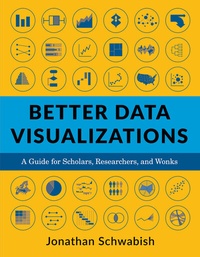
Better Data Visualizations
A Guide for Scholars, Researchers, and Wonks
1st Edition
Published on 8. February 2021
464 pages
978-0-231-55015-4 (ISBN)
Description

Now more than ever, content must be visual if it is to travel far. Readers everywhere are overwhelmed with a flow of data, news, and text. Visuals can cut through the noise and make it easier for readers to recognize and recall information. Yet many researchers were never taught how to present their work visually.
This book details essential strategies to create more effective data visualizations. Jonathan Schwabish walks readers through the steps of creating better graphs and how to move beyond simple line, bar, and pie charts. Through more than five hundred examples, he demonstrates the do's and don'ts of data visualization, the principles of visual perception, and how to make subjective style decisions around a chart's design. Schwabish surveys more than eighty visualization types, from histograms to horizon charts, ridgeline plots to choropleth maps, and explains how each has its place in the visual toolkit. It might seem intimidating, but everyone can learn how to create compelling, effective data visualizations. This book will guide you as you define your audience and goals, choose the graph that best fits for your data, and clearly communicate your message.
This book details essential strategies to create more effective data visualizations. Jonathan Schwabish walks readers through the steps of creating better graphs and how to move beyond simple line, bar, and pie charts. Through more than five hundred examples, he demonstrates the do's and don'ts of data visualization, the principles of visual perception, and how to make subjective style decisions around a chart's design. Schwabish surveys more than eighty visualization types, from histograms to horizon charts, ridgeline plots to choropleth maps, and explains how each has its place in the visual toolkit. It might seem intimidating, but everyone can learn how to create compelling, effective data visualizations. This book will guide you as you define your audience and goals, choose the graph that best fits for your data, and clearly communicate your message.
More details
Other editions
Additional editions
Book
02/2021
Columbia University Press
€35.00
Shipment within 10-20 days
Book
02/2021
Columbia University Press
€99.04
Article exhausted; check different version
Person
Jonathan Schwabish is an economist and writer, teacher, and creator of policy-relevant data visualizations. He helps nonprofits, research institutions, and governments at all levels improve how they communicate their work and findings to their colleagues, partners, clients, and constituents. He is the author of Better Presentations: A Guide for Scholars, Researchers, and Wonks (Columbia, 2016).
Content
Introduction
Part I: Principles of Data Visualization
1. Visual Processing and Perceptual Rankings
2. Five Guidelines for Better Data Visualizations
3. Form and Function
Part II: Chart Types
4. Comparing Categories
5. Time
6. Distribution
7. Geospatial
8. Relationship
9. Part-to-Whole
10. Qualitative
11. Tables
Part III: Designing and Redesigning Your Visual
12. Developing a Data Visualization Style Guide
13. Redesigns
Conclusion
Appendix 1. Data Visualization Tools
Appendix 2. Further Reading and Resources
Acknowledgments
References
Index
Part I: Principles of Data Visualization
1. Visual Processing and Perceptual Rankings
2. Five Guidelines for Better Data Visualizations
3. Form and Function
Part II: Chart Types
4. Comparing Categories
5. Time
6. Distribution
7. Geospatial
8. Relationship
9. Part-to-Whole
10. Qualitative
11. Tables
Part III: Designing and Redesigning Your Visual
12. Developing a Data Visualization Style Guide
13. Redesigns
Conclusion
Appendix 1. Data Visualization Tools
Appendix 2. Further Reading and Resources
Acknowledgments
References
Index
