

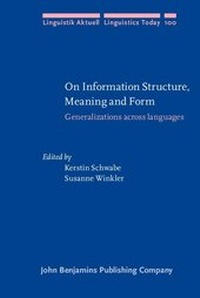
On Information Structure, Meaning and Form
Generalizations across languages
1st Edition
Published on 8. March 2007
VII, 570 pages
978-90-272-9264-3 (ISBN)
Description

This collection of articles offers a new and compelling perspective on the interface connecting syntax, phonology, semantics and pragmatics. At the core of this volume is the hypothesis that information structure represents the common interface of these grammatical components. Information structure is investigated here from different theoretical viewpoints yielding typologically relevant information and structural generalizations. In the volume's introductory chapter, the editors identify two central approaches to information structure: the formal and the interpretive view. The remainder of the book is organized accordingly. The first part examines information structure and grammar, concentrating on generalizations across languages. The second part investigates information structure and pragmatics, concentrating on clause structure and context. Through concrete analyses of topic, focus, and related phenomena across different languages, the contributors add new and convincing evidence to the research on information structure.
More details
Other editions
Additional editions
Kerstin Schwabe | Susanne Winkler
On Information Structure, Meaning and Form
Generalizations across languages
Book
03/2007
John Benjamins Publishing Co
€148.40
Shipment within 10-15 days
Persons
Content
- On Information Structure, Meaning and Form
- Editorial page
- Title page
- LCC data
- Table of contents
- Acknowledgments
- On information structure, meaning and form
- Generalizations across languages
- 1. The outset
- 2. The formal approach and the interpretive approach
- 2.1 The formal approach: Syntax and prosody
- 2.1.1 Focus: Arguments for a syntactic implementation
- 2.1.2 Topic and focus positions
- 2.2 The interpretive approach: The semantics-pragmatics interface
- 2.3 Longstanding questions and new contributions
- i. Isomorphism hypothesis
- ii. Focus and topic marking hypothesis
- iii. Multiple question-answer congruence hypothesis
- iv. Focus underspecification hypothesis
- 3. The chapters
- 3.1 Information structure and grammar: Generalizations across languages
- 3.1.1 Topics and topicalization across languages
- 3.1.2 Focus and focus movement across languages
- 3.2 Information structure and pragmatics: Clause structure and context
- 4. Conclusion
- Information structure and grammar
- Generalizations across languages
- Phases and the typology of focus constructions*
- 1. Introduction
- 2. The typology of peripheral focus positions
- 3. Two assumptions about phase structure
- 3.1 Clausal phase structure is event structure
- 3.2 The functional peripheries of phases are isomorphic
- 4. Do eventive and propositional phases have parallel structures?
- 4.1 Polarity
- 4.2 Modality
- 4.2.1 The modal hierarchy
- 4.2.2 Root and epistemic modality in Thai
- 4.2.3 Towards an analysis
- 4.3 Force and Mood
- 4.3.1 The nonuniqueness of sentence type
- 4.3.2 Direction of fit and subordination
- 5. Further consequences for the theory of information structure
- 5.1 Terms and shells
- 5.2 Cleft clauses
- 5.3 Typological variation in cleft focus constructions
- 6. Conclusion
- Topics and topicalization across languages
- The prosody of topicalization*
- 1. Introduction
- 2. Theoretical framework
- 3. Topic and topicalization
- 3.1 Topic
- 3.2 Topicalization
- 4. Discontinuous DP constructions
- 6. Conclusion
- Types of topics in German and Italian*
- 1. Introduction
- 2. The intonation of topic constituents in Italian
- 2.1 The interpretation of tonal events
- 2.1.1 The L*+H contour
- 2.1.2 The H* contour
- 2.1.3 The L* contour
- 2.1.4 A case of multiple realization
- 2.2 Tonal events on topics: conclusions
- 3. The syntax of topics in Italian
- 3.1 Merge, move and clitic resumption
- 3.2 The derivation of right-hand topics
- 3.3 Contrast: an interplay between focus and topic
- 3.4 Rizzi (1997) and the topic-focus/wh relation
- 4. The intonation of topic constituents in German
- 4.1 The corpus
- 4.2 The analysis
- 4.2.1 The L+H* contour
- 4.2.2 The L*+H contour
- 4.2.3 The L* contour
- 5. The syntax of German topics
- 5.1 The order of topics
- 5.2 The derivation of topic constituents in German
- 5.3 The proper treatment of continuing topics
- 5.4 V2 and the functional structure in the C-domain
- 6. Conclusions
- The Korean particle nun, the English fall-rise accent and thetic/categorical judgements*
- 1. Introduction
- 2. On Korean sentences with the 'topic particle' nun
- 3. On the role of the fall-rise accent in English sentences
- 4. Korean and English: Accented Korean nun-phrases and English fall-rise accents
- Topicalization and null arguments in Malagasy, Tagalog and Tsou*
- 1. Introduction
- 2. Verbal morphology in Austronesian languages and topicalization
- 2.1 Two typical characteristics of Austronesian languages
- 2.2 Topicalization of the trigger
- 3. Null arguments and topicalization of non-triggers
- 3.1 Agreement and null arguments in Tsou
- 3.2 Null arguments and discourse in Tagalog
- 3.3 Null arguments in Malagasy
- 3.4 Syntactic structure of topicalization of non-triggers
- 4. Conclusion
- Focus(ing) from a typological perspective
- On the discourse configurationalityof West Germanic*
- 1. Introduction
- 2. Scrambling as permutation of maximal projections
- 3. Identifying the underlying order
- 4. Scrambling and focus potential
- 5. What drives refocusing in German?
- 6. Scrambling in two-place predicates - a case of pragmatically marked base word orders
- 7. Scrambling in Afrikaans
- 8. A discourse functional account
- 9. Refocusing without focus positions
- 10. Defocusing as the trigger of scrambling
- 11. On the interpretation of scrambled and non-scrambled definite object categories
- 12. Conclusion
- Topic, focus, and default vs. contrastive accent
- Typological differences with respect to discourse prominence*
- 1. The type of German discourse prominence
- 2. 'Flat' accounts of word order and discourse functions
- 3. German discourse prominence vs. English grammar prominence
- 4. Discourse-functional landing sites vs. syntactically computeddiscourse functions
- 4.1 The discourse-functional extension by several nodes(Grewendorf 2004, Frey 2004b)
- 4.2 The clause-internal higher Topic position
- 4.3 The clause-internal higher Focus position
- 4.4 The discourse-functional extension by one single node (Molnárfi this volume)
- 5. Summary
- Focus and focus movement across languages
- Identifying inferences in focus*
- 1. The FP phenomenon and conventional analysis
- 1.1 Syntax: The 'focus movement' analysis
- 1.2 Semantics: exhaustivity and identification in the grammar
- 1.2.1 The exhaustivity operator analysis
- 1.2.2 The identificational operator analysis
- 2. A 'main predicate' position in an incremental account
- 3. The putative FP/cleft correspondence
- 4. Summary
- Focus structure and the interpretationof multiple questions*
- 1. Introduction
- 2 Multiple foci: Structures and interpretations
- 3 Focus in multiple wh-interrogatives
- 4 Multiple questions: structure and interpretation
- 4.1 Movements
- 4.2 Interpretation
- 4.3 Predicitons
- 5 Serbo-Croatian: MF as focus movement
- 6 Japanese: An interpretive Subjacency effect
- 7 Conclusion
- Focus structure, movement to spec-Foc and syntactic processing*
- 1. Introduction
- 2. Focus structure
- 3. The FocP-hypothesis
- 4. Identificational and informational focus
- 5. The exceptionality ('markedness') of object fronting in English
- 6. A processing account
- 6.1 The principles of early immediate constituents (EIC) and dependent nodes later (DNL)
- 6.2 EIC and DNL differences for movement to spec-Foc between English and German
- 6.3 Processing advantages due to case morphology
- 7. Summary
- Focus and marked positions for VP adverbs*
- 1. Preliminary remarks
- 2. Unmarked positions for manner adverbs
- 3. Licensing transportable adverbs
- 4. Objections to genuine transportability
- 5. Narrow focus on manner adverbs
- 5.1 A marked position for manner adverbs
- 5.2 Where's the focused adverb?
- 5.2.1 PP scrambling
- 5.2.2 Focus-movement in the lower IP area
- 6. Concluding remarks
- Ellipsis and inversion
- A feature-based focus account*
- 1. Introduction
- 2. The PF-output constraint account
- 3. An information structural account
- 3.1 Diachronic and synchronic evidence
- 3.2 The Focus Hypothesis
- 3.3 The Focus Isolation account of comparative ellipsis with inversion
- 4. The extension of the Focus Isolation account:Evidence from pseudogapping
- 5. Conclusion
- Subject/object-asymmetry in Northern Sotho*
- 1. Introduction
- 2. The subject/object-asymmetry
- 2.1 Basic observations
- 2.2 Functional approach
- 3. OT-approach
- 3.1 Essentials of OT
- 3.2 Agreement
- 3.3 In situ focus of non-subjects
- 3.4 Focus with subjects of intransitive verbs
- 3.5 The special case of subject clefts
- 3.6 Summary and discussion
- 4. Extension of the account to further discourse notions
- 5. Conclusion
- Wide focus interpretation with fronted focus exponents in Czech*
- 1. Introduction
- 2. Basic assumptions
- 2.1 Identification of focus: Theoretical background
- 2.2 Information structuring in Czech declarative clauses
- 3. Maximal focus with a fronted focus exponent: First data
- 4. Properties and limits of FE-fronting with maximal focus interpretation
- 4.1 Interfering overt subjects
- 4.2 Extraction, embedding, clause type
- 5. Licensing of FE fronting and cross-linguistic parallels
- 6. Summary and further research
- In place - out of place?Focus strategies in Hausa*
- 1. Introduction
- 1.1 Focus: a discourse-semantic category
- 1.2 Background information on Hausa
- 2. Syntactic focus strategies in Hausa
- 2.1 Ex situ focus
- 2.2 In situ focus
- 2.2.1 Non-subjects
- 2.2.2 Subjects
- 2.3 Co-occurrence of in situ and ex situ focus
- 3. On prosodic focus-marking in Hausa or the absence thereof
- 3.1 Hausa intonational phonology
- 3.2 No prosodic marking of in situ focus in Hausa
- 3.2.1 Experimental set-up
- 3.2.2 Qualitative and Quantitative Results
- 3.2.3 A perception study of in situ focus
- 3.3 No prosodic marking of in situ focus in other languages
- 4. Syntactic focus-marking and interpretation
- 4.1 Hausa - a counterexample to the Meaning-Structure Mapping Hypothesis
- 4.3 Ex situ versus in situ: a quantitative study
- 5. The ex situ strategy: focus pied-piping and partial focus movement
- 5.1 Focus pied-piping in Hausa
- 5.2 Partial focus movement in Hausa
- 5.3 Conditions on focus movement
- 6. On pragmatically induced movement and the absence of focus-marking
- 6.1 Pragmatic movement
- 6.1.1 Partial focus movement again
- 6.1.2 Emphatic intonation in intonation languages
- 6.1.3 Pragmatically driven movement in Hausa
- 6.2 On the absence of focus-marking
- 6.3 Compensating for the lack of focus marking
- 7. Conclusion
- Information structure and pragmatics
- Clause structure and context
- Instructions for interpretation asseparate performatives*
- 1. Overview
- 2. Vocatives
- 2.1 Vocatives and reference to the addressee
- 2.2 Instructional meaning of vocatives
- 2.2.1 Informal description
- 2.2.2 The expressive meaning of vocatives
- 1. Tags
- 2. Addresses
- 3. Topics
- 4. Force markers
- 5. Embedded clauses
- 6. Conclusion
- Interrogative complement clauses*
- 1. Introduction
- 2. Canonically used interrogative root and complement clauses
- 2.1 Interrogative root clauses
- 2.2 Complement clauses
- 3. Independently used interrogative verb-final clauses
- 3.1 Syntax and semantics of independently used verb-final clauses
- 3.2 Interpretation of interrogative solitaires
- 4. Conclusion
- The syntax and pragmatics of embeddedyes/no-questions
- 1. Embedded questions
- 2. Embedded yes/no questions: whether or if
- 3. Open issues in the syntactic account
- 4. If or whether, the simple case
- 5. The general case
- 6. The wider perspective
- Toward a uniform analysis of short answers and gapping*
- 1. Introduction
- 2. Some (very) suggestive commonalities
- 3. A topical account within Alternative Semantics
- 3.1 Congruent sentential answers
- 3.2 Deriving short answers
- 3.3 The Subset Condition as a semantic condition on ellipsis
- 3.4 Short answers, gapping and 'questions under discussion'
- 4. Excursion: An alternative formulation
- 4.1 A potential problem: The case of underfocusation
- 4.2 Toward a solution with unstructured propositions
- 5. Some implications of a uniform approach
- 6. Summary
- Alternative Semantics for definite NPs*
- 1. Introduction
- 2. The domain of focus operators
- 2.1 LF-movement theories
- 2.2 Focus and Focus Phrases
- 3. Alternative Semantics for definite NPs
- 3.1 Alternative Semantics
- 3.2 CN and CN-modifier
- 3.3 The definite article
- 4. The architecture of Alternative Semantics
- 4.1 Fine-grained descriptions
- 4.2 No number information
- 4.3 Choice functions
- 4.4 Polymorph choice function
- 4.5 Type shifting operation
- 5. Concluding remarks
- The information structure of bare pluralsin English and Italian*
- 1. Topics
- 2. English bare plurals
- 2.1 Existential readings
- 2.2 Generic readings
- 3. Italian bare plurals
- 3.1 Existential readings
- 3.2 Generic readings
- 4. English indefinite singulars
- 4.1 The data
- 4.2 Explanation
- 4.3 Normative English BPs
- 5. Back to Italian BPs
- 6. Conclusion
- References
- Name index
- Subject index
- The series Linguistik Aktuell/Linguistics Today
