

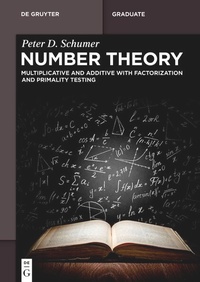
Number Theory
Description

This is a book for an undergraduate number theory course, senior thesis work, graduate level study, or for those wishing to learn about applications of number theory to data encryption and security. With no abstract algebra background required, it covers congruences, the Euclidean algorithm, linear Diophantine equations, the Chinese Remainder Theorem, Mobius inversion formula, Pythagorean triplets, perfect numbers and amicable pairs, Law of Quadratic Reciprocity, theorems on sums of squares, Farey fractions, periodic continued fractions, best rational approximations, and Pell's equation. Results are applied to factoring and primality testing including those for Mersenne and Fermat primes, probabilistic primality tests, Pollard's rho and p-1 factorization algorithms, and others. Also an introduction to cryptology with a full discussion of the RSA algorithm, discrete logarithms, and digital signatures.
Chapters on analytic number theory including the Riemann zeta function, average orders of the lattice and divisor functions, Chebyshev's theorems, and Bertrand's Postulate. A chapter introduces additive number theory with discussion of Waring's Problem, the pentagonal number theorem for partitions, and Schnirelmann density.
More details
Other editions
Additional editions
Person
Peter D. Schumer is the John C. Baldwin Professor of Mathematics and Natural Philosophy at Middlebury College. He received his B.S and M.S. degrees from Rensselaer Polytechnic Institute and his Ph.D. from University of Maryland. He has held research and teaching positions at UC Berkeley, Stanford, UC San Diego, San Jose State U, and at Doshisha U, Keio U, and ICU in Japan. His main areas of interest are number theory and the history of mathematics. His courses vary from calculus, linear algebra, and the mathematics of games and puzzles to combinatorics, complex analysis, and advanced number theory. He has directed more than fifty senior projects and theses in related areas. His scholarly work has appeared in Mathematika, Journal of Number Theory, Math Horizons, College Mathematics Journal, and elsewhere. He has published two books, Introduction to Number Theory (PWS, 1996) and Mathematical Journeys (Wiley, 2004). His book Fractions - A Sliver of the Story will be release this year (OUP, 2024). He has also written articles for general audiences on when humans first began to count and the origins of the letter x in algebra. He is a recipient of the Trevor Evans Award from the MAA on an article about the mathematician Paul Erdos (2000). He also teaches courses on the game of go and its cultural significance and has been awarded the national Teacher of the Year award from the American Go Association (2021).
Content
- Intro
- Preface
- Contents
- Chapter 1 Background
- 1.1 Brief historical introduction
- Exercise 1.1
- 1.2 Induction and the well-ordering principle
- Exercise 1.2
- 1.3 Divisibility and congruences
- Exercise 1.3
- 1.4 Basic combinatorics
- Exercise 1.4
- Chapter 2 Congruences and prime factorization
- 2.1 The Euclidean algorithm and some consequences
- Exercise 2.1
- 2.2 Congruence equations and the Chinese remainder theorem
- Exercise 2.2
- 2.3 Primes and the fundamental theorem of arithmetic
- Exercise 2.3
- 2.4 Introduction to primality testing and factoring
- Exercise 2.4
- 2.5 Some important congruence relations
- Outline placeholder
- 2.5.1 Binary exponentiation algorithm
- Exercise 2.5
- 2.6 General polynomial congruences: Hensel's lemma
- Exercise 2.6
- Chapter 3 Arithmetic functions
- 3.1 Important arithmetic functions
- Exercise 3.1
- 3.2 Multiplicativity
- Exercise 3.2
- 3.3 Möbius inversion and some consequences
- Exercise 3.3
- 3.4 Perfect numbers and amicable pairs
- Exercise 3.4
- Chapter 5 Sums of squares
- 5.1 Fundamentals of Diophantine equations
- Exercise 5.1
- 5.2 Sums of two squares
- Exercise 5.2
- 5.3 Sums of three squares
- Exercise 5.3
- 5.4 Sums of four or more squares
- Exercise 5.4
- 5.5 Legendre's equation
- Exercise 5.5
- Chapter 6 Continued fractions and Farey sequences
- 6.1 Finite simple continued fractions
- Exercise 6.1
- 6.2 Farey fractions
- Exercise 6.2
- 6.3 Infinite simple continued fractions
- Exercise 6.3
- 6.4 Rational approximations of irrationals
- Exercise 6.4
- 6.5 Pell's equation
- Exercise 6.5
- 6.6 The continued fraction for e
- Exercise 6.6
- 6.7 Algebraic and transcendental numbers
- Exercise 6.7
- Chapter 7 Factoring and primality testing
- 7.1 Primality and compositeness
- Exercise 7.1
- 7.2 Pseudoprimes and Carmichael numbers
- Exercise 7.2
- 7.3 Miller-Rabin-Jaeschke primality test
- Exercise 7.3
- 7.4 Mersenne primes
- Exercise 7.4
- 7.5 Fermat numbers
- Exercise 7.5
- 7.6 Factorization methods
- Exercise 7.6
- 7.7 Quadratic sieve factorization algorithm
- Exercise 7.7
- 7.8 The AKS primality test
- Exercise 7.8
- Chapter 8 Some applications
- 8.1 Introduction to cryptology
- Exercise 8.1
- 8.2 RSA algorithm
- Exercise 8.2
- 8.3 Random number generation
- Exercise 8.3
- Chapter 9 Introduction to analytic number theory
- 9.1 The infinitude of primes and the zeta function
- Exercise 9.1
- 9.2 Average order of the lattice and divisor functions
- Exercise 9.2
- 9.3 Average order of ?(n) and applications
- Exercise 9.3
- 9.4 Chebyshev's theorems and the distribution of primes
- Exercise 9.4
- 9.5 Bertrand's postulate and applications
- Exercise 9.5
- Chapter 10 Introduction to additive number theory
- 10.1 Waring's problem
- Exercise 10.1
- 10.2 Schnirelmann density and the ? + ß theorem
- Exercise 10.2
- 10.3 Van der Waerden's theorem
- Exercise 10.3
- 10.4 Introduction to the theory of partitions
- Exercise 10.4
- 11_Schumer_0825_EF_Hints
- Hints and answers to selected exercises
- Exercise 1.1
- Exercise 1.2
- Exercise 1.3
- Exercise 1.4
- Exercise 2.1
- Exercise 2.2
- Exercise 2.3
- Exercise 2.4
- Exercise 2.5
- Exercise 2.6
- Exercise 3.1
- Exercise 3.2
- Exercise 3.3
- Exercise 3.4
- Exercise 4.1
- Exercise 4.2
- Exercise 4.3
- Exercise 4.4
- Exercise 5.1
- Exercise 5.2
- Exercise 5.3
- Exercise 5.4
- Exercise 5.5
- Exercise 6.1
- Exercise 6.2
- Exercise 6.3
- Exercise 6.4
- Exercise 6.5
- Exercise 6.6
- Exercise 6.7
- Exercise 7.1
- Exercise 7.2
- Exercise 7.3
- Exercise 7.4
- Exercise 7.5
- Exercise 7.6
- Exercise 7.7
- Exercise 8.1
- Exercise 8.2
- Exercise 8.3
- Exercise 9.1
- Exercise 9.2
- Exercise 9.3
- Exercise 9.4
- Exercise 9.5
- Exercise 10.1
- Exercise 10.2
- Exercise 10.3
- Exercise 10.4
- Bibliography
- Index
