

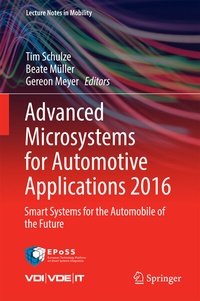
Advanced Microsystems for Automotive Applications 2016
Description

This book contains the papers presented at the 20th anniversary edition of the AMAA conference held in Brussels, Belgium in 2016. The theme of the conference was "Smart Systems for the Automobile of the Future". The automobile is currently being reshaped at unprecedented pace. Automation and electrification are the two dominant megatrends which dramatically change the choice and design of components, systems, vehicular architectures and ultimately the way we use cars in the coming decades. Novel E/E architectures, vehicular connectivity and cloud services will be key to extending the perception and decision-making horizons of automated vehicles, to enable cooperative functions and a seamless digital user experience. The AMAA's ongoing mission to detect novel trends in automotive ICT, electronics and smart systems and to discuss the technological implications is once again reflected in this volume. The book will be a valuable read for research experts and professionals in the automotive and smart systems industry but the book may also be beneficial for graduate students.
More details
Other editions
Additional editions
Persons
Content
2 - Supporters and Organisers [Seite 8]
3 - Steering Committee [Seite 9]
4 - Contents [Seite 10]
5 - Networked Vehicles & Navigation [Seite 13]
6 - 1 Requirements and Evaluation of a Smartphone Based Dead Reckoning Pedestrian Localization for Vehicle Safety Applications [Seite 14]
6.1 - Abstract [Seite 14]
6.2 - 1 Introduction [Seite 15]
6.3 - 2 Localization Estimation Filter [Seite 16]
6.3.1 - 2.1 Sensor Error Models and Impact of the Error Terms [Seite 17]
6.3.2 - 2.2 Error-State Model [Seite 18]
6.3.3 - 2.3 Observation Models [Seite 18]
6.3.3.1 - 2.3.1 Loosely Coupled GNSS Measurement [Seite 19]
6.3.3.2 - 2.3.2 Tightly Coupled GNSS Measurement [Seite 19]
6.3.3.3 - 2.3.3 Barometric Height Measurement [Seite 19]
6.4 - 3 Methods [Seite 20]
6.4.1 - 3.1 Reference Measurement System [Seite 20]
6.4.2 - 3.2 Measurement Environment [Seite 21]
6.5 - 4 Results [Seite 22]
6.5.1 - 4.1 GNSS Receiver and Method Comparison [Seite 22]
6.5.2 - 4.2 Velocity Accuracy [Seite 22]
6.5.3 - 4.3 Simulated Short-Time GNSS Outage [Seite 23]
6.5.4 - 4.4 Location Estimation Accuracy Requirements for Pedestrian Protection Systems [Seite 23]
6.6 - 5 Discussion [Seite 26]
6.7 - 6 Conclusions [Seite 27]
6.8 - References [Seite 28]
7 - 2 Probabilistic Integration of GNSS for Safety-Critical Driving Functions and Automated Driving-the NAVENTIK Project [Seite 29]
7.1 - Abstract [Seite 29]
7.2 - 1 Introduction to GNSS in Automotive Applications [Seite 30]
7.3 - 2 Confidence Adaptive Use Cases [Seite 33]
7.3.1 - 2.1 E-Call Extension [Seite 33]
7.3.2 - 2.2 Active Navigation [Seite 33]
7.4 - 3 NAVENTIK Measures and System Architecture [Seite 35]
7.5 - 4 Conclusion [Seite 38]
7.6 - Acknowledgments [Seite 38]
7.7 - References [Seite 39]
8 - 3 Is IEEE 802.11p V2X Obsolete Before it is Even Deployed? [Seite 40]
8.1 - Abstract [Seite 40]
8.2 - 1 Introduction [Seite 40]
8.3 - 2 Related Work [Seite 41]
8.4 - 3 The ETSI ITS-G5 Standard [Seite 42]
8.4.1 - 3.1 Access Layer [Seite 42]
8.4.2 - 3.2 Networking and Transport Layer [Seite 43]
8.4.3 - 3.3 The Common Data Dictionary [Seite 44]
8.4.4 - 3.4 Cooperative Awareness Basic Service [Seite 44]
8.4.5 - 3.5 Security Services [Seite 45]
8.5 - 4 Evaluation Framework and Methodology [Seite 45]
8.6 - 5 Results [Seite 47]
8.7 - 6 Conclusion and Future Work [Seite 49]
8.8 - Acknowledgments [Seite 49]
8.9 - References [Seite 49]
9 - 4 Prototyping Framework for Cooperative Interaction of Automated Vehicles and Vulnerable Road Users [Seite 51]
9.1 - Abstract [Seite 51]
9.2 - 1 Introduction [Seite 52]
9.3 - 2 Prototyping Hardware Equipment and Sensorial Systems [Seite 52]
9.3.1 - 2.1 Overview of Sensorial Systems [Seite 52]
9.3.2 - 2.2 Research Vehicle for Automated Driving [Seite 53]
9.3.3 - 2.3 Prototyping Testbed-Mobile Road Side Unit [Seite 55]
9.3.4 - 2.4 Mobile Devices for VRUs [Seite 55]
9.4 - 3 Software Framework for Prototyping [Seite 55]
9.4.1 - 3.1 Software Modules Overview [Seite 55]
9.4.2 - 3.2 Algorithmic Components [Seite 56]
9.4.2.1 - 3.2.1 Vehicle Trajectory Representation [Seite 56]
9.4.2.2 - 3.2.2 Intent Estimation [Seite 57]
9.5 - 4 Application Scenarios [Seite 58]
9.5.1 - 4.1 Manoeuvre Planning for Automated Green Driving and VRU Safety [Seite 58]
9.5.2 - 4.2 Cooperative Interactions Between VRU and Automated Vehicles [Seite 59]
9.6 - 5 Conclusion [Seite 60]
9.7 - Acknowledgment [Seite 60]
9.8 - References [Seite 60]
10 - 5 Communication Beyond Vehicles-Road to Automated Driving [Seite 62]
10.1 - Abstract [Seite 62]
10.2 - 1 Trends-Automated Driving and Smart System [Seite 63]
10.3 - 2 Robustness-the Need for Smart Vehicles [Seite 64]
10.4 - 3 Evolution-Communication Architectures [Seite 64]
10.5 - 4 Essentiality-V2X Communication [Seite 67]
10.6 - 5 Urgency-Secured Vehicle Architectures [Seite 69]
10.7 - 6 Outlook-Requirements Secured Car Communication [Seite 71]
10.8 - References [Seite 71]
11 - 6 What About the Infrastructure? [Seite 72]
11.1 - Abstract [Seite 72]
11.2 - 1 Variation in Vehicles [Seite 72]
11.3 - 2 Evolution in Car Systems [Seite 73]
11.3.1 - 2.1 Introduction [Seite 73]
11.3.2 - 2.2 Lateral Assistance Systems [Seite 73]
11.3.3 - 2.3 Longitudinal Assistance Systems [Seite 74]
11.3.4 - 2.4 Automated Cars [Seite 75]
11.3.5 - 2.5 Fleets [Seite 76]
11.3.6 - 2.6 Location, Communication, Maps [Seite 76]
11.4 - 3 Involved Parties [Seite 77]
11.4.1 - 3.1 The User [Seite 77]
11.4.2 - 3.2 Road Operators [Seite 78]
11.4.3 - 3.3 Law Makers [Seite 79]
11.5 - 4 Conclusion [Seite 79]
11.6 - References [Seite 80]
12 - Advanced Sensing, Perception and Cognition Concepts [Seite 81]
13 - 7 Towards Dynamic and Flexible Sensor Fusion for Automotive Applications [Seite 82]
13.1 - Abstract [Seite 82]
13.2 - 1 Introduction [Seite 83]
13.3 - 2 Related Work [Seite 84]
13.4 - 3 SADA System Architecture [Seite 85]
13.4.1 - 3.1 Overview [Seite 85]
13.4.2 - 3.2 Distributed System [Seite 86]
13.5 - 4 Communication Architecture [Seite 89]
13.6 - 5 Preliminary Experimental Results [Seite 91]
13.7 - 6 Conclusion [Seite 93]
13.8 - Acknowledgments [Seite 93]
13.9 - References [Seite 93]
14 - 8 Robust Facial Landmark Localization for Automotive Applications [Seite 95]
14.1 - Abstract [Seite 95]
14.2 - 1 Introduction [Seite 96]
14.3 - 2 Related Work [Seite 96]
14.4 - 3 Overview-AAM Framework Using MCT Features [Seite 97]
14.5 - 4 AAM Using MCT Features [Seite 98]
14.5.1 - 4.1 Initial Guess Generation [Seite 100]
14.5.2 - 4.2 Model Generation and Parameter Optimization for Matching [Seite 100]
14.5.3 - 4.3 Parameter Constraints and Weighting for Matching [Seite 101]
14.5.4 - 4.4 Occlusion Handling, Quality and Intelligent Stopping Criterion [Seite 101]
14.5.5 - 4.5 Head-Pose Estimation [Seite 103]
14.6 - 5 Evaluation [Seite 103]
14.7 - 6 Conclusion [Seite 105]
14.8 - References [Seite 106]
15 - 9 Using eHorizon to Enhance Camera-Based Environmental Perception for Advanced Driver Assistance Systems and Automated Driving [Seite 107]
15.1 - Abstract [Seite 107]
15.2 - 1 Introduction [Seite 107]
15.3 - 2 The eHorizon [Seite 108]
15.4 - 3 The Problem and Solution of Mapping a Camera Picture to the Real World and Vise Versa [Seite 110]
15.4.1 - 3.1 Coordinate System and the Perceptible Range of the Camera [Seite 110]
15.4.2 - 3.2 Analysis Based on Linear Geometric Optics [Seite 110]
15.4.3 - 3.3 The Inverse-Light-Ray and Its Construction [Seite 112]
15.4.4 - 3.4 The Inverse-Light-Ray-Method for Mapping a Picture to the Real Word [Seite 113]
15.4.5 - 3.5 The Mapping from Real Word to Picture [Seite 114]
15.5 - 4 Conclusion and Outlook [Seite 115]
15.6 - References [Seite 115]
16 - 10 Performance Enhancements for the Detection of Rectangular Traffic Signs [Seite 117]
16.1 - Abstract [Seite 117]
16.2 - 1 Introduction [Seite 117]
16.3 - 2 Related Work [Seite 118]
16.4 - 3 Radial Symmetry Detection [Seite 119]
16.5 - 4 Improvement Potential [Seite 120]
16.5.1 - 4.1 Scaled Voting Arrays [Seite 120]
16.5.2 - 4.2 Altered Voting Process [Seite 121]
16.6 - 5 Implementation [Seite 122]
16.7 - 6 Results [Seite 123]
16.7.1 - 6.1 Benchmark [Seite 123]
16.7.2 - 6.2 Qualitative Performance [Seite 123]
16.7.3 - 6.3 Quantitative Performance [Seite 125]
16.7.4 - 6.4 Conclusion [Seite 126]
16.8 - 7 Future Work [Seite 126]
16.9 - References [Seite 126]
17 - 11 CNN Based Subject-Independent Driver Emotion Recognition System Involving Physiological Signals for ADAS [Seite 128]
17.1 - Abstract [Seite 128]
17.2 - 1 Introduction [Seite 129]
17.3 - 2 Physiological Signals Used [Seite 131]
17.4 - 3 Research Methodology [Seite 131]
17.4.1 - 3.1 Physiological Datasets Used [Seite 132]
17.4.2 - 3.2 Feature Extraction [Seite 132]
17.4.3 - 3.3 Classification Concept [Seite 133]
17.4.4 - 3.4 Fusion Concept [Seite 136]
17.5 - 4 Experimental Results [Seite 137]
17.6 - 5 Conclusion [Seite 139]
17.7 - References [Seite 140]
18 - Safety and Methodological Challenges of Automated Driving [Seite 142]
19 - 12 Highly Automated Driving-Disruptive Elements and Consequences [Seite 143]
19.1 - Abstract [Seite 143]
19.2 - 1 Disruptive Elements [Seite 143]
19.2.1 - 1.1 The Physical Change [Seite 144]
19.2.2 - 1.2 The Change of Responsibility [Seite 145]
19.2.2.1 - 1.2.1 Higher Safety Expectations [Seite 145]
19.2.2.2 - 1.2.2 Safe and Comfortable Use of New Freedom [Seite 147]
19.2.2.3 - 1.2.3 Common and Permanent Observation and Learning [Seite 148]
19.2.3 - 1.3 The Change of the Vehicle Getting Part of a Mobile Network (Data-Driven Mobility Ecosystem) [Seite 149]
19.3 - 2 Conclusions [Seite 152]
19.4 - 3 Summary and Outlook [Seite 153]
19.5 - Reference [Seite 154]
20 - 13 Scenario Identification for Validation of Automated Driving Functions [Seite 155]
20.1 - Abstract [Seite 155]
20.2 - 1 Introduction [Seite 155]
20.3 - 2 Validation of ADS Functions Using Real-World Scenarios [Seite 157]
20.3.1 - 2.1 Definition of a Scenario [Seite 157]
20.3.2 - 2.2 Real-World Scenarios for Testing and Validation of ADS [Seite 158]
20.4 - 3 Detection of Driving Events in Microscopic Traffic Data [Seite 159]
20.4.1 - 3.1 Data Set [Seite 159]
20.4.2 - 3.2 Detection Methods [Seite 160]
20.4.3 - 3.3 Results [Seite 162]
20.5 - 4 Discussion and Conclusion [Seite 163]
20.6 - References [Seite 165]
21 - 14 Towards Characterization of Driving Situations via Episode-Generating Polynomials [Seite 166]
21.1 - Abstract [Seite 166]
21.2 - 1 Introduction [Seite 166]
21.3 - 2 Definition of Situation and Episode [Seite 167]
21.4 - 3 Generation and Evaluation of Episodes [Seite 168]
21.4.1 - 3.1 Generation [Seite 169]
21.4.2 - 3.2 Evaluation [Seite 169]
21.5 - 4 Identification of Collisions [Seite 170]
21.5.1 - 4.1 Coarse Collision Check [Seite 170]
21.5.2 - 4.2 Fine Collision Check [Seite 171]
21.6 - 5 Criticality Assessment of the Situation [Seite 171]
21.7 - 6 Evaluation of Example Situations [Seite 172]
21.8 - 7 Discussion [Seite 173]
21.9 - 8 Conclusion [Seite 174]
21.10 - References [Seite 174]
22 - 15 Functional Safety: On-Board Computing of Accident Risk [Seite 175]
22.1 - Abstract [Seite 175]
22.2 - 1 Introduction [Seite 175]
22.3 - 2 A New Solution for Measuring the on-Board Risk of Accident [Seite 176]
22.4 - 3 Results and Discussion of Validation Tests [Seite 177]
22.5 - 4 Conclusion [Seite 179]
22.6 - References [Seite 180]
23 - Smart Electrified Vehicles and Power Trains [Seite 181]
24 - 16 Optimal Predictive Control for Intelligent Usage of Hybrid Vehicles [Seite 182]
24.1 - Abstract [Seite 182]
24.2 - 1 Context of This Development for Connected Vehicles [Seite 183]
24.2.1 - 1.1 The "from Well to Tank" Path [Seite 183]
24.2.2 - 1.2 The "from Tank to Wheels" Path [Seite 184]
24.2.3 - 1.3 The "from Wheels to Miles" Path [Seite 184]
24.2.4 - 1.4 The Energy Optimization Purpose [Seite 185]
24.2.5 - 1.5 The PMP Method [Seite 186]
24.3 - 2 Power and Torque Efficiency Optimization in Hybrid Configurations [Seite 187]
24.3.1 - 2.1 "Local" Optimization [Seite 187]
24.3.2 - 2.2 "PMP"-Based Optimization of Torque Split [Seite 188]
24.3.3 - 2.3 Predictive Complement in Connected Configurations [Seite 190]
24.3.4 - 2.4 Actual Results [Seite 190]
24.4 - 3 Trajectory Optimization on Given Trip [Seite 191]
24.4.1 - 3.1 General Rules for Eco-Driving [Seite 191]
24.4.2 - 3.2 "PMP"-Based Optimization [Seite 192]
24.4.3 - 3.3 Actual Results [Seite 193]
24.5 - 4 Merged Optimization [Seite 194]
24.5.1 - 4.1 General Optimization System [Seite 194]
24.6 - 5 Model-Based Control Impacts on Embedded SW Architectures [Seite 195]
24.6.1 - 5.1 Model-Based Concepts [Seite 195]
24.6.1.1 - 5.1.1 "External" Plant Model for Validation [Seite 195]
24.6.1.2 - 5.1.2 "Internal" Plant Model in SW [Seite 196]
24.6.2 - 5.2 Model-in-the-Software ("MIS") Concepts [Seite 196]
24.6.2.1 - 5.2.1 Delay 'Compensation' [Seite 196]
24.6.2.2 - 5.2.2 Onboard Diagnostic [Seite 197]
24.6.2.3 - 5.2.3 Model-Based Predictive Control ("MBPC") [Seite 197]
24.6.2.4 - 5.2.4 Pontryagin Maximum Principle [Seite 197]
24.6.3 - 5.3 Consequences on Hardware Architecture [Seite 198]
24.7 - 6 Conclusion [Seite 198]
24.8 - References [Seite 199]
25 - 17 Light Electric Vehicle Enabled by Smart Systems Integration [Seite 200]
25.1 - Abstract [Seite 200]
25.2 - 1 A Comprehensive Approach for LEV Development [Seite 201]
25.3 - 2 Multi-disciplinary Investigation and Definition of the Specifications [Seite 202]
25.3.1 - 2.1 Lightweight Seats [Seite 203]
25.3.2 - 2.2 Assisted Rear e-Lift [Seite 204]
25.3.3 - 2.3 HMI Based on Gesture Recognition [Seite 204]
25.3.4 - 2.4 LEV Test in a Realistic Scenario [Seite 204]
25.4 - 3 Energy Efficient Torque Management System [Seite 205]
25.4.1 - 3.1 Handling Performance and Energy Efficiency [Seite 205]
25.4.2 - 3.2 Parking Capability [Seite 206]
25.5 - 4 Advanced Steering and Suspension System Design [Seite 206]
25.5.1 - 4.1 Front Suspension/Steering System Design [Seite 207]
25.6 - 5 Direct-Drive Air Cooled In-Wheel Motor with an Integrated Inverter [Seite 207]
25.6.1 - 5.1 Flexible Integration [Seite 208]
25.6.2 - 5.2 Thermal Performance Optimization and Mechanical/Thermo-mechanical Robustness Analysis [Seite 209]
25.7 - 6 Innovative HMI Based on Gesture Recognition [Seite 210]
25.8 - 7 E/E Architecture and Control Systems Development [Seite 211]
25.9 - 8 Conclusions [Seite 213]
25.10 - Acknowledgments [Seite 214]
25.11 - References [Seite 214]
26 - 18 Next Generation Drivetrain Concept Featuring Self-learning Capabilities Enabled by Extended Information Technology Functionalities [Seite 215]
26.1 - Abstract [Seite 215]
26.2 - 1 Introduction [Seite 215]
26.3 - 2 State-of-the-Art for Electrical Drive-Train Systems [Seite 216]
26.4 - 3 Novel Concept for Drive-Train Architecture [Seite 217]
26.4.1 - 3.1 System Architecture and Design [Seite 217]
26.4.2 - 3.2 Main Technological Challenges [Seite 220]
26.5 - 4 Conclusion [Seite 221]
26.6 - References [Seite 222]
27 - 19 Embedding Electrochemical Impedance Spectroscopy in Smart Battery Management Systems Using Multicore Technology [Seite 223]
27.1 - Abstract [Seite 223]
27.2 - 1 Introduction [Seite 224]
27.3 - 2 Deployment of Safe and Secure Multicore-Based Computing Platforms [Seite 225]
27.3.1 - 2.1 Migration of BMS Control Strategies to Multicore Platforms [Seite 225]
27.3.2 - 2.2 INCOBAT Multicore Development Framework [Seite 225]
27.3.3 - 2.3 Hardware Safety and Security Approach [Seite 227]
27.4 - 3 Embedding EIS in Automotive Control Units [Seite 229]
27.5 - 4 Thermo-Mechanical Stress Investigations [Seite 231]
27.5.1 - 4.1 Ensuring Functionality of the Modules During Development Phase [Seite 232]
27.5.2 - 4.2 Environmental and Lifetime Testing [Seite 233]
27.6 - 5 Outlook: Demonstrator Vehicle Integration [Seite 233]
27.7 - 6 Conclusion [Seite 234]
27.8 - References [Seite 235]
28 - 20 Procedure for Optimization of a Modular Set of Batteries in a High Autonomy Electric Vehicle Regarding Control, Maintenance and Performance [Seite 236]
28.1 - Abstract [Seite 236]
28.2 - 1 Introduction [Seite 236]
28.3 - 2 Modeling of Gorila EV's Batteries [Seite 238]
28.3.1 - 2.1 Batteries Operation [Seite 238]
28.3.2 - 2.2 Choice of Batteries [Seite 238]
28.4 - 3 Methodology [Seite 240]
28.5 - 4 Testing and Analysis [Seite 240]
28.5.1 - 4.1 Definition of Parameters [Seite 240]
28.5.2 - 4.2 Test Characteristics [Seite 241]
28.5.2.1 - 4.2.1 Vehicle in Initial State [Seite 241]
28.5.2.2 - 4.2.2 Vehicle After a Balancing of Batteries and Its Corresponding Full Charge [Seite 242]
28.6 - 5 Results [Seite 242]
28.6.1 - 5.1 Vehicle in Initial Stage [Seite 242]
28.6.2 - 5.2 Vehicle After a Balancing of Batteries and Its Corresponding Full Charge [Seite 245]
28.7 - 6 Protocol for Selective Charging of the Unbalanced Batteries [Seite 246]
28.8 - 7 Summary and Conclusions [Seite 247]
28.9 - References [Seite 248]
29 - 21 Time to Market-Enabling the Specific Efficiency and Cooperation in Product Development by the Institutional Role Model [Seite 249]
29.1 - Abstract [Seite 249]
29.2 - 1 Introduction [Seite 250]
29.3 - 2 Institutional Economic Role Model as Methodological Approach [Seite 252]
29.4 - 3 Literature Review-Hypothesis Development [Seite 253]
29.5 - 4 Methodology-Research Design [Seite 257]
29.6 - 5 Statistical Analysis and Results [Seite 258]
29.7 - 6 Approach for a Procedure Model [Seite 260]
29.8 - 7 Conclusion [Seite 262]
