

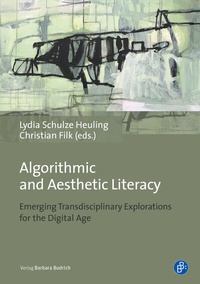
Algorithmic and Aesthetic Literacy
Emerging Transdisciplinary Explorations for the Digital Age
1st Edition
Published on 29. March 2021
228 pages
978-3-8474-1566-4 (ISBN)
Description

Mehr denn je prägen computergestützte und algorithmische Modalitäten gesellschaftliche Transformationsprozesse. Die algorithmische Bildung ist herausgefordert, transdisziplinäre Synthesen für Modellvorstellungen und Praxisansätze fruchtbar zu machen. Doch wie können Ästhetik und Kreativität ihren Eingang in algorithmische Bildungspraktiken finden? Der Sammelband vereint innovative Beiträge, mit denen sowohl Lehrende als auch Lernende zu schöpferischem Denken und nachhaltigem Handeln in der digitalen, wissensbasierten Netzwerkgesellschaft angeregt werden.
More details
Other editions
Additional editions
Lydia Schulze Heuling | Christian Filk
Algorithmic and Aesthetic Literacy
Emerging Transdisciplinary Explorations for the Digital Age
Book
03/2021
1st Edition
Verlag Barbara Budrich
€28.00
No shipping information available
Persons
Dr. Lydia Schulze Heuling, Professorin für Physikdidaktik, Western Norway University of Applied Sciences (HVL), Norwegen
Prof. Dr. Christian Filk, Professor für Medienpädagogik/Medienforschung und Leiter des Fachbereichs Medienpädagogik, Europa-Universität Flensburg
Content
Lydia Schulze Heuling, Christian Filk: Introduction
Susanne Martin: Dancing with Real Bodies: Dance Improvisation for Engineering, Science, and Architecture Students
Simon Nestler, Sven Quadflieg, Klaus Neuburg: The Design Prism. How Informatics Education Can Benefit from Design Competencies
Ellen Harlizius-Klück, Alex McLean: The PENELOPE Project: A Case Study in Computational Thinking
Hanno Schauer: Informatikkonzepte an Nicht-Informatiker mit Prozessmodellierungstechniken vermitteln
Michael Herczeg, Alexander Ohlei, Toni Schumacher, Thomas Winkler: Ambient Learning Spaces: Systemic Learning in Physical-Digital Interactive Spaces
Willy Noll: Ästhetische Erfahrung als produktive Enttäuschung - Entwurf eines (kunst-)pädagogischen Making
Elke Mark, Lindsey French: In Formation: Micro-Phenomenology as a Technology of Memory
Harry Lehmann: From Scores to Samples
Christoph Best: Ars gratia retium? Understanding How Artificial Neural Networks Learn to Emulate Art
James Bridle: Something Is Wrong on the Internet
