

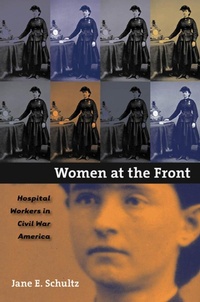
Women at the Front
Description

As many as 20,000 women worked in Union and Confederate hospitals during America’s bloodiest war. Black and white, and from various social classes, these women served as nurses, administrators, matrons, seamstresses, cooks, laundresses, and custodial workers. Jane E. Schultz provides the first full history of these female relief workers, showing how the domestic and military arenas merged in Civil War America, blurring the line between homefront and battlefront. Schultz uses government records, private manuscripts, and published sources by and about women hospital workers, some of whom are familiar — such as Dorothea Dix, Clara Barton, Louisa May Alcott, and Sojourner Truth — but most of whom are not well-known. Examining the lives and legacies of these women, Schultz considers who they were, how they became involved in wartime hospital work, how they adjusted to it, and how they challenged it. She demonstrates that class, race, and gender roles linked female workers with soldiers, both black and white, but became sites of conflict between the women and doctors and even among themselves. Schultz also explores the women’s postwar lives — their professional and domestic choices, their pursuit of pensions, and their memorials to the war in published narratives. Surprisingly few parlayed their war experience into postwar medical work, and their extremely varied postwar experiences, Schultz argues, defy any simple narrative of pre-professionalism, triumphalism, or conciliation.
More details
Other editions
Additional editions
Person
Content
- Cover Page
- Women at the Front
- Copyright Page
- Dedication
- Contents
- Illustrations and Figures
- Acknowledgments
- Introduction
- Part One On Duty
- 1 Women at the Front
- 2 Getting to the Hospital
- 3 Adjusting to Hospital Life
- 4 Coming into Their Own
- Part Two The Legacy of War Work
- 5 After the War
- 6 Pensioning Women
- 7 Memory and the Triumphal Narrative
- Appendix A Note on Historiography
- Notes
- Bibliography
- Index
