

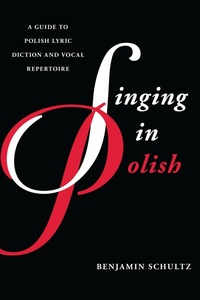
Singing in Polish
A Guide to Polish Lyric Diction and Vocal Repertoire
1st Edition
Published on 8. December 2015
334 pages
978-1-4422-3023-1 (ISBN)
Description

Singing in Polish: A Guide to Polish Lyric Diction and Vocal Repertoire stands as the first book-length resource for non-Polish-speaking singers, voice teachers, and vocal coaches that offers the essential tools for learning how to sing in Polish. Scholar and singer Benjamin Schultz offers a rich repertory of works virtually unknown outside of Poland, providing a unique catalyst for the introduction of Polish vocal music into the English-speaking world of performance. Never before has Polish vocal music been made so accessible to the musical world.
With a foreword by Timothy Cheek, the author of Singing in Czech, as well as an overview of the development of Polish music by renowned violinist, Polish music specialist, and scholar Tyrone Greive, Singing in Polish concisely outlines the science and art of Polish lyric diction through the use of the International Phonetic Alphabet (IPA). The included texts of more than 60 art songs and arias from some of the most distinguished Polish composers of all time each feature IPA transcriptions and English translations. Appendixes include lists of key Polish music publishing companies, cultural centers, and Polish poets.
Singing in Polish fills a void for singers, voice teachers, and vocal coaches in the Western tradition. It is a invaluable resource for anyone looking to add global variety to vocal performance in the studio, classroom, concert hall, or on the operatic stage.
With a foreword by Timothy Cheek, the author of Singing in Czech, as well as an overview of the development of Polish music by renowned violinist, Polish music specialist, and scholar Tyrone Greive, Singing in Polish concisely outlines the science and art of Polish lyric diction through the use of the International Phonetic Alphabet (IPA). The included texts of more than 60 art songs and arias from some of the most distinguished Polish composers of all time each feature IPA transcriptions and English translations. Appendixes include lists of key Polish music publishing companies, cultural centers, and Polish poets.
Singing in Polish fills a void for singers, voice teachers, and vocal coaches in the Western tradition. It is a invaluable resource for anyone looking to add global variety to vocal performance in the studio, classroom, concert hall, or on the operatic stage.
More details
Series
Edition
1. Auflage
Language
English
Place of publication
New York
United States
Publishing group
Bloomsbury Publishing Plc
Illustrations
1 b/w illustration; 1 b/w photo
ISBN-13
978-1-4422-3023-1 (9781442230231)
Copyright in bibliographic data and cover images is held by Nielsen Book Services Limited or by the publishers or by their respective licensors: all rights reserved.
Schweitzer Classification
Other editions
Additional editions
Book
12/2015
Rowman & Littlefield Publishers
€85.10
Shipment within 10-20 days
Person
Benjamin Schultz holds degrees in vocal performance from the University of Wisconsin-Madison, Belmont University, and the University of Wisconsin-Milwaukee. He currently serves as the assistant director of the School of Music at the University of Wisconsin-Madison. As a bass-baritone, he has sung in numerous operas and performed oratorios and solo recitals. He has received national recognition from Polish cultural organizations for his research and performance of Polish vocal music.
Content
- Singing in Polish
- Contents
- Recording Examples
- Foreword
- Preface
- Part One The Sounds of the Polish Language
- 1 The Polish Vowel Sounds
- i
- y
- e/e
- a
- o/a
- ó/u
- The Polish Nasal Vowels
- e
- a
- The Polish Schwa
- Polish Shadow Vowels
- 2 The Polish Consonants
- The Bilabial Consonants [b], [p], [m]
- The Alveolar Consonants [t], [d], [n], [r], [s], [z]
- The Labiodental Fricatives [f], [v]
- The Alveolo-Palatal Fricatives [?], [?]
- The Post-Alveolar Fricatives [?], [?]
- The Lateral Alveolar Approximant [l]
- The Palatal Nasal [?]
- The Velar Consonants [k], [g], [x], [?]
- The Polish Approximants [j], [w]
- The Polish Affricates [t?s], [d?z], [t??], [d??], [t??], [d??]
- Assimilation and Devoicing
- Palatal and Palatalized Consonants
- Consonant Clusters and Double Consonants
- Notes
- 3 Word Stress and Polish Dialects
- Word Stress
- Polish Dialects
- Notes
- Part Two Polish Vocal Repertoire
- Introduction to Part Two
- 4 A Violinist's View of the "Undiscovered" World of Polish Music
- Notes
- 5 Fryderyk Chopin
- Collected Songs op. 74
- Notes
- 6 Stanislaw Moniuszko
- Spiewnik domowy
- Halka's Aria
- Jontek's Aria
- Skoluba's Aria
- Notes
- 7 Ignacy Jan Paderewski
- Konwalijka op. 7
- 6 Lieder op. 18
- Notes
- 8 Karol Szymanowski
- Rymy dzieciece
- Piesni ksiezniczki z basni op. 31
- Slopiewnie op. 46b
- Roksana spiewa
- Notes
- 9 Grazyna Bacewicz
- Boli mnie glowa
- Dzwon i dzwonki
- Mów do mnie, o mily!
- Nad woda wielka i czysta
- Rozstanie
- Sroczka
- Notes
- 10 Wojciech Kilar
- Angelus
- Notes
- 11 Henryk Górecki
- Symphony No. 3 Symfonia piesni zalosnych
- Notes
- Appendix A Publishers and Retail Stores
- Appendix B Organizations
- Appendix C Polish Poets
- Appendix D Checklist
- References
- Index
- About the Author and Contributor
