

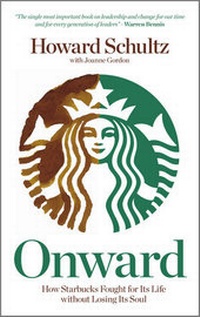
Onward
How Starbucks Fought For Its Life without Losing Its Soul
1st Edition
Published on 20. April 2011
348 pages
978-1-119-97923-4 (ISBN)
Description

In 2008, Howard Schultz, the president and chairman of Starbucks,made the unprecedented decision to return as the CEO eight yearsafter he stepped down from daily oversight of the company andbecame chairman. Concerned that Starbucks had lost its way, Schultzwas determined to help it return to its core values and restore notonly its financial health, but also its soul. In Onward, heshares the remarkable story of his return and the company's ongoingtransformation under his leadership, revealing how, during one ofthe most tumultuous economic times in history, Starbucks againachieved profitability and sustainability without sacrificinghumanity.
Offering readers a snapshot of a moment in history that left nocompany unscathed, the book zooms in to show, in riveting detail,how one company struggled and recreated itself in the midst of itall. The fast paced narrative is driven by day-to-day tension asconflicts arise and lets readers into Schultz's psyche as he comesto terms with his limitations and evolving leadership style. Onwardis a compelling, candid narrative documenting the maturing of abrand as well as a businessman.
Onward represents Schultz's central leadershipphilosophy: It's not just about winning, but the right way to win.Ultimately, he gives readers what he strives to deliver every day-a sense of hope that, no matter how tough times get, the future canbe just as or more successful than the past, whatever one definessuccess to be.
"Through the lens of his personal leadership journey, with allof its dizzying ups and agonizing downs, Howard Schultz haswritten, with aching honesty and passion, the single most importantbook on leadership and change for our time and for every generationof leaders. This book is not just recommended reading, it'srequired."
Warren Bennis, Distinguished Professor of Business,University of Southern California, and author of the recentlypublished Still Surprised: A Memoir of a Life in Leadership
"[This] sequel to the founding of Starbucks is grittier, moregripping, and dramatic, and [Schultz's] voice is winning andauthentic. This is a must-read for anyone interested in leadership,management, or the quest to connect a brand with the consumer."
Publishers Weekly
More details
Other editions
Additional editions
Book
04/2011
Wiley
€18.56
Article exhausted; check different version
Persons
Howard Schultz is chairman, president, and chief executive officer of Starbucks Coffee Company. Howard moved to Seattle from his native New York and joined the company in 1982 as director of operations and marketing when Starbucks had only four stores. He has been recognized extensively for his passion, leadership, and efforts to strengthen communities, with honors including the Horatio Alger Award for those who have overcome adversity to achieve success; the Rev. Theodore M. Hesburgh Award for Business Ethics given by Notre Dame University's Mendoza College of Business; the Botwinick Prize in Business Ethics from Columbia Business School; and the first ever John Wooden Global Leadership Award from UCLA Anderson School of Management. He has also been included in Time magazine's "Time 100," a list of the most influential people in the world. Howard and his wife, Sheri, live in Seattle and have two children.
The Starbucks Foundation and the CUP Fund
All of Howard Schultz's proceeds from the sale of this book will be donated to the Starbucks Foundation, founded in 1997 to support the company's commitment to community; and the CUP Fund, founded by partners (employees) to provide financial relief to partners facing emergency situations that have unexpectedly impacted their life.
Joanne Gordon is a former Forbes writer who has spent more than a decade profiling companies and business leaders for numerous publications. She has written five previous books.
Content
Introduction.
Part One: Love.
1 A Beverage of Truth.
2 A Love Story.
3 Surfacing.
4 Nothing is Confidential.
5 Magic.
6 Loyalty.
7 Believe.
Part Two: Confidence.
8 A Reservoir of Trust.
9 A New Way to See.
10 Playing to Win.
11 Elevating the Core.
12 Get in the Mud.
13 A Reason to Exist.
14 Benevolence.
15 Beyond the Status Quo.
16 Bold Moves.
Part Three: Pain.
17 Whirlwind.
18 A Lethal Combination.
19 Reverence.
20 No Silver Bullets.
21 I Know this to be True.
Part Four: Hope.
22 Truth in Crisis.
23 A Galvanizing Moment.
24 Nimble.
25 Plan B.
26 Stay the Course.
Part Five: Courage.
27 Innovate.
28 Conviction.
29 Connecting Dots.
30 Balance.
31 Conscience.
32 Winning.
33 Ni Hao.
Tribute.
Acknowledgments.
Photo credits.
Index.
3 SURFACING Work should be personal. For all of us. Not just for the artist and the entrepreneur. Work should have meaning for the accountant, the construction worker, the technologist, the manager, and the clerk.
Infusing work with purpose and meaning, however, is a two-way street. Yes, love what you do, but your company should love you back. As a merchant, my desire has always been to inspire customers, exceed their high expectations, and establish and maintain their trust in us. As an employer, my duty has always been to also do the same for people on the other side of the counter. For our partners. This latter responsibility has driven me for many, many years. When I was 7 years old, I came home from school one winter day and saw my father sprawled on a couch with a cast from his hip to his ankle. My dad was an uneducated war veteran, and while he was very proud, he never really found his spot in the world. He held a series of really rough blue-collar jobs to support our family, never making more than $20,000 a year. He'd been a truck driver, a factory worker, and even a cab driver for a while, but his current job was the worst. He drove a truck picking up and delivering cloth diapers. That week Dad had fallen on a sheet of ice and broken his hip and his ankle, and for a blue-collar worker in 1960 there was no worker's compensation. No health-care coverage. No severance. My dad was simply sent home after his accident and dismissed by the company. I never imagined I would one day be in a position to run a company a different way. But I did believe, even then, that everyone deserved more respect than my parents had received. By the time my father passed away in 1988 from lung cancer, he had no savings or pension. Just as tragic, in my mind, was that he never found fulfillment or meaning in his work. As a business leader, I wanted to build the kind of company that my dad never got a chance to work for. But like crafting the perfect cup of coffee, creating an engaging, respectful, trusting workplace culture is not the result of any one thing. It's a combination of intent, process, and heart, a trio that must constantly be fine-tuned. Sometimes we've gotten it very right. Other times, we've faltered. People at Starbucks, in our offices as well as our stores, work very, very hard. The jobs can be stressful because we set a high bar, but at the end of the day I want each person to go home feeling that he or she made a difference. By the year 2000, I was the one ready to take on new challenges. After running Starbucks' daily operations for almost 15 years, something inside me had shifted. The company was performing exceptionally well. With 2,600 stores in 13 countries, our revenue was just shy of $2 billion. Since 1992 we had achieved a compounded annual growth rate of 49 percent. Yet I was feeling down. At times, almost depressed. I talked with Sheri about my change in mood and, after much soul-searching, concluded that my job was not as challenging as it had been for so many years. I was still passionate about Starbucks, but also a bit bored. Leaving, of course, was not an option. But with my engagement less than it needed to be for the health of the company, I decided the time was right to step away from overseeing day-to-day operations. To replace me as ceo, the board of directors and I appointed our president and chief operating officer at the time, Orin C. Smith. Wise, thoughtful, and affable, Orin had joined Starbucks in 1990 as chief financial officer. He shared my vision, was well respected by partners and investors, and had an admirably measured approach to solving complex problems. I trusted him, he trusted me, and we had a decade-long history of making decisions together. He knew the company inside and out, and would continue to strengthen the core business and invest in growth. Orin committed to spending five years as ceo. I turned my attention to expanding Starbucks around the world. Since opening our first store outside North America in Tokyo in 1996, we had been deluged with requests to open Starbucks locations in other countries. Then, as now, the opening of a Starbucks was often viewed as a sort of "coming of age," a sign of arrival for a city as well as its inhabitants. At the time, Starbucks had 525 stores outside the United States, in such far-flung places as New Zealand and China. Soon we would bring Starbucks into Spain, France, and Russia. My new role as chairman and chief global strategist was, in large part, to help select local companies that would operate our stores in each region. We chose these international partners very carefully, selecting only organizations whose leaders shared our values. As the ambassador of the brand, it was also my job to imprint our mission on our local representatives, to ensure the brand's consistency across cultures. I was ecstatic about the possibilities that the future held for me as well as for the company, and during the next several years I officiated at hundreds of store openings throughout the world. Traveling exposed me to more innovative retailers and other merchants whose love for their products and professions was obvious the minute I walked into their shops. During my years as chairman, we opened US stores at a rapid rate and continued to expand around the world, pushing toward a target of 20,000 stores outside the United States. We opened in Dubai and in Hong Kong. In Saudi Arabia and Australia. And we continued to build and open stores in our most promising growth market: China. In 2003 our new Beijing store was Starbucks' 1,000th store in Asia Pacific. The next year we opened the first Starbucks in Paris, followed over the years by stores in the Bahamas, Brazil, Egypt, Ireland, Jordan, Northern Ireland, and Romania. One of my most touching moments abroad occurred in 2001 in Japan, the country where we opened our very first store outside North America in 1996. Japan was also the first market outside the United States and Canada where we gave full- and part-time partners equity, and I will never forget the day we announced it at a regional company meeting. As I looked out over the audience, I saw that some of our partners were actually crying. Owning a piece of the company gave not just our partners in Japan, but so many of our partners a tremendous sense of pride, demonstrating that we respected our people enough to share our success. After the announcement, young people who worked in our stores in Japan approached me and explained, through translators, that they could not wait to go home and tell their parents because their mothers and fathers had never owned anything in their lives. It was an incredibly humbling and fulfilling day, the kind that reminded me that Starbucks is about so much more than coffee. Ironically, my days spent working back home in Seattle were often when I felt most out of sorts. Although, as chairman, I occupied the same office I had as ceo, with its expansive view of Seattle's ports and skyline, I felt somewhat lost inside our nine-story building on Utah Avenue. The role of chairman did not require me to be involved in day-to-day decisions. No longer was I part of the same meetings and planning sessions that had once packed my calendar. And while I felt comfortable, out of trust as well as respect, with leaving decisions to Orin and his team, there were times when, walking by closed-door conference rooms, I would peer through the windows, literally feeling like an outsider looking in. During Orin's five years as ceo, there was a great deal of momentum as our store count almost tripled to just more than 9,000. The company was rapidly breaking into new markets and geographies, bringing our stores to smaller metropolitan areas and suburbs. Back in major cities, where we had always thrived, competitors were following our lead and exploding their own presences. Yet even as more coffee shops sprang up, the lines at our stores got longer and longer. It was during this time that Starbucks began to better understand its customers, and what they wanted was convenience in all its forms. They didn't want to wait in line for their lattes, but they also did not want to walk a few more blocks or drive an extra mile to get it. Our way to reduce wait times was to open more stores, so we grew aggressively in urban markets, too. It was not easy and required hard work, but our growth felt manageable in large part because we had developed easily adaptable store designs. We also had adept real estate experts who took time to find just the right store locations, as well as skilled regional, district, and store managers who oversaw quality. It was also during Orin's leadership that Starbucks capitalized on opportunities to bring our coffee to people outside of our stores. We signed an agreement to supply our coffee to guests at hotels owned by Hyatt and Marriott. Expanding our store-within-a-store concept-Starbucks was already doing business in Barnes & Noble stores-we opened stand-alone kiosks inside hundreds of national supermarket chains such as Safeway, Kroger, and Publix. These new sales channels provided another revenue stream. But perhaps one of the most important, yet less publicized, strides that Starbucks made when Orin was ceo was to more fully and formally commit itself to social responsibility. Going about our business in ways that were good for people as well as good for the planet is something Starbucks has always strived to do. It is part of our DNA. But beginning in the late 1990s, social responsibility also became a marketplace imperative. Most people, I have always believed, want to...
Infusing work with purpose and meaning, however, is a two-way street. Yes, love what you do, but your company should love you back. As a merchant, my desire has always been to inspire customers, exceed their high expectations, and establish and maintain their trust in us. As an employer, my duty has always been to also do the same for people on the other side of the counter. For our partners. This latter responsibility has driven me for many, many years. When I was 7 years old, I came home from school one winter day and saw my father sprawled on a couch with a cast from his hip to his ankle. My dad was an uneducated war veteran, and while he was very proud, he never really found his spot in the world. He held a series of really rough blue-collar jobs to support our family, never making more than $20,000 a year. He'd been a truck driver, a factory worker, and even a cab driver for a while, but his current job was the worst. He drove a truck picking up and delivering cloth diapers. That week Dad had fallen on a sheet of ice and broken his hip and his ankle, and for a blue-collar worker in 1960 there was no worker's compensation. No health-care coverage. No severance. My dad was simply sent home after his accident and dismissed by the company. I never imagined I would one day be in a position to run a company a different way. But I did believe, even then, that everyone deserved more respect than my parents had received. By the time my father passed away in 1988 from lung cancer, he had no savings or pension. Just as tragic, in my mind, was that he never found fulfillment or meaning in his work. As a business leader, I wanted to build the kind of company that my dad never got a chance to work for. But like crafting the perfect cup of coffee, creating an engaging, respectful, trusting workplace culture is not the result of any one thing. It's a combination of intent, process, and heart, a trio that must constantly be fine-tuned. Sometimes we've gotten it very right. Other times, we've faltered. People at Starbucks, in our offices as well as our stores, work very, very hard. The jobs can be stressful because we set a high bar, but at the end of the day I want each person to go home feeling that he or she made a difference. By the year 2000, I was the one ready to take on new challenges. After running Starbucks' daily operations for almost 15 years, something inside me had shifted. The company was performing exceptionally well. With 2,600 stores in 13 countries, our revenue was just shy of $2 billion. Since 1992 we had achieved a compounded annual growth rate of 49 percent. Yet I was feeling down. At times, almost depressed. I talked with Sheri about my change in mood and, after much soul-searching, concluded that my job was not as challenging as it had been for so many years. I was still passionate about Starbucks, but also a bit bored. Leaving, of course, was not an option. But with my engagement less than it needed to be for the health of the company, I decided the time was right to step away from overseeing day-to-day operations. To replace me as ceo, the board of directors and I appointed our president and chief operating officer at the time, Orin C. Smith. Wise, thoughtful, and affable, Orin had joined Starbucks in 1990 as chief financial officer. He shared my vision, was well respected by partners and investors, and had an admirably measured approach to solving complex problems. I trusted him, he trusted me, and we had a decade-long history of making decisions together. He knew the company inside and out, and would continue to strengthen the core business and invest in growth. Orin committed to spending five years as ceo. I turned my attention to expanding Starbucks around the world. Since opening our first store outside North America in Tokyo in 1996, we had been deluged with requests to open Starbucks locations in other countries. Then, as now, the opening of a Starbucks was often viewed as a sort of "coming of age," a sign of arrival for a city as well as its inhabitants. At the time, Starbucks had 525 stores outside the United States, in such far-flung places as New Zealand and China. Soon we would bring Starbucks into Spain, France, and Russia. My new role as chairman and chief global strategist was, in large part, to help select local companies that would operate our stores in each region. We chose these international partners very carefully, selecting only organizations whose leaders shared our values. As the ambassador of the brand, it was also my job to imprint our mission on our local representatives, to ensure the brand's consistency across cultures. I was ecstatic about the possibilities that the future held for me as well as for the company, and during the next several years I officiated at hundreds of store openings throughout the world. Traveling exposed me to more innovative retailers and other merchants whose love for their products and professions was obvious the minute I walked into their shops. During my years as chairman, we opened US stores at a rapid rate and continued to expand around the world, pushing toward a target of 20,000 stores outside the United States. We opened in Dubai and in Hong Kong. In Saudi Arabia and Australia. And we continued to build and open stores in our most promising growth market: China. In 2003 our new Beijing store was Starbucks' 1,000th store in Asia Pacific. The next year we opened the first Starbucks in Paris, followed over the years by stores in the Bahamas, Brazil, Egypt, Ireland, Jordan, Northern Ireland, and Romania. One of my most touching moments abroad occurred in 2001 in Japan, the country where we opened our very first store outside North America in 1996. Japan was also the first market outside the United States and Canada where we gave full- and part-time partners equity, and I will never forget the day we announced it at a regional company meeting. As I looked out over the audience, I saw that some of our partners were actually crying. Owning a piece of the company gave not just our partners in Japan, but so many of our partners a tremendous sense of pride, demonstrating that we respected our people enough to share our success. After the announcement, young people who worked in our stores in Japan approached me and explained, through translators, that they could not wait to go home and tell their parents because their mothers and fathers had never owned anything in their lives. It was an incredibly humbling and fulfilling day, the kind that reminded me that Starbucks is about so much more than coffee. Ironically, my days spent working back home in Seattle were often when I felt most out of sorts. Although, as chairman, I occupied the same office I had as ceo, with its expansive view of Seattle's ports and skyline, I felt somewhat lost inside our nine-story building on Utah Avenue. The role of chairman did not require me to be involved in day-to-day decisions. No longer was I part of the same meetings and planning sessions that had once packed my calendar. And while I felt comfortable, out of trust as well as respect, with leaving decisions to Orin and his team, there were times when, walking by closed-door conference rooms, I would peer through the windows, literally feeling like an outsider looking in. During Orin's five years as ceo, there was a great deal of momentum as our store count almost tripled to just more than 9,000. The company was rapidly breaking into new markets and geographies, bringing our stores to smaller metropolitan areas and suburbs. Back in major cities, where we had always thrived, competitors were following our lead and exploding their own presences. Yet even as more coffee shops sprang up, the lines at our stores got longer and longer. It was during this time that Starbucks began to better understand its customers, and what they wanted was convenience in all its forms. They didn't want to wait in line for their lattes, but they also did not want to walk a few more blocks or drive an extra mile to get it. Our way to reduce wait times was to open more stores, so we grew aggressively in urban markets, too. It was not easy and required hard work, but our growth felt manageable in large part because we had developed easily adaptable store designs. We also had adept real estate experts who took time to find just the right store locations, as well as skilled regional, district, and store managers who oversaw quality. It was also during Orin's leadership that Starbucks capitalized on opportunities to bring our coffee to people outside of our stores. We signed an agreement to supply our coffee to guests at hotels owned by Hyatt and Marriott. Expanding our store-within-a-store concept-Starbucks was already doing business in Barnes & Noble stores-we opened stand-alone kiosks inside hundreds of national supermarket chains such as Safeway, Kroger, and Publix. These new sales channels provided another revenue stream. But perhaps one of the most important, yet less publicized, strides that Starbucks made when Orin was ceo was to more fully and formally commit itself to social responsibility. Going about our business in ways that were good for people as well as good for the planet is something Starbucks has always strived to do. It is part of our DNA. But beginning in the late 1990s, social responsibility also became a marketplace imperative. Most people, I have always believed, want to...
