

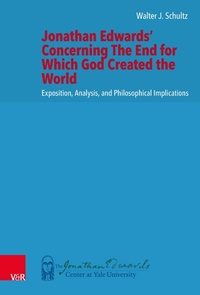
Jonathan Edwards' Concerning The End for Which God Created the World
Exposition, Analysis, and Philosophical Implications
1st Edition
Published on 20. January 2020
351 pages
978-3-647-56486-9 (ISBN)
Description

This book is an exposition of Jonathan Edwards' argumentation in his dissertation Concerning the End for Which God Created the World. In addition to stating Edwards' theses regarding God's end and motivation in creation, this book identifies and discusses the assumptions of his argumentation, analyses and explains its crucial components, and explores its philosophical implications. These implications include a version of exemplarism (i.e., the nature of God's ideas for creation), dispositionalism (i.e., the characteristics of God which explain God's motivation), and emanationism (i.e., what God shares of himself with persons who have a living faith in Christ). These entail a view of idealism (i.e., a view of the ultimate ontological ground of the universe), God's temporal nature, continuous creationism (i.e., how God sustains creation), a version of panentheism (i.e., how God, who is infinite, is related to creation, from which God is absolutely distinct), and occasionalism (i.e., the nature of causation of physical events or states of creation). These concepts and what they entail constitute a complete metaphysical system, providing a thoroughgoing divine action understanding of the foundation of reality. For Jonathan Edwards, God's acting according to his plans for his purposes in Christ is fundamental to all things. Were we to have an understanding of how the fundamental concepts of science, mathematics, and ordinary experience are related in reality to the God who acts for his original ultimate end in creation, sustaining the universe, while providentially guiding its affairs, and working redemption, we would have the opportunity to develop these as he had hoped, he pointed the way for others to follow.
Walter J. Schultz is Professor of Philosophy / Scholar-in-Residence at the University of Northwestern - St. Paul.
Walter J. Schultz is Professor of Philosophy / Scholar-in-Residence at the University of Northwestern - St. Paul.
More details
Other editions
Additional editions
Walter J. Schultz
Jonathan Edwards' Concerning The End for Which God Created the World
Exposition, Analysis, and Philosophical Implications
Book
01/2020
1st Edition
Vandenhoeck & Ruprecht
from
€120.00
Shipment within 5-7 days
Person
Walter J. Schultz is Professor of Philosophy / Scholar-in-Residence at the University of Northwestern - St. Paul.
Content
- Intro
- Title Page
- Copyright
- Acknowledgements
- Table of Contents
- Body
- Preface
- A Personal Note
- Summary of Chapters
- PART ONE Exposition and Analysis
- Chapter One Background to End of Creation
- I. God's nature
- Attribute
- Perfection
- Disposition
- Function of dispositional discourse
- II. Nine problems facing a theory of God's end in creation
- III. Edwards' three goals in writing: constructive, polemical, logical/conceptual
- IV. Edwards' rhetorical method: Reason and Scripture
- Chapter Two God's End in Creation is an "Original Ultimate End"
- I. There are three types of ultimate ends
- II. Edwards' complete concept of an ultimate end
- The practical aspect
- The pleasure aspect
- The valuational aspect
- Agreeable
- III. Dispositions in relation to acting for ends
- IV. The difference between original and consequential ultimate ends
- V. Edwards' use of the terms work and works
- Four points of elaboration
- Chapter Three The Master Argument in Fifteen Propositions
- I. Assumptions, definitions, and two "theorems"
- II. Four derived criteria
- Section I of Chapter One
- III. Four things that satisfy Criterion II and Criterion IV
- Section II of Chapter One
- IV. The same four things satisfy Criterion III
- Section III of Chapter One
- V. The most valuable of the four things and God's motivation
- Chapter Four God's End in Creation Must Manifest God's Supreme Self-Regard
- I. The requirements for something being God's end in creation
- Objection
- II. Only God meets the requirements
- III. God values himself inherently and infinitely so
- IV. Can God be morally justified in loving himself infinitely?
- V. God is morally justified to love himself and must show it in action
- A Third Being?
- VI. How this supports Christian experience and undermines false teaching
- Chapter Five A Moral Justification of God: On the Use of a Fictitious Third Being
- I. Could God be morally justified in making himself his end?
- II. The rhetorical role of the Third Being
- III. British rational intuitionism
- IV. John Gill and Jonathan Edwards against the rationalists
- Chapter Six Is Jonathan Edwards a Neo-Platonist? Edwards' Use of "Emanation"
- I. The problem stated: is Edwards a Neoplatonist?
- II. Edwards' concept of emanation: a brief statement
- III. An explication of Edwards' concept of emanation
- Chapter Seven A Solution to The Divine Self-Sufficiency / Divine Action Problem
- I. The Divine Self-Sufficiency / Divine Action Problem
- II. Evidence of Edwards' awareness of Spinoza's Conundrum
- III. God's original ultimate end and motivation for creating
- God's original ultimate end
- God's motivation for creating
- IV. Nothing of ontological or "psychological" value can be gained by creating
- A. No ontological value could have been accomplished by creating because creation is ex nihilo.
- B. No increase in divine felicity could have been accomplished by creating because God is infinite and perfect.
- C. No qualitative value could be gained by the existence of creation because the value of the end depends on the value of the attributes producing its realization.
- D. No ontological value could be gained by the existence of creation because the ontological substance of creation is never more than an idea in God's mind.
- E. No increase in divine felicity could have been accomplished because the pleasure God has in the act of communicating his infinite fullness and in the state of affairs achieved by so acting (which is God's original ultimate end) is the pleasure he has in himself.
- F. No increase in divine felicity could have been accomplished by creating because God's end in creation manifests God supreme selfregard.
- V. Summary
- PART TWO Philosophical Implications
- Chapter Eight The Origin of Possibility is God's Ability ad extra
- I. The Origin of Possibility
- II. The Tradition
- III. Differences
- Chapter Nine The Logical Necessity of Idealism
- I. Introduction
- The threat of inconsistency
- II. The two facets of Edwards' idealism
- III. How "The universe is ideal with respect to God's mind" is logically required
- IV. How "The universe is real with respect to creatures" is logically required
- Conceiving the two facets
- Summary and conclusion
- V. Did Edwards change his view or did he refine it from Berkeleyan idealism?
- Chapter Ten On God's Freedom in Creation
- I. A Neoplatonic (Pseudo-Dionysian) interpretation
- What is the "emanation"?
- What is "the disposition" that "excited" God to create the world?
- Why Edwards' view is not an instance of the Dionysian Principle
- Objection
- II. An Augustinian (Leibniz) interpretation
- What is "the best"?
- There can be no best
- III. A Libertarian (Clarke) interpretation
- IV. Conclusion
- Chapter Eleven Continuous Creationism, Occasionalism, and Panentheism
- I. Continuous creationism
- Idealism
- II. Occasionalism
- Dispositions, laws of nature, mechanisms
- Concurrentism
- III. Panentheism
- Not Pan-theism
- IV. Concluding summation
- Chapter Twelve Divine Action and the Persistence of Physical Objects
- I. An objection to continuous creationism and occasionalism
- Two features of the objection
- II. Edwards' argumentation entails the persistence of physical objects
- Physical fundamentality and ontological ground
- The persistence of physical objects
- A recurrent misconception
- Toward a positive account of persistence
- III. Edwardsian persistence overcomes the "problem of persistence" and the objection
- IV. The no persistence of objects objection against occasionalism is false
- APPENDIX A: Outline of The End for Which God Created the World
- APPENDIX B: A Synopsis of the Argumentation in End of Creation
- APPENDIX C: A Logical Analysis of Edwards' Argumentation
- APPENDIX D: Four Criteria in Edwards' Six-Stage Argument
- APPENDIX E: On Behalf of Edwards' Complete Representation Exemplarism
- APPENDIX F: Edwards on God's being metaphysically temporal
- References
- The Works of Jonathan Edwards
- Ancient, Medieval, and Early Modern Works
- Contemporary secondary works
- Person Index
- Subject Index
