

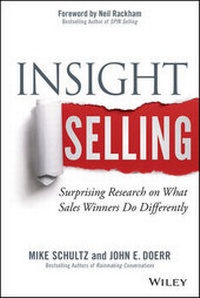
Insight Selling
Description

Reviews / Votes
"The majority of experienced sellers would agree thatwhile a lot of existing sales wisdom is good, some things havebecome outdated and must change. The hard part is deciding what tokeep, what to change and what to discard. Insight Sellinglays out a convincing case for which parts of current practice weshould keep, which parts must be tweaked, and which parts must bechanged entirely. Whether you're an experienced seller orjust starting out in sales, you stand to learn something usefulfrom this book." --Professor Neil Rackham, author of SPINSelling "Wow! Even your most experienced strategic sellers willsharpen their game with these insights. RAIN Group's research andapplication to real life situations will educate your team on howto inspire buyers with possibilities and demonstrate the value addfor your offerings like never before." --Sandy Miller, Partner, Strategic Accounts, AonHewitt "While "solutions selling" isn't dead,it is now just the price of admission. In this book, Mike andJohn provide the fundamentals and techniques around advanced"insight selling" and how you need to become the changeagent for the customer to be a true sales winner! After all, insales the second-place finisher is just the firstloser." --Jim Madson, Vice President, Sales, TycoSimplexGrinnell "Professional salespeople a decade ago wouldn't evenrecognize the landscape, challenges, and skill sets required today.This content is essential for contemporarysellers." --Peter Ostrow, VP and Research Group Director, CustomerManagement, Aberdeen Group "The recipe for growth today is dramatically differentthan just a few years ago, yet many sellers have failed to adapt.For those aspiring to elevate their game, you've picked upthe right playbook." --Richard Tober, Senior Vice President, Capgemini "Few sales books are destined to become classics that willmake a real difference in the world of selling. This one will jointhat rare club that will stand the test of time." --Gord Smith, Partner, Hitachi Solutions "Schultz and Doerr are truly among the elite sales thoughtleaders. Insight Selling outlines exactly what youneed to do to set yourself apart and find yourself in thewinner's circle. It's a must read for even the mostexperienced sellers." --Jill Konrath, bestselling author of Agile Selling& SNAP SellingMore details
Other editions
Additional editions
Persons
Content
Chapter 1
Sales Winners Sell Differently
The New World of Selling
It’s old news that buyers have a lot more information about everything than in decades past. Primarily through the Internet—but also through increased availability of research and use of consultants—buyers know more about your offerings, market, and competitors, and their issues and problems, industry, and options for action, than ever before.
Also fairly well established is that today’s buyers are harder to reach, buying cycles are longer, and more decision makers are involved in every sale. Buyers are also more skeptical. Although the great recession is largely in the rearview mirror, the psychological scars will remain for years to come.
Yes, buying has changed a lot, yet from the 1970s until recently, not much changed in the world of sales methodologies. The prevailing thinking in recent decades has been sellers could study and learn traditional solution or consultative selling approaches, apply them well, and produce excellent results consistently.
Not anymore.
Given the changes in buying, the commoditization of many products and services, and the radical intensification of competition in many industries, it’s no surprise that solution sales concepts aren’t working as they once did. We at RAIN Group are not the only ones seeing this trend either. Articles in the mainstream business press, including the Harvard Business Review,1 routinely raise the specter of the death of solutions sales.
In any case, it’s a new world in selling. As is the way of things, with the sunset of one paradigm comes the sunrise of another. Those sellers still living in the old paradigm, however, are losing sales. It’s not surprising, then, that the pace of companies calling us saying, “How we used to sell isn’t working anymore” has been accelerating for years and seems to have reached a tipping point.
Yet as these sellers report more losses, buying is still happening! This means someone is winning. This raises a fairly obvious question: What are they doing to win?
Analyzing What Sales Winners Do Differently
What’s Actually Happening
An obvious question, perhaps, but it seemed like a good one to ask, so we did. We wrote this on our whiteboard in big red letters:
What are the winners of actual sales opportunities doing differently than the sellers who come in second place?
To find the answer, in late 2012 and into early 2013 we began studying actual purchases in industries with complex sales, such as technology, consulting and professional services, financial services, industrial products, and a variety of other business-to-business (B2B) industries. The results of this study focus on more than 700 B2B purchases made by a broad sample of buyers. In aggregate, these buyers were responsible for $3.1 billion in annual purchases. Along with our survey research, we’ve now spoken to more than 150 corporate buyers about their recent purchasing experiences.
Here’s what we found:
- Winners sell radically differently than the second-place finishers. In many ways, what sales winners do differently is both surprising and fascinating.
- There’s a specific combination of behaviors that sales winners exhibit and outcomes they achieve that the second-place finishers don’t.
- Several key factors that set apart the winners are rarely discussed in the world of selling. These now demand attention.
- With all due respect to the Harvard Business Review, solution sales is definitely not dead. However, although solution sales concepts are still necessary, they’re no longer sufficient to win sales. Also, fundamental solution sales concepts need reimagination and relabeling. They need to evolve.
Before we share the specifics of what we found, it’s important to note we did not have preferences for what the results would show. Our intent was to find out what’s really going on and proceed from there. We expected the results would influence our thinking, our sales consulting, and our RAIN Selling training process and programs, requiring us to make updates and changes. Indeed, this has been the case.
Research from the Buyer’s Perspective
One of the interesting things about reading sales books and articles is that much advice seems to make sense on its face, even to us after 50 collective years living in the sales training and enablement world. Although, with a few exceptions, most selling methods sound fine, the reality is that some of them are wrong, or at least wrong for certain businesses and people. It’s not, however, easy to suss out the good advice from the bad.
There are a lot of ways to do the sussing, too. Not all of them are helpful. Sales research methods often focus on asking sellers, sales managers, and company leaders what the top performers do versus average performers. Unfortunately, people’s perceptions of what they do—and what they actually do—don’t tend to match up.
For example, Hinge Research Institute recently studied buyers and sellers across several B2B industries about the buyers’ perceptions of seller companies’ selling and marketing practices. Dr. Lee W. Frederiksen, managing partner of Hinge, told us, “Across the board, sellers and buyers think tremendously differently about what’s important. For example, sellers vastly overestimate the role of price in closing the sale. They see it as more than twice as important as the buyers view it.”a We see the same incongruity in buyer and seller perceptions. We recently polled several hundred sellers on some of the same questions we asked the buyers in our study. What the buyers perceived about what sellers did, and what the sellers perceived what they, themselves, did, were markedly different.
The primary research on which Insight Selling is based looked at sales from the buyers’ perspective. As mentioned, our objective was to find the answer to the question, What are the winners of actual sales opportunities doing differently than the sellers who come in second place? We looked at it, however, through the eyes of the buyers. This approach allowed us to get past sellers’ perceptions of themselves and their colleagues and concentrate on the buyers’ perspective and what actually happened in the field of play. After all, buyers make purchase decisions based on their perceptions. This is what matters.
Six-Prong Analysis Yields Fascinating Story
We asked buyers to consider recent major purchases and rate the winner (the seller who won their business) and the second-place finisher (the other seller they most seriously considered in the buying process but who ultimately came in second place). Our objectives were to see:
- What winners do: Simply, what are the behaviors they exhibit and impressions they make on buyers?
- What winners do more often than the second-place finishers: The idea here was to understand what most separates winners from second-place finishers.
- What the buyers told us the second-place finishers should change to make the buyers more likely to choose them; in other words, we wanted to know what the buyers perceived to be the most important factors in their decision making.
We also looked at the statistical key driversb of buyer:
- Satisfaction with the buying process
- Likelihood to buy again
- Likelihood to refer the seller
The first three categories are the keys to winning the current sale. They’re what the sellers do to win now, so to speak. The latter three help to win now, but mostly they are the keys to win later.
Each of these six categories turned out to be pieces of a puzzle. When we viewed all six pieces together, an elegant and fascinating story emerged. It turns out not only do the winners sell radically differently than the second-place finishers, but they also sell similarly to each other! In Insight Selling, we’ve done our best to codify what the winners look like and explain what they do. The idea is that—for those sellers willing to make changes to how they sell—they can maximize their current wins and their ongoing selling success. We call this model 3 Levels of RAIN Selling.
As you begin reading about the 3 levels, note that sellers should learn and apply them not separately or in sequence, but as a combination. Applied in combination, there’s a compounding effect as the various areas build on and reinforce each other. At the same time, leave a level (or piece of a level) out, and you introduce barriers to winning competitive sales and increase the odds of losing to no decision.
3 Levels of RAIN Selling
We categorized our findings into 3 levels of selling behaviors and outcomes that set the sales winners apart from the second-place finishers. Following are the highlights.
Level 1 Is Connect.
Winners connect the dots between customer needs and their company’s products and services as solutions more often than the second-place finishers. Winners also connect with people. They’re perceived to listen and connect personally with buyers more often.
Connecting with people and connecting the dots—this sounds a lot like relationship and solution selling to us. Not only is connecting still relevant (and not dead!), but it’s...
