

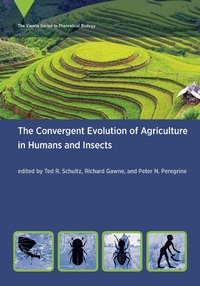
The Convergent Evolution of Agriculture in Humans and Insects
Published on 15. February 2022
338 pages
978-0-262-36756-1 (ISBN)
Description

Contributors explore common elements in the evolutionary histories of both human and insect agriculture resulting from convergent evolution.
During the past 12,000 years, agriculture originated in humans as many as twenty-three times, and during the past 65 million years, agriculture also originated in nonhuman animals at least twenty times and in insects at least fifteen times. It is much more likely that these independent origins represent similar solutions to the challenge of growing food than that they are due purely to chance. This volume seeks to identify common elements in the evolutionary histories of both human and insect agriculture that are the results of convergent evolution. The goal is to create a new, synthetic field that characterizes, quantifies, and empirically documents the evolutionary and ecological mechanisms that drive both human and nonhuman agriculture.
The contributors report on the results of quantitative analyses comparing human and nonhuman agriculture; discuss evolutionary conflicts of interest between and among farmers and cultivars and how they interfere with efficiencies of agricultural symbiosis; describe in detail agriculture in termites, ambrosia beetles, and ants; and consider patterns of evolutionary convergence in different aspects of agriculture, comparing fungal parasites of ant agriculture with fungal parasites of human agriculture, analyzing the effects of agriculture on human anatomy, and tracing the similarities and differences between the evolution of agriculture in humans and in a single, relatively well-studied insect group, fungus-farming ants.
During the past 12,000 years, agriculture originated in humans as many as twenty-three times, and during the past 65 million years, agriculture also originated in nonhuman animals at least twenty times and in insects at least fifteen times. It is much more likely that these independent origins represent similar solutions to the challenge of growing food than that they are due purely to chance. This volume seeks to identify common elements in the evolutionary histories of both human and insect agriculture that are the results of convergent evolution. The goal is to create a new, synthetic field that characterizes, quantifies, and empirically documents the evolutionary and ecological mechanisms that drive both human and nonhuman agriculture.
The contributors report on the results of quantitative analyses comparing human and nonhuman agriculture; discuss evolutionary conflicts of interest between and among farmers and cultivars and how they interfere with efficiencies of agricultural symbiosis; describe in detail agriculture in termites, ambrosia beetles, and ants; and consider patterns of evolutionary convergence in different aspects of agriculture, comparing fungal parasites of ant agriculture with fungal parasites of human agriculture, analyzing the effects of agriculture on human anatomy, and tracing the similarities and differences between the evolution of agriculture in humans and in a single, relatively well-studied insect group, fungus-farming ants.
More details
Other editions
Additional editions
Ted R. Schultz | Richard Gawne
The Convergent Evolution of Agriculture in Humans and Insects
Book
02/2022
MIT Press
€89.13
Shipment within 10-20 days
Persons
Ted R. Schultz is Research Entomologist at the Smithsonian Institution. Richard Gawne is Postdoctoral Fellow at the Allen Discovery Center at Tufts University. Peter N. Peregrine is Professor of Anthropology and Museum Studies at Lawrence University.
Content
Series Foreword ix
Introduction 1
I Comparative Analyses of Human and Nonhuman Agriculture
1 Convergent Evolution of Agriculture in Bilaterian Animals: An Adaptive Landscape Perspective 7
2 The Convergent Evolution of Agriculture: A Systematic Comparative Analysis 31
II Conflict and Cooperation in Human and Nonhuman Agriculture
3 If Group Selection is Weak, What Can Agriculture Learn from Fungus-Farming Insects? 49
4 The Sociobiology of Domestication 61
5 Lifetime Commitment between Social Insect Families and Their Fungal Cultivars Complicates Comparisons with Human Farming 73
III The Diversity of Insect Agriculture
6 Fungus-Growing Termites: An Eco-Evolutionary Perspective 89
7 Mycangia Define the Diverse Ambrosia Beetle-Fungus Symbioses 105
8 Agricultural and Proto-Argicultural Symbioses in Ants 143
9 Plant Farming by Ants: Convergence and Divergence in the Evolution of Agriculture 161
IV Patterns of Convergence in Agriculturalists, Domesticates, and Parasites
10 Coevolution in the Arable Battlefield: Pathways to Crop Domestication, Cultural Practices, and Parasitic Domesticoids 177
11 Convergent Adaptation and Specialization of Eukaryotic Pathogens across Agricultural Systems 209
12 Evaluating Potential Proximate and Ultimate Causes of Phenotypic Change in the Human Skeleton over the Agricultural Transition 225
13 Hammond's Law: A Mechanism Governing the Development and Evolution of Form in Domesticated Organisms 257
14 The Convergent Evolution of Agriculture in Humans and Fungus-Farming Ants 281
Contributors 315
Index 317
Introduction 1
I Comparative Analyses of Human and Nonhuman Agriculture
1 Convergent Evolution of Agriculture in Bilaterian Animals: An Adaptive Landscape Perspective 7
2 The Convergent Evolution of Agriculture: A Systematic Comparative Analysis 31
II Conflict and Cooperation in Human and Nonhuman Agriculture
3 If Group Selection is Weak, What Can Agriculture Learn from Fungus-Farming Insects? 49
4 The Sociobiology of Domestication 61
5 Lifetime Commitment between Social Insect Families and Their Fungal Cultivars Complicates Comparisons with Human Farming 73
III The Diversity of Insect Agriculture
6 Fungus-Growing Termites: An Eco-Evolutionary Perspective 89
7 Mycangia Define the Diverse Ambrosia Beetle-Fungus Symbioses 105
8 Agricultural and Proto-Argicultural Symbioses in Ants 143
9 Plant Farming by Ants: Convergence and Divergence in the Evolution of Agriculture 161
IV Patterns of Convergence in Agriculturalists, Domesticates, and Parasites
10 Coevolution in the Arable Battlefield: Pathways to Crop Domestication, Cultural Practices, and Parasitic Domesticoids 177
11 Convergent Adaptation and Specialization of Eukaryotic Pathogens across Agricultural Systems 209
12 Evaluating Potential Proximate and Ultimate Causes of Phenotypic Change in the Human Skeleton over the Agricultural Transition 225
13 Hammond's Law: A Mechanism Governing the Development and Evolution of Form in Domesticated Organisms 257
14 The Convergent Evolution of Agriculture in Humans and Fungus-Farming Ants 281
Contributors 315
Index 317
