

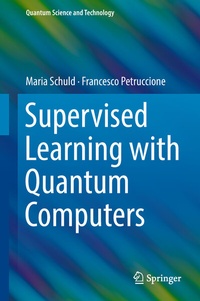
Supervised Learning with Quantum Computers
Description

Quantum machine learning investigates how quantum computers can be used for data-driven prediction and decision making. The books summarises and conceptualises ideas of this relatively young discipline for an audience of computer scientists and physicists from a graduate level upwards. It aims at providing a starting point for those new to the field, showcasing a toy example of a quantum machine learning algorithm and providing a detailed introduction of the two parent disciplines. For more advanced readers, the book discusses topics such as data encoding into quantum states, quantum algorithms and routines for inference and optimisation, as well as the construction and analysis of genuine ``quantum learning models''. A special focus lies on supervised learning, and applications for near-term quantum devices.
Reviews / Votes
"The book is very well written and contains sufficiently many examples and illustrations. The authors make a concerted effort to make the material accessible to both computer science graduates as well as scientists with a quantum physics background. . The intended audience are thus machine learning scientists that want to explore the quantum approach to their discipline or quantum information scientists that want to enter the field of machine learning." (Andreas Maletti, zbMATH 1411.81008, 2019)More details
Other editions
Additional editions
Persons
Maria Schuld received her PhD degree from the University of KwaZulu-Natal in South Africa in 2017 as a fellow of the German Academic Foundation. Her Master's degree was awarded by the Technical University of Berlin and supported through a scholarship of the German Academic Exchange Service (DAAD). Since 2013 she dedicates her research to the design of quantum machine learning algorithms, which she presented at numerous international conferences and in a range of research articles. Maria Schuld is a Post-Doc at the University of KwaZulu-Natal and works as a researcher for the Canadian-based quantum computing startup Xanadu.
