

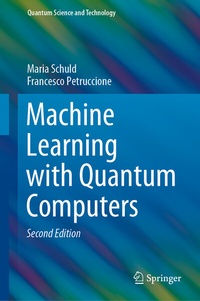
Machine Learning with Quantum Computers
Description

This book offers an introduction into quantum machine learning research, covering approaches that range from "near-term" to fault-tolerant quantum machine learning algorithms, and from theoretical to practical techniques that help us understand how quantum computers can learn from data. Among the topics discussed are parameterized quantum circuits, hybrid optimization, data encoding, quantum feature maps and kernel methods, quantum learning theory, as well as quantum neural networks. The book aims at an audience of computer scientists and physicists at the graduate level onwards.
The second edition extends the material beyond supervised learning and puts a special focus on the developments in near-term quantum machine learning seen over the past few years.
More details
Other editions
Additional editions
Persons
Maria Schuld works as a researcher for the Toronto-based quantum computing start-up Xanadu. She received her Ph.D. from the University of KwaZulu-Natal in 2017, where she began working on the intersection between quantum computing and machine learning in 2013. Besides her numerous contributions to the field, she is a co-developer for the open-source quantum machine learning software framework
PennyLane
.
Francesco Petruccione received his Ph.D. (1988) and "Habilitation" (1994) from the University of Freiburg, Germany. Since 2004, he has been a professor of Theoretical Physics at the University of KwaZulu-Natal in Durban, South Africa, where in 2007, he was granted a South African Research Chair for Quantum Information Processing and Communication. He is the co-author of "The Theory of Open Quantum Systems" (Oxford University Press, 2002) and has published more than 250 papers in refereed journals. Francesco Petruccione's research focuses on open quantum systems and quantum information processing and communication.
Content
Chapter 1. Introduction.- Chapter 2. Machine Learning.- Chapter 3. Quantum Computing.- Chapter 4. Representing Data on a Quantum Computer.- Chapter 5. Variational Circuits as Machine Learning Models.- Chapter 6. Quantum Models as Kernel Methods.- Chapter 7. Fault-Tolerant Quantum Machine Learning.- Chapter 8. Approaches Based on the Ising Model.- Chapter 9. Potential Quantum Advantages.
