

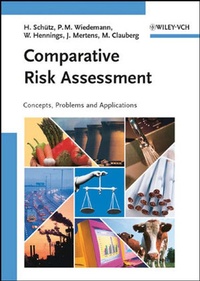
Comparative Risk Assessment
Concepts, Problems and Applications
1st Edition
Published on 21. August 2006
XII, 217 pages
978-3-527-60855-3 (ISBN)
Description

Providing a catalogue of suggested solutions for different categories of issues, this book offers a balanced overview and methodological examples for the practical implementation of the CRA. It considers CRA in the USA, Europe and Germany, using case studies to analyze and exemplify the decision-making processes and challenges involved. The authors then go on to look at the practical lessons learned from these case studies, together with an in-depth discussion of the underlying scientific hypotheses.
Sound scientific knowledge for everyone who makes decisions, whether government ministers, regulators, or company directors.
Sound scientific knowledge for everyone who makes decisions, whether government ministers, regulators, or company directors.
Reviews / Votes
"...offers a possible means of providing a scientific basis for decisions concerning environmental components and health related. There is still a need to further study and understand how best comparative risk assessment can fulfill its full potential, and the publication of this book is a most helpful addition."Environmental Engineering and Management Journal
More details
Other editions
Additional editions
Software
08/2006
Wiley-VCH
€181.74
No shipping information available
Holger Schütz | Peter M. Wiedemann | Wilfried Hennings
Comparative Risk Assessment
Concepts, Problems and Applications
Book
06/2006
1st Edition
Wiley-VCH
€135.00
Shipment within 5-7 days
Persons
Holger Schütz is a senior scientist in the MUT (Man, Environment and Technology) Program Group at the Jülich Research Center, focusing on risk perception and risk communication, comparative assessment of environmental health risks and evidence assessment.
Peter M. Wiedemann is the Director of the MUT Program Group and also teaches at the University of Innsbruck, Austria. He was elected President of the Society for Risk Analysis - Europe and served on the WHO task force on risk communication, the Scientific Expert Group of the National Action Program "Environment and Health", and on the EMF Communication Group of the WHO EMF Project. He has extensive experience in societal conflicts over modern technologies with a focus on risk communication and conflict resolution.
Wilfried Hennings is a member of the MUT Program Group, whose current research centers on methods for assessing technological risks. He received his diploma in electrical engineering from the RWTH Aachen University.
Johannes Mertens is a member of the MUT Program Group, who received his PhD in physics from the RWTH Aachen University. His recent research is on the assessment and management of technological risks.
Martin Clauberg is a lecturer at the University of Tennessee, Knoxville and also Sr. Risk/Science Consultant & Founder of Dr. Clauberg-Consulting, Germany & US. He has been a visiting scientist at the Jülich Research Center and at the National Institutes of Health, Washington, DC, as well as Human Health Risk Assessor & Risk Assessment Team Leader at Oak Ridge National Laboratory.
Peter M. Wiedemann is the Director of the MUT Program Group and also teaches at the University of Innsbruck, Austria. He was elected President of the Society for Risk Analysis - Europe and served on the WHO task force on risk communication, the Scientific Expert Group of the National Action Program "Environment and Health", and on the EMF Communication Group of the WHO EMF Project. He has extensive experience in societal conflicts over modern technologies with a focus on risk communication and conflict resolution.
Wilfried Hennings is a member of the MUT Program Group, whose current research centers on methods for assessing technological risks. He received his diploma in electrical engineering from the RWTH Aachen University.
Johannes Mertens is a member of the MUT Program Group, who received his PhD in physics from the RWTH Aachen University. His recent research is on the assessment and management of technological risks.
Martin Clauberg is a lecturer at the University of Tennessee, Knoxville and also Sr. Risk/Science Consultant & Founder of Dr. Clauberg-Consulting, Germany & US. He has been a visiting scientist at the Jülich Research Center and at the National Institutes of Health, Washington, DC, as well as Human Health Risk Assessor & Risk Assessment Team Leader at Oak Ridge National Laboratory.
Content
Introduction
CONCEPTS AND DEFINITIONS
Risk
Danger/ Potential for Damage - Hazard
Incertitude and Uncertainty
Risk Assessment
Risk Evaluation
Risk Comparison
Risk Management
Risk Regulation
Risk Communication
CRA IN PRACTICE
CRA's Political Environment
Projects Case Studies
THE EMPIRICAL FOUNDATIONS OF CRA
A Starting Point for Risk Comparisons
Risk Comparisons as a Means of Risk Communication
Procedural Challenges
CRA Negotiations under Conflict
CONCEPTUAL FRAMEWORK FOR AN INTEGRATED COMPARATIVE RISK EVALUATION
Methodological Problems of a CRA
Methodology of Comparative Risk Evaluation
THE PRACTICAL IMPLEMENTATION OF CRA
Limits of Comparability
Goals of a Comparative Evaluation of Risks
Participation Models
CRA Participants
The Sequence of Events in a CRA
The Organization of Communication
APPENDIX
Risk Metrics
Multiattribute Comparative Risk Evaluation (MCRA)
Comparative Evaluation of Unclear Risks
The Comparative Evaluation of the Risks of Hazardous Incidents
Bibliography
CONCEPTS AND DEFINITIONS
Risk
Danger/ Potential for Damage - Hazard
Incertitude and Uncertainty
Risk Assessment
Risk Evaluation
Risk Comparison
Risk Management
Risk Regulation
Risk Communication
CRA IN PRACTICE
CRA's Political Environment
Projects Case Studies
THE EMPIRICAL FOUNDATIONS OF CRA
A Starting Point for Risk Comparisons
Risk Comparisons as a Means of Risk Communication
Procedural Challenges
CRA Negotiations under Conflict
CONCEPTUAL FRAMEWORK FOR AN INTEGRATED COMPARATIVE RISK EVALUATION
Methodological Problems of a CRA
Methodology of Comparative Risk Evaluation
THE PRACTICAL IMPLEMENTATION OF CRA
Limits of Comparability
Goals of a Comparative Evaluation of Risks
Participation Models
CRA Participants
The Sequence of Events in a CRA
The Organization of Communication
APPENDIX
Risk Metrics
Multiattribute Comparative Risk Evaluation (MCRA)
Comparative Evaluation of Unclear Risks
The Comparative Evaluation of the Risks of Hazardous Incidents
Bibliography
