

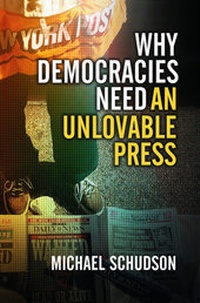
Why Democracies Need an Unlovable Press
Published on 22. April 2013
160 pages
978-0-7456-7531-2 (ISBN)
Description

Journalism does not create democracy and democracy does not inventjournalism, but what is the relationship between them? Thisquestion is at the heart of this book by world renowned sociologistand media scholar Michael Schudson.
Focusing on the U.S. media but seeing them in a comparativecontext, Schudson brings his understanding of news as at once astory-telling and fact-centered practice to bear on a variety ofcontroversies about what public knowledge today is and what itshould be. Should experts have a role in governing democracies? Isnews melodramatic or is it ironic - or is it both atdifferent times?
In the title essay, Schudson even suggests that journalismserves the interests of free expression and democracy best when itleast lives up to the demands of media critics for deep thought andanalysis; passion for the sensational event may be news at itsdemocratically most powerful.
Lively, provocative, unconventional, and deeply informed by arich understanding of journalism's history, this workcollects the best of Schudson's recent writings, includingseveral pieces published here for the first time.
Focusing on the U.S. media but seeing them in a comparativecontext, Schudson brings his understanding of news as at once astory-telling and fact-centered practice to bear on a variety ofcontroversies about what public knowledge today is and what itshould be. Should experts have a role in governing democracies? Isnews melodramatic or is it ironic - or is it both atdifferent times?
In the title essay, Schudson even suggests that journalismserves the interests of free expression and democracy best when itleast lives up to the demands of media critics for deep thought andanalysis; passion for the sensational event may be news at itsdemocratically most powerful.
Lively, provocative, unconventional, and deeply informed by arich understanding of journalism's history, this workcollects the best of Schudson's recent writings, includingseveral pieces published here for the first time.
More details
Other editions
Additional editions
Michael Schudson
Why Democracies Need an Unlovable Press
Book
09/2008
Polity Press
€70.50
Shipment within 15-20 days
Michael Schudson
Why Democracies Need an Unlovable Press
Book
09/2008
Polity Press
€25.50
Shipment within 15-20 days
Person
Michael Schudson is Distinguished Professor in the Department of Communication at the University of California, San Diego, and Professor of Communication at the Graduate School of Journalism, Columbia University.
Content
Acknowledgements vi
1 Introduction: facts and democracy 1
2 Six or seven things news can do for democracy 11
3 The US model of journalism: exception or exemplar? 27
4 The invention of the American newspaper as popular art,1890-1930 40
5 Why democracies need an unlovable press 50
6 The concept of politics in contemporary US journalism 63
7 What's unusual about covering politics as usual 77
8 The anarchy of events and the anxiety of story telling 88
9 Why conversation is not the soul of democracy 94
10 The trouble with experts - and why democracies needthem 108
Notes 126
Index 141
1 Introduction: facts and democracy 1
2 Six or seven things news can do for democracy 11
3 The US model of journalism: exception or exemplar? 27
4 The invention of the American newspaper as popular art,1890-1930 40
5 Why democracies need an unlovable press 50
6 The concept of politics in contemporary US journalism 63
7 What's unusual about covering politics as usual 77
8 The anarchy of events and the anxiety of story telling 88
9 Why conversation is not the soul of democracy 94
10 The trouble with experts - and why democracies needthem 108
Notes 126
Index 141
