

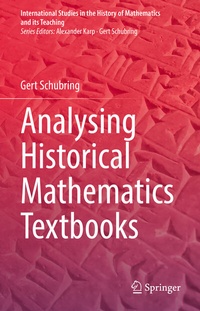
Analysing Historical Mathematics Textbooks
Description

This book is about the creation and production of textbooks for learning and teaching mathematics. It covers a period from Antiquity to Modern Times. The analysis begins by assessing principal cultures with a practice of mathematics. The tension between the role of the teacher and his oral mode, on the one hand, and the use of a written (printed) text, in their respective relation with the student, is one of the dimensions of the comparative analysis, conceived of as the 'textbook triangle'. The changes in this tension with the introduction of the printing press are discussed. The book presents various national case studies (France, Germany, Italy) as well as analyses of the internationalisation of textbooks via transmission processes.
As this topic has not been sufficiently explored in the literature, it will be very well received by scholars of mathematics education, mathematics teacher educators and anyone with an interest in the field.
Reviews / Votes
"This book has its own history. . This stunning book by Gert Schubring helps the reader gain deeper knowledge about the contextualized analysis of historical mathematics textbooks. It is a reference book for historians of mathematics education and for those historians of mathematics interested in the social history of mathematical ideas." (Mónica Blanco, Mathematical Reviews, November, 2025)
More details
Other editions
Additional editions
Person
Gert Schubring is a retired member of the Institut für Didaktik der Mathematik , a research institute at Bielefeld University, and was for various periods a visiting professor for history of mathematics at the Universidade Federal do Rio de Janeiro (Brazil). His research interests focus on the history of mathematics and the sciences in the eighteenth and nineteenth centuries and their systemic interrelation with social-cultural systems. One of his specialisations is history of mathematics education.
He has published a great number of papers in journals and many books, among which is Conflicts between Generalization, Rigor and Intuition: Number Concepts Underlying the Development of Analysis in 17th-19th century France and Germany (New York, 2005). He was Chief-Editor of the International Journal for the History of Mathematics Education from 2005 to 2015, and is co-editor of the series International Studies in the History of Mathematics and its Teaching, published by Springer.
He organised and co-organised various international workshops and conferences on history of mathematics education and history of mathematics.. He participated in numerous Juries for doctoral dissertations in Germany, France, the Netherlands, Great Britain, Spain, Australia and Brazil.
In 2019, he received the Hans Freudenthal Award by the International Commission on Mathematical Instruction (ICMI) , for having established the research programme on the history of mathematics education.
