

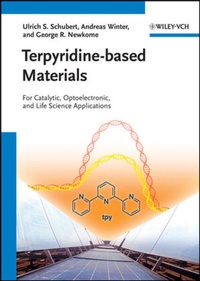
Terpyridine-based Materials
For Catalytic, Optoelectronic and Life Science Applications
1st Edition
Published on 25. September 2012
XX, 522 pages
978-3-527-63963-2 (ISBN)
Description

In recent years, the utilization of terpyridines both in macromolecular structure assembly and device chemistry has exploded, enabling, for
example, supramolecular polymer architectures with switchable chemical and physical properties as well as novel functional materials
for optoelectronic applications such as light-emitting diodes and solar cells. Further applications include the usage of terpyridines and their
metal complexes as catalysts for asymmetric organic reactions and, in a biological context, as anti-tumor agents or biolabels. This book covers terpyridine-based materials topics ranging from syntheses, chemistry, and multinuclear metal complexes, right up to functionalized polymers, 3D-architectures, and surfaces. Aimed at materials scientists, (in)organic chemists, polymer chemists, complex chemists, physical chemists, biochemists, and libraries.
example, supramolecular polymer architectures with switchable chemical and physical properties as well as novel functional materials
for optoelectronic applications such as light-emitting diodes and solar cells. Further applications include the usage of terpyridines and their
metal complexes as catalysts for asymmetric organic reactions and, in a biological context, as anti-tumor agents or biolabels. This book covers terpyridine-based materials topics ranging from syntheses, chemistry, and multinuclear metal complexes, right up to functionalized polymers, 3D-architectures, and surfaces. Aimed at materials scientists, (in)organic chemists, polymer chemists, complex chemists, physical chemists, biochemists, and libraries.
More details
Other editions
Additional editions
US Schubert
Terpyridine-based Materials - For Catalytic, Optoelectronic and Life Science Applications
Software
10/2011
Wiley-VCH
€239.57
No shipping information available

Ulrich S. Schubert | Andreas Winter | George R. Newkome
Terpyridine-based Materials
For Catalytic, Optoelectronic and Life Science Applications
Book
10/2011
1st Edition
Wiley-VCH
€189.00
Article exhausted; check different version
Persons
Ulrich S. Schubert performed his Ph.D. work under the supervision of Prof. C. D. Eisenbach (Bayreuth, Germany) and Prof. G. R. Newkome (Florida, USA). After a postdoctoral training with Prof. J.-M. Lehn at the Université Strasbourg (France), he moved to the Munich University of Technology (Germany) to obtain his habilitation in 1999. From 1999 to spring 2000, he held a temporary position as a professor at the Center for NanoScience at the LMU Munich. From June 2000 to March 2007, he was Full-Professor at the Eindhoven University of Technology (Chair for Macromolecular Chemistry and Nanoscience), the Netherlands. Since April 2007, he is Full-Professor at the Friedrich-Schiller-University Jena (Chair of Organic and Macromolecular Chemistry), Germany. He has published over 500 papers, 18 patents, and edited/written 5 scientific books.
Andreas Winter studied chemistry at the University of Dortmund (Germany), where he graduated in organic chemistry in 1999. In 2003, he received his Ph.D. in chemistry (University of Paderborn, Germany) for work on applications of the Mannich reaction in the synthesis of pyridine derivatives under supervision of Professor N. Risch, and stayed on as a postdoc. Subsequently, in 2005 he joined the group of Prof. U. S. Schubert (Eindhoven University of Technology, The Netherlands and Friedrich-Schiller University Jena, Germany). His research is focused on the synthesis of emissive and luminescent metallo-supramolecular assemblies.
George R. Newkome received his B.S. and Ph.D. in chemistry from Kent State University. He became a full professor in 1978 and Distinguished Research Master in 1982 at Louisiana State University. In 1986, he moved to the University of South Florida as Vice President for
Research and Professor of Chemistry, becoming a Distinguished Research Professor in 1992. In 2001, he became Vice President for Research and Dean of the Graduate School at The University of Akron. He is the Oelschlager Professor of Science and Technology and professor in the departments of Polymer Science and Chemistry. Currently, he is the President and CEO of the University of Akron`s Research Foundation and the Akron Innovation Campus. He has published over 430 papers, 45 patents, and edited/written over 15 scientific books and monographs.
Andreas Winter studied chemistry at the University of Dortmund (Germany), where he graduated in organic chemistry in 1999. In 2003, he received his Ph.D. in chemistry (University of Paderborn, Germany) for work on applications of the Mannich reaction in the synthesis of pyridine derivatives under supervision of Professor N. Risch, and stayed on as a postdoc. Subsequently, in 2005 he joined the group of Prof. U. S. Schubert (Eindhoven University of Technology, The Netherlands and Friedrich-Schiller University Jena, Germany). His research is focused on the synthesis of emissive and luminescent metallo-supramolecular assemblies.
George R. Newkome received his B.S. and Ph.D. in chemistry from Kent State University. He became a full professor in 1978 and Distinguished Research Master in 1982 at Louisiana State University. In 1986, he moved to the University of South Florida as Vice President for
Research and Professor of Chemistry, becoming a Distinguished Research Professor in 1992. In 2001, he became Vice President for Research and Dean of the Graduate School at The University of Akron. He is the Oelschlager Professor of Science and Technology and professor in the departments of Polymer Science and Chemistry. Currently, he is the President and CEO of the University of Akron`s Research Foundation and the Akron Innovation Campus. He has published over 430 papers, 45 patents, and edited/written over 15 scientific books and monographs.
Content
Preface
INTRODUCTION
SYNTHESES, PROPERTIES, AND APPLICATIONS OF FUNCTIONALIZED 2,2':6',2''-TERPYRIDINES
Introduction
Basic Synthetic Strategies
Synthesis and Properties of 2,2':6',2''-Terpyridine Derivatives
2,2':6',2''-Terpyridines Symmetrically Substituted on the Outer Pyridine Rings
Ziessel-Type 2,2':6',2''-Terpyridines
Kröhnke-Type 2,2':6',2''-Terpyridines
Miscellaneous Terpyridine-Analogous Compounds
CHEMISTRY AND PROPERTIES OF TERPYRIDINE TRANSITION METAL ION COMPLEXES
Introduction
Basic Synthetic Strategies and Characterization Tools
Ru11 and Os11 Complexes
Iridium(III) Complexes with Terpyridine Ligands
Platinum(III) Mono(terpyridine) Complexes
METALLO-SUPRAMOLECULAR ARCHITECTURES BASED ON TERPYRIDINE COMPLEXES
Introduction
Terpyridine-Containing Metallo-Macrocycles
The HETTAP Concept
Racks and Grids
Helicates
Rotaxanes and Catenanes
Miscellaneous Structures
PI-CONJUGATED POLYMERS INCORPORATING TERPYRIDINE METAL COMPLEXES
Introduction
Metallo-Supramolecular Polymerization
Metallopolymers Based on Pi-Conjugated Bis(terpyridine)s
Main-Chain Metallopolymers Based on Terpyridine-Functionalized Pi-Conjugated Polymers
FUNCTIONAL POLYMERS INCORPORATING TERPYRIDINE-METAL COMPLEXES
Introduction
Polymers with Terpyridine Units in the Side Chain
Polymers with Terpyridines within the Polymer Backbone
TERPYRIDINE METAL COMPLEXES AND THEIR BIOMEDICAL RELEVANCE
Introduction
Terpyridine Metal Complexes with Biological Activity
TERPYRIDINES AND NANOSTRUCTURES
Introduction
Terpyridines and Surface Chemistry
Terpyridines and Inorganic Nanomaterials
Terpyridines and Nano-Structured TiO2: Photovoltaic Applications
Organopolymeric Resins, Beads, and Nanoparticles
CATALYTIC APPLICATIONS OF TERPYRIDINES AND THEIR TRANSITION METAL COMPLEXES
Introduction
(Asymmetric) Catalysts in Organic Reactions
Electrocatalytic Oxidation and Reduction Processes
Photocatalytic Processes
CONCLUDING REMARKS
INTRODUCTION
SYNTHESES, PROPERTIES, AND APPLICATIONS OF FUNCTIONALIZED 2,2':6',2''-TERPYRIDINES
Introduction
Basic Synthetic Strategies
Synthesis and Properties of 2,2':6',2''-Terpyridine Derivatives
2,2':6',2''-Terpyridines Symmetrically Substituted on the Outer Pyridine Rings
Ziessel-Type 2,2':6',2''-Terpyridines
Kröhnke-Type 2,2':6',2''-Terpyridines
Miscellaneous Terpyridine-Analogous Compounds
CHEMISTRY AND PROPERTIES OF TERPYRIDINE TRANSITION METAL ION COMPLEXES
Introduction
Basic Synthetic Strategies and Characterization Tools
Ru11 and Os11 Complexes
Iridium(III) Complexes with Terpyridine Ligands
Platinum(III) Mono(terpyridine) Complexes
METALLO-SUPRAMOLECULAR ARCHITECTURES BASED ON TERPYRIDINE COMPLEXES
Introduction
Terpyridine-Containing Metallo-Macrocycles
The HETTAP Concept
Racks and Grids
Helicates
Rotaxanes and Catenanes
Miscellaneous Structures
PI-CONJUGATED POLYMERS INCORPORATING TERPYRIDINE METAL COMPLEXES
Introduction
Metallo-Supramolecular Polymerization
Metallopolymers Based on Pi-Conjugated Bis(terpyridine)s
Main-Chain Metallopolymers Based on Terpyridine-Functionalized Pi-Conjugated Polymers
FUNCTIONAL POLYMERS INCORPORATING TERPYRIDINE-METAL COMPLEXES
Introduction
Polymers with Terpyridine Units in the Side Chain
Polymers with Terpyridines within the Polymer Backbone
TERPYRIDINE METAL COMPLEXES AND THEIR BIOMEDICAL RELEVANCE
Introduction
Terpyridine Metal Complexes with Biological Activity
TERPYRIDINES AND NANOSTRUCTURES
Introduction
Terpyridines and Surface Chemistry
Terpyridines and Inorganic Nanomaterials
Terpyridines and Nano-Structured TiO2: Photovoltaic Applications
Organopolymeric Resins, Beads, and Nanoparticles
CATALYTIC APPLICATIONS OF TERPYRIDINES AND THEIR TRANSITION METAL COMPLEXES
Introduction
(Asymmetric) Catalysts in Organic Reactions
Electrocatalytic Oxidation and Reduction Processes
Photocatalytic Processes
CONCLUDING REMARKS
