

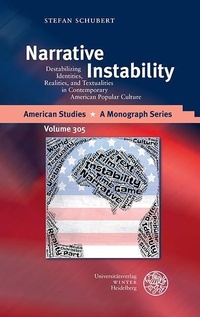
Narrative Instability
Destabilizing Identities, Realities, and Textualities in Contemporary American Popular Culture
Published on 15. November 2019
VII, 293 pages
978-3-8253-7923-0 (ISBN)
Description

This book introduces the concept of 'narrative instability' in order to make visible a new trend in contemporary US popular culture, to analyze this trend's poetics, and to scrutinize its textual politics. It identifies those texts as narratively unstable that consciously frustrate and obfuscate the process of narrative understanding and comprehension. Despite-or rather, exactly because of-their destabilizing tendencies, such texts have attained mainstream popularity in recent years across media, most prominently in films, video games, and TV series. Focusing on three clusters of instability that form around identities, realities, and textualities, the book argues that narratively unstable texts encourage their audiences to engage with the constructedness of their universes, that narrative instability embodies a new facet of popular culture, that it can only be understood transmedially, and that its textual politics particularly speak to white male middle-class Americans.
More details
Other editions
Additional editions
Stefan Schubert
Narrative Instability
Destabilizing Identities, Realities, and Textualities in Contemporary American Popular Culture
Book
11/2019
1st Edition
Universitätsverlag Winter
€45.00
Shipment within 5-7 days
Content
- Cover
- Titel
- Imprint
- Contents
- Acknowledgments
- 1 Introduction: Popularizing Instability
- 1.1 Methodology and Interdisciplinary Impulses
- 1.2 The Structure of This Book
- 2 Introducing Narrative Instability
- 2.1 Conceptualizing and Theorizing Narrative Instability
- 2.1.1 Previous Research
- 2.1.2 Narrative Instability as a Concept
- 2.1.3 Play and Transmediality:Instability Across Media
- 2.2 Contextualizing and Historicizing Narrative Instability: Why Instability Now?
- 2.2.1 Approaching the Contemporary Moment
- 2.2.2 Popularity and Popular Clulture
- 2.2.3 American Culture and Society in the Contemporary Moment
- 2.2.4 Clusters of Instability: Identities, Realities, and Textualities
- 3 Unstable Identities
- 3.1 Introduction
- 3.2 Narrating Unstable Identities
- 3.2.1 General Characteristics: 'Fight Club'
- 3.2.2 Identity, Twists, and Pleasure
- 3.3 'BioShock'
- 3.3.1 Twisting the Storyworld: Narrative Instability
- 3.3.2 Identity: Rapture, Objectivism, and Class
- 3.3.3 Self-Awareness, Reception, and Pleasure
- 3.4 'Black Swan'
- 3.4.1 Nina's Swan Dive: Narrative Instability
- 3.4.2 Constructions of Femininity
- 3.4.3 Intertextuality, Metatextuality, and Performances
- 3.5 Conclusion
- 4 Unstable Realities
- 4.1 Introduction
- 4.2 Narrating Unstable Realities
- 4.2.1 General Characteristics: 'Interstellar'
- 4.2.2 Reality, Space/Time, and Popularization
- 4.3 'Inception'
- 4.3.1 "It's Never Just a Dream": Narrative Instability
- 4.3.2 "The Dream Has Become Their Reality": Reality and Realities
- 4.3.3 Popularization and Metatextuality
- 4.4 'BioShock Infinite'
- 4.4.1 "A Wordl of Difference between What We See and What Is": Narrative Instability
- 4.4.2 Reality and Realities-History and Histories
- 4.4.3 Breaking the Circle: Unstable Realities, Popularization, and Metatextuality
- 4.5 Conclusion
- 5 Unstable Textualities
- 5.1 Introduction
- 5.2 Narrating Unstable Textualities
- 5.2.1 General Characteristics: 'The Stanley Parable'
- 5.2.2 (Meta)Textuality, Self-Reflexivity, and Genre
- 5.3 'Alan Wake'
- 5.3.1 A Multiplicity of Voices: Narrative Instability
- 5.3.2 Omnipresent Textualities
- 5.3.3 "There Can Be No Explanation": Genre and Media Reflexivity
- 5.4 'Westworld'
- 5.4.1 "This Whole World Is a Story": Narrative Instability
- 5.4.2 Textual Politics: Narratives of Race and Gender
- 5.4.3 "The Stories are Best Left To The Guests": Genre, Play, Andmetatextuality
- 5.5 Conclusion
- 6 Conclusion: Future Instabilities?
- Works Cited
- Backcover
