

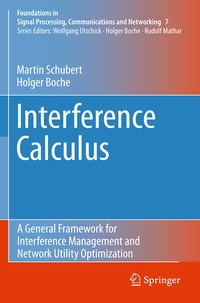
Interference Calculus
A General Framework for Interference Management and Network Utility Optimization
1st Edition
Published on 20. November 2011
XII, 240 pages
978-3-642-24621-0 (ISBN)
Description

This book develops a mathematical framework for modeling and optimizing interference-coupled multiuser systems. At the core of this framework is the concept of general interference functions, which provides a simple means of characterizing interdependencies between users. The entire analysis builds on the two core axioms scale-invariance and monotonicity.
The proposed network calculus has its roots in power control theory and wireless communications. It adds theoretical tools for analyzing the typical behavior of interference-coupled networks. In this way it complements existing game-theoretic approaches.
The framework should also be viewed in conjunction with optimization theory. There is a fruitful interplay between the theory of interference functions and convex optimization theory. By jointly exploiting the properties of interference functions, it is possible to design algorithms that outperform general-purpose techniques that only exploit convexity.
The title "network calculus" refers to the fact that the theory of interference functions constitutes a generic theoretical framework for the analysis of interference coupled systems. Certain operations within the framework are "closed", that is, combinations of interference functions are interference functions again. Also, certain properties are preserved under such operations. This, provides a methodology for analyzing different multiuser performance measures that can be expressed as interference functions or combinations of interference functions.
The proposed network calculus has its roots in power control theory and wireless communications. It adds theoretical tools for analyzing the typical behavior of interference-coupled networks. In this way it complements existing game-theoretic approaches.
The framework should also be viewed in conjunction with optimization theory. There is a fruitful interplay between the theory of interference functions and convex optimization theory. By jointly exploiting the properties of interference functions, it is possible to design algorithms that outperform general-purpose techniques that only exploit convexity.
The title "network calculus" refers to the fact that the theory of interference functions constitutes a generic theoretical framework for the analysis of interference coupled systems. Certain operations within the framework are "closed", that is, combinations of interference functions are interference functions again. Also, certain properties are preserved under such operations. This, provides a methodology for analyzing different multiuser performance measures that can be expressed as interference functions or combinations of interference functions.
Reviews / Votes
From the reviews:
"The book provides an overview of recent advances in the field with particular emphasis on analysing the elementary structure properties of interference functions . . Generally, the targeted audience includes graduate students of engineering and applied mathematics, as well as academic and industrial researchers in the field of wireless communications, networking, control and game theory. No particular background is needed for reading the book, except for some familiarity with basic concepts from convex analysis and linear algebra." (Vangelis Grigoroudis, Zentralblatt MATH, Vol. 1251, 2012)
More details
Other editions
Additional editions
Martin Schubert | Holger Boche
Interference Calculus
A General Framework for Interference Management and Network Utility Optimization
Book
04/2014
Springer
€106.99
Shipment within 7-9 days
Martin Schubert | Holger Boche
Interference Calculus
A General Framework for Interference Management and Network Utility Optimization
Book
03/2012
1st Edition
Springer
€106.99
Shipment within 7-9 days
Content
Systems of Coupled Interference Functions.- The Structure of Interference Functions and Comprehensive Sets.- Nash Bargaining and Proportional Fairness.- The Power Minimization Problem.- Max-Min Fairness.
