

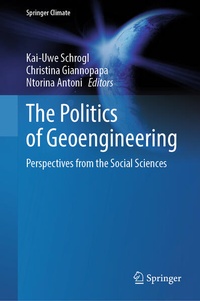
The Politics of Geoengineering
Description

This book offers the first comprehensive social science perspective on geoengineering-technologies that deliberately intervene in Earth's systems to counter climate change. It examines the political, legal, economic, and societal dimensions of Carbon Dioxide Removal (CDR) and Solar Radiation Modification (SRM), combining SWOT analyses with regional perspectives from Africa and the Asia-Pacific.
Contributors illuminate the urgent governance, ethical, and geopolitical challenges that arise when states and societies confront the "risk versus risk" dilemma: unchecked climate change versus potentially disruptive interventions.
Offering clear insights into emerging regulatory debates and global power dynamics, the volume provides scholars, policymakers, and practitioners with tools to engage in informed and responsible decision-making.
A timely guide to one of the 21st century's most controversial climate strategies, it helps readers navigate the politics of turning Earth's thermostat down.
More details
Other editions
Additional editions
Persons
Kai-Uwe Schrogl is Special Advisor at the European Space Agency (ESA) and Honorary Professor at the University of Tübingen, with expertise in international technology policy, space law, and the governance of geoengineering. He previously served as ESA's Chief Strategy Officer and as Director of the European Space Policy Institute. Author of over 150 publications, he currently serves as President of the International Institute of Space Law.
Christina Giannopapa is Head of the Executive Director's Office at the EU Agency for the Space Programme (EUSPA). She previously held senior advisory roles at ESA and the Greek Ministry of Digital Governance. Her work focuses on space security, innovation, and the governance of emerging technologies. She has published more than 80 works and co-edited the Handbook on Space Security .
Ntorina Antoni is Postdoctoral researcher at Eindhoven University of Technology, specializing in innovation ecosystems and strategic management. She coordinates EU-funded innovation projects and previously worked as a legal and policy analyst at ESA. She holds advanced law degrees in international, European, and aerospace law.
Content
Part I. Introducing GE.- Chapter 1. Introduction: Turning Earth's thermostat down - but how? The politics of Geoengineering. Perspectives from the Social Sciences (Kai-Uwe Schrogl, Christina Giannopapa, Ntorina Antoni).- Chapter 2. A SWOT Analysis for Carbon Dioxide Removal (CDR) (Valeria Pinna, Leonora Burnik, Laure-Marine Vioujard, and Editors).- Chapter 3. A SWOT Analysis for Solar Radiation Management (SRM) (Valeria Pinna, Leonora Burnik, Laure-Marine Vioujard, and Editors).- Part II. International political and legal aspects.-Chapter 4. Governing Carbon Dioxide Removal and Solar Radiation Modification (Joshua Horton).- Chapter 5. Asia-Pacific perspectives on Solar Geoengineering (Masahiro Sugiyama).- Chapter 6. African Union and Geoengineering: The potential role of human rights (Ademola Oluborode Jegede).- Chapter 7. Reflections on Geoengineering and Biodiversity (Perses Bilimoria).- Chapter 8. Geoengineering and International Law (Alla Pozdnakova).- Chapter 9. Geoengineering and the Global Commons - What role for Ecocide Law? (Anna Maddrick).- Chapter 10. Geoengineering and outer space - policy and legal considerations (Anthi Koskina and Manolis Plionis).- Part III. Societal and public aspects.-Chapter 11. Geoengineering and public value: Towards a global climate sensibility (Rick Wylie).- Chapter 12. Public engagement with Geoengineering: emerging technologies, experimentation and the climate crisis (António Carvalho).- Chapter 13. Geoengineering extended: Terraforming on Celestial Bodies (Chris Pak).
