

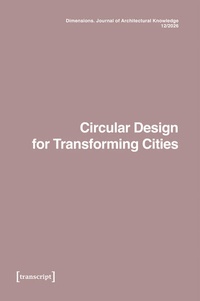
Dimensions. Journal of Architectural Knowledge
Vol. 6, No. 12/2026: Circular Design for Transforming Cities
1st Edition
Will be published approx. on 27. November 2026
200 pages
E-Book
978-3-8394-2403-2 (ISBN)
Description

»Dimensions. Journal of Architectural Knowledge« is an academic journal in, on, and from the discipline of architecture, addressing the creation, constitution, and transmission of architectural knowledge. It explores methods genuine to the discipline and architectural modes of interdisciplinary methodological adaptions. Processes, procedures, and results of knowledge creation and practice are esteemed coequally, with particular attention to the architectural design and epistemologies of aesthetic practice and research.
Issue 12/2026 discusses how knowledge on circularity and the city can be enhanced for a change of academic and professional paradigms. It claims a new role of creativity, culture and arts to extend architectural-urbanistic knowledge towards climate-neutrality and sustainability. How can an urban perspective trigger understanding and upscaling of context-based practices and experiments? How can design-driven approaches contribute to circular innovation? How can performativity-oriented practices foster activation and engagement? The issue extends circularity and circular economy principles towards transformative urban thinking, organising material change as dynamic flows and driving processes of change.
More details
Other editions
Additional editions
Jörg Schröder | Alissa Diesch | Riccarda Cappeller
Dimensions. Journal of Architectural Knowledge
Vol. 6, No. 12/2026: Circular Design for Transforming Cities
Book
approx. 11/2026
1st Edition
transcript
€39.00
Not yet published
Persons
Editor
Jörg Schröder, Gottfried Wilhelm Leibniz Universität Hannover, Deutschland
Jörg Schröder is an architect and urban planner, full professor for Territorial Design and Urban Planning at Leibniz Universität Hannover (LUH), and Dean for Research of the Faculty of Architecture and Landscape. His focus is on urbanism for sustainable transition, circularity, design research, and territorial innovation. He is coordinator of the Circular Design Innovation Alliance (CiD), funded by the European Union. Further projects include reCITYing and CFC in the EU Creative Europe Programme.
Alissa Diersch, Universidad del Norte, Kolumbien
Alissa Diesch is an architect-urbanist and works as a professor and DAAD long-term lecturer for sustainable development at the School of Architecture, Urbanism and Design at Universidad del Norte in Barranquilla, Colombia. She did her doctorate about the rural heritage of Bogotá at Technische Universität München and worked from 2018 to 2024 at the Chair for Territorial Design at Leibniz Universität Hannover. Her research interests are urban transformation and cultural heritage with a perspective towards circular futures in Latin American and European cities and territories.
Riccarda Cappeller, Gottfried Wilhelm Leibniz Universität Hannover, Deutschland
Riccarda Cappeller works across architecture, urban transformation, visual sociology and art. Her practice merges design research and artistic processes, exploring the co-creation of urban knowledge. She teaches and researches at the chair for territorial design at Leibniz Universität Hannover (LUH) and develops workshops for various institutes. Her awarded doctoral dissertation frames architecture as a performative practice and proposes new methods to grasp urban contexts and create spatial experiences.
Anna Pape, Gottfried Wilhelm Leibniz Universität Hannover, Deutschland
Anna Pape works at the intersection of architecture, urbanism, graphics and art at Leibniz Universität Hannover. She studied Architecture and Urban Design in Hannover and Brussels. In the EU Circular Design Innovation Alliance (CiD) she researches on urban transformation and develops new educational formats. She is also part of raumlaborberlin. Engaging Architecture as an interdisciplinary approach to ecological, economic and social issues, she has been working on different dynamics of urban development that enable common practices on land use for community-driven and common resources.
Martynas Germanavicius, Architekturos fondas, Litauen
Martynas Germanavicius, born in 1996, is a researcher, curator, and producer working in the fields of architecture and the arts. He has been working at Architekturos fondas since 2020, where he initiated and leads international projects such as the Open House Europe cooperation project, and represents various organisations. He is keen in exploring the relationships and influences of energy, materiality and the collective imagination in the processes of spatial production.
