

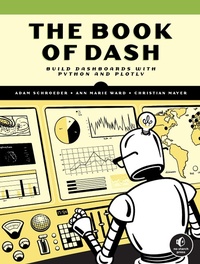
The Book of Dash
Build Dashboards with Python and Plotly
Published on 25. October 2022
224 pages
978-1-7185-0223-9 (ISBN)
Description

Create stunning interactive dashboard applications in Python with the Dash visualization and data analysis tool. Build interfaces that make sense of your data, and make it pretty.
A swift and practical introduction to building interactive data visualization apps in Python, known as dashboards. You've seen dashboards before; think election result visualizations you can update in real time, or population maps you can filter by demographic. With the Python Dash library you'll create analytic dashboards that present data in effective, usable, elegant ways in just a few lines of code.
The book is fast-paced and caters to those entirely new to dashboards. It will talk you through the necessary software, then get straight into building the dashboards themselves. You'll learn the basic format of a Dash app by building a twitter analysis dashboard that maps the number of likes certain accounts gained over time. You'll build up skills through three more sophisticated projects. The first is a global analysis app that compares country data in three areas: the percentage of a population using the internet, percentage of parliament seats held by women, and CO2 emissions. You'll then build an investment portfolio dashboard, and an app that allows you to visualize and explore machine learning algorithms.
In this book you will:
• Create and run your first Dash apps
• Use the pandas library to manipulate and analyze social media data
• Use Git to download and build on existing apps written by the pros
• Visualize machine learning models in your apps
• Create and manipulate statistical and scientific charts and maps using Plotly
Dash combines several technologies to get you building dashboards quickly and efficiently. This book will do the same.
A swift and practical introduction to building interactive data visualization apps in Python, known as dashboards. You've seen dashboards before; think election result visualizations you can update in real time, or population maps you can filter by demographic. With the Python Dash library you'll create analytic dashboards that present data in effective, usable, elegant ways in just a few lines of code.
The book is fast-paced and caters to those entirely new to dashboards. It will talk you through the necessary software, then get straight into building the dashboards themselves. You'll learn the basic format of a Dash app by building a twitter analysis dashboard that maps the number of likes certain accounts gained over time. You'll build up skills through three more sophisticated projects. The first is a global analysis app that compares country data in three areas: the percentage of a population using the internet, percentage of parliament seats held by women, and CO2 emissions. You'll then build an investment portfolio dashboard, and an app that allows you to visualize and explore machine learning algorithms.
In this book you will:
• Create and run your first Dash apps
• Use the pandas library to manipulate and analyze social media data
• Use Git to download and build on existing apps written by the pros
• Visualize machine learning models in your apps
• Create and manipulate statistical and scientific charts and maps using Plotly
Dash combines several technologies to get you building dashboards quickly and efficiently. This book will do the same.
More details
Other editions
Additional editions
Christian Mayer | Adam Schroeder | Ann Marie Ward
The Book of Dash
Build Dashboards with Python and Plotly
Book
10/2022
No Starch Press
€33.00
Available immediately
Persons
Adam Schroeder has been teaching Plotly Dash for over two years on YouTube as @CharmingData. His videos have over 60 thousand views per month. Adam is passionate about helping people learn data visualization. He has an M.A. in Government and Conflict Resolution and currently works at Plotly.
Christian Mayer has a PhD in computer science and is the founder of the popular Python site Finxter.com, an educational platform that helps more than 3 million people a year learn to code. He has published a number of books, including the Coffee Break Python series, and is the author of Python One-Liners (No Starch Press, 2020).
Ann Marie Ward is a Dash contributor and a moderator on the Dash community forum. Ann Marie has a BA in Economics and is a retired CEO. She discovered Dash when searching for a better way to analyze financial data and was so amazed by what's possible to create with Dash that she started to learn Python, JavaScript and R. Her contributions to Dash include improving documentation, fixing bugs, and adding features.
Christian Mayer has a PhD in computer science and is the founder of the popular Python site Finxter.com, an educational platform that helps more than 3 million people a year learn to code. He has published a number of books, including the Coffee Break Python series, and is the author of Python One-Liners (No Starch Press, 2020).
Ann Marie Ward is a Dash contributor and a moderator on the Dash community forum. Ann Marie has a BA in Economics and is a retired CEO. She discovered Dash when searching for a better way to analyze financial data and was so amazed by what's possible to create with Dash that she started to learn Python, JavaScript and R. Her contributions to Dash include improving documentation, fixing bugs, and adding features.
