

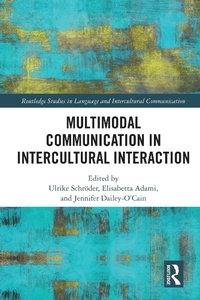
Multimodal Communication in Intercultural Interaction
1st Edition
Published on 24. February 2023
262 pages
978-1-000-84684-3 (ISBN)
Description

This collection brings together a range of perspectives on multimodal communication in intercultural interaction, bridging cognitive, social, and functional approaches towards promoting cross-disciplinary dialogues and taking research at the intersections of these fields into new directions.
The volume assembles conversationalist, socially oriented, cognitive, and sensory approaches in considering culture as a dynamic construct, co-constituted and (re)negotiated among participants in interaction and filtering it through a multimodal lens, drawing on a range of examples, such as educational settings or online video platforms. Each chapter offers a unique perspective on "culture" and "intercultural," while also situating their own definitions of these labels against those of the other chapters. Taken together, the chapters form a fluid conversation on the nature of intercultural encounters in today's globalizsd world, as digital environments intertwine with the physical mobility of people, encouraging researchers across these fields to adopt a more holistic multimodal perspective to approach intercultural interaction.
This book will be of interest to students and scholars in intercultural communication, multimodality, sociolinguistics, cognitive and interactional linguistics, and semiotics.
The volume assembles conversationalist, socially oriented, cognitive, and sensory approaches in considering culture as a dynamic construct, co-constituted and (re)negotiated among participants in interaction and filtering it through a multimodal lens, drawing on a range of examples, such as educational settings or online video platforms. Each chapter offers a unique perspective on "culture" and "intercultural," while also situating their own definitions of these labels against those of the other chapters. Taken together, the chapters form a fluid conversation on the nature of intercultural encounters in today's globalizsd world, as digital environments intertwine with the physical mobility of people, encouraging researchers across these fields to adopt a more holistic multimodal perspective to approach intercultural interaction.
This book will be of interest to students and scholars in intercultural communication, multimodality, sociolinguistics, cognitive and interactional linguistics, and semiotics.
More details
Series
Edition
1. Auflage
Language
English
Place of publication
London
United Kingdom
Publishing group
Taylor & Francis Ltd
Target group
College/higher education
Professional and scholarly
Illustrations
7 Tables, black and white; 55 Halftones, black and white; 55 Illustrations, black and white
ISBN-13
978-1-000-84684-3 (9781000846843)
Copyright in bibliographic data and cover images is held by Nielsen Book Services Limited or by the publishers or by their respective licensors: all rights reserved.
Schweitzer Classification
Other editions
Additional editions
Ulrike Schroder | Elisabetta Adami | Jennifer Dailey-O'Cain
Multimodal Communication in Intercultural Interaction
Book
10/2024
1st Edition
Routledge
€63.40
Shipment within 10-20 days
Ulrike Schroder | Elisabetta Adami | Jennifer Dailey-O'Cain
Multimodal Communication in Intercultural Interaction
Book
02/2023
1st Edition
Routledge
€185.60
Shipment within 10-20 days
Persons
Ulrike Schroeder has been Full Professor of Linguistics and German Studies at the Federal University of Minas Gerais since 2006. She obtained her Venia Legendi and PhD in communication studies at the University of Duisburg-Essen, Germany. Her research areas comprise cognitive linguistics, gesture studies, intercultural pragmatics, and interactional linguistics. She edited and published several books and over hundred articles and book chapters.
Elisabetta Adami, PhD, is Associate Professor in Multimodal Communication at the University of Leeds, UK. Her research specialises in social semiotic multimodal analysis with a focus on issues of culture and translation. She has published on sign-making practices in place, in digital environments, and in face-to-face interaction. She is editor of Multimodality & Society, leads Multimodality@Leeds, and co-organises the Multimodality Talks seminar series.
Jennifer Dailey-O'Cain is a sociolinguist and Professor of German and Applied Linguistics at the University of Alberta, Canada. Among her recent publications are Trans-National English in Social Media Communities (Palgrave, 2017), Multilingualism, (Im)mobilities, and Spaces of Belonging (Multilingual Matters, 2019), and many papers on various aspects of language in use.
Elisabetta Adami, PhD, is Associate Professor in Multimodal Communication at the University of Leeds, UK. Her research specialises in social semiotic multimodal analysis with a focus on issues of culture and translation. She has published on sign-making practices in place, in digital environments, and in face-to-face interaction. She is editor of Multimodality & Society, leads Multimodality@Leeds, and co-organises the Multimodality Talks seminar series.
Jennifer Dailey-O'Cain is a sociolinguist and Professor of German and Applied Linguistics at the University of Alberta, Canada. Among her recent publications are Trans-National English in Social Media Communities (Palgrave, 2017), Multilingualism, (Im)mobilities, and Spaces of Belonging (Multilingual Matters, 2019), and many papers on various aspects of language in use.
Content
Table of Contents
Contributor Information
List of Figures and Tables
Chapter 1. Introduction: Multimodal Communication in Intercultural Interaction 3
Ulrike Schroeder, Elisabetta Adami, and Jennifer Dailey-O'Cain
PART 1: CONCEPTUALISING MULTIMODALITY IN INTERCULTURAL INTERACTION *
Chapter 2. Multimodality and the issue of culture: A social semiotic perspective onto the interculturality of communication *
Elisabetta Adami
Chapter 3. Rhythmic bodies: Sensorial multimodality, entrainment, and intercultural communication *
Sachi Sekimoto
PART 2: ANALYSING MULTIMODALITY IN INTERCULTURAL INTERACTION *
Chapter 4. Methodological aspects of the analysis of co-speech gestures in intercultural interactions *
Anna Ladilova
Chapter 5. Identity construction through multimodal positioning in intercultural interaction *
Jennifer Dailey-O'Cain and Kerry Sluchinski
PART 3: DOING MULTIMODALITY IN INTERCULTURAL INTERACTION *
Chapter 6. Modal particles in multimodal language use: Towards a cognitive, comparative and intercultural approach to GFL teaching *
Ulrike Schroeder
Chapter 7. The multimodal positioning of (future) multilingual teachers of EFL *
Milene Mendes de Oliveira and Adriana Fernandes Barbosa
Chapter 8. Taboos and euphemisms in foreign language conversations: a multimodal analysis of talk-in-interaction *
Fernanda Roque Amendoeira and Thiago da Cunha Nascimento
Chapter 9. Semiosis and ethicality in youth transnational digital storytelling *
Emilee Moore, Margaret R. Hawkins, Julia Llompart, and Claudia Vallejo
Chapter 10. Intercultural communication in YouTubers' gameplay video: A social semiotic perspective *
Weimin Toh, Fei Victor Lim, and Elisabetta Adami
Chapter 11. Concluding remarks 190
Ulrike Schroeder, Elisabetta Adami, and Jennifer Dailey-O'Cain
Index
Contributor Information
List of Figures and Tables
Chapter 1. Introduction: Multimodal Communication in Intercultural Interaction 3
Ulrike Schroeder, Elisabetta Adami, and Jennifer Dailey-O'Cain
PART 1: CONCEPTUALISING MULTIMODALITY IN INTERCULTURAL INTERACTION *
Chapter 2. Multimodality and the issue of culture: A social semiotic perspective onto the interculturality of communication *
Elisabetta Adami
Chapter 3. Rhythmic bodies: Sensorial multimodality, entrainment, and intercultural communication *
Sachi Sekimoto
PART 2: ANALYSING MULTIMODALITY IN INTERCULTURAL INTERACTION *
Chapter 4. Methodological aspects of the analysis of co-speech gestures in intercultural interactions *
Anna Ladilova
Chapter 5. Identity construction through multimodal positioning in intercultural interaction *
Jennifer Dailey-O'Cain and Kerry Sluchinski
PART 3: DOING MULTIMODALITY IN INTERCULTURAL INTERACTION *
Chapter 6. Modal particles in multimodal language use: Towards a cognitive, comparative and intercultural approach to GFL teaching *
Ulrike Schroeder
Chapter 7. The multimodal positioning of (future) multilingual teachers of EFL *
Milene Mendes de Oliveira and Adriana Fernandes Barbosa
Chapter 8. Taboos and euphemisms in foreign language conversations: a multimodal analysis of talk-in-interaction *
Fernanda Roque Amendoeira and Thiago da Cunha Nascimento
Chapter 9. Semiosis and ethicality in youth transnational digital storytelling *
Emilee Moore, Margaret R. Hawkins, Julia Llompart, and Claudia Vallejo
Chapter 10. Intercultural communication in YouTubers' gameplay video: A social semiotic perspective *
Weimin Toh, Fei Victor Lim, and Elisabetta Adami
Chapter 11. Concluding remarks 190
Ulrike Schroeder, Elisabetta Adami, and Jennifer Dailey-O'Cain
Index
