

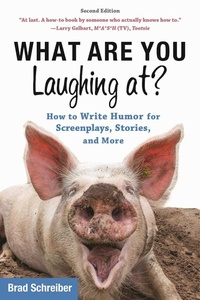
What Are You Laughing At?
How to Write Humor for Screenplays, Stories, and More
Published on 24. October 2017
280 pages
978-1-62153-601-7 (ISBN)
Description

**Winner of the 2022 William Randolph Hearst Award for Outstanding Service in Professional Journalism**
"People have forgotten how to be funny," says Chris Vogler in his foreword to What Are You Laughing at? Luckily, experienced and award-winning humor writer Brad Schreiber is here to remind us all how it's done. If laughter is the best medicine, be prepared to feel fit as a fiddle after perusing these pages. Brad's clever wit and well-timed punch lines are sure to leave you grasping your sides, while his wise advice will ensure that you're able to follow in his comedic footsteps.
With more than seventy excerpts from such expert prose and screenwriters as Woody Allen, Steve Martin, and Kurt Vonnegut Jr., as well as unique writing exercises for all situations, this comprehensive tutorial will teach you how to write humor prose for any literary form, including screenwriting, story writing, theater, television, and audio/radio. Additionally, readers are given sage advice on different tactics for writing comedic fiction versus comedic nonfiction. Some of the topics discussed include:
- Life experience versus imagination
- How to use humor to develop theme/setting, character, and dialogue
- Rhythm and sound of words
- Vulgarity and bad taste
- How to market your humor prose in the digital market
- Thoroughly revised and updated, and with new information on writing short, humorous films, What Are You Laughing at? is your endless source to learning the art of comedy.
More details
Other editions
Additional editions
Book
11/2017
Allworth Press,U.S.
€16.50
Shipment within 3-4 weeks
Person
Brad Schreiber has worked as a writer in all forms of media. He has sold and optioned screenplays, was nominated for the Kingman Films KASA Award for his script The Couch, and has won awards from the Edward Albee Foundation, the California Writers Club, STAGES Theater Festival, and the National Audio Theater Festival. He teaches humor writing for the UCLA Extension Writers' Program and screenwriting for Columbia College of Chicago at CBS Studio Center. He is also the author of Weird Wonders and Blunders.
Content
- Intro
- Title Page
- Copyright
- Contents
- Acknowledgments
- Introduction by Chris Vogler
- Chapter 1: Comedic Structure
- The Nature of Humor
- Healing Aspects of Humor
- If It's Painful, Why Am I Laughing?
- Confusion Creates Humor
- Comedy's Enemies (Humor's Tumors): Cliché and Meekness
- Some Principles of Comedic Structure
- Chapter 2: Screenwriting
- Comedic Character vs. Comedic Universe
- The Process of Screenwriting
- High Concept, Low Concept, No Concept
- Things Bad Screenwriters Commonly Do
- Chapter 3: Fiction vs. Nonfiction
- Life Experience vs. Imagination
- To Lie or Not to Lie
- Standup Nonfiction
- Creating a Fictional World
- Chapter 4: Forms of Fiction
- Jokes
- Aphorisms
- Insults
- Short Story
- Novel
- Chapter 5: Forms of Nonfiction
- Anecdote
- Article
- Essay
- Speech
- Column/Journalism
- Criticism
- Memoir/Autobiography
- Chapter 6: Theme/Setting
- Generating Ideas
- The Author's Voice
- What's Wrong with This Picture?
- How to Write About What You Don't Know
- Chapter 7: Story
- Aristotle in a Bottle
- Chris Vogler: The Bozo's Journey
- Variety of Action
- Exploring Possibilities
- Chapter 8: Character
- Observing Characters
- Character Point of View
- A Character PSI Chart
- Protagonist vs. Antagonist
- Chapter 9: Dialogue
- Hit and Mis-
- 11 Modes of Comedic Dialogue
- The Importance of Subtext
- Exposition
- Chapter 10: Rhythm and Sound of Words
- Yiddish Sound Theory
- Inexplicable Humor
- Alliteration as Ally
- Character, Location and Other Names
- Fonetic Spellings/Phoreign Words
- Chapter 11: Other Styles of Humor Writing
- Satire
- Parody
- Black Comedy
- Vulgarity and Bad Taste
- Chapter 12: Other Prose Humor Forms
- Poetry
- Songs
- The List
- The Monologue
- Letters
- Other Forms
- Chapter 13: Other Media
- Thoughts on TV Writing
- Thoughts on Playwriting
- Thoughts on Audio/Radio Writing
- Chapter 14: Brief Thoughts on Short Films
- Size Isn't Everything, Except Maybe in Sumo Wrestling
- Nobody Wants the Same Thing All the Time
- It's Like Other Successful Writing, but Different
- Chapter 15: Digital Marketing
- Tools of the Trade
- The Query Letter
- Sales
- Promotion
- Syndication
- On Reflection: Being a Writer
- Bibliography
- Filmography
- Permissions
- About the Author
