

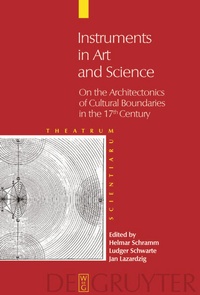
Instruments in Art and Science
Description

This volume presents a collection of original papers at the intersection of philosophy, the history of science, cultural and theatrical studies. Based on a series of case studies on the 17th century, it contributes to an understanding of the role played by instruments at the interface of science and art. The papers pursue the hypothesis that the development and construction of instruments make a substantive contribution to the opening of new fields of knowledge, the development of new cultural practices, but also to the delineation of particular genres, methods, and disciplines. This perspective leads the authors to reflect anew on what actually defines an instrument and to develop a series of basic questions to determine what an instrument is - which actions does the instrument incorporate? - which actions does the instrument make possible? - when do the objects of examination themselves become instruments? - what skills are required to use an instrument, which skills does it produce?
With its combination of new theoretical models and historical case studies, its detailed demonstration of the mutual influence of art and science with the instrument as the point of intersection, this volume enters new territory. It is of great value for all those interested in the history of our perception of instruments.
Besides the editors, the authors of the papers are: Jörg Jochen Berns, Olaf Breidbach, Georges Didi-Huberman, Peter Galison, Sybille Krämer, Dieter Mersch, Hans-Jörg Rheinberger, Wilhelm Schmidt-Biggemann, and Otto Sibum.
More details
Other editions
Additional editions
Persons
Content
- Intro
- Editors' Preface
- Contents
- Introduction: The Hand as "instrumentum instrumentorum"
- Intersections: Some Thoughts on Instruments and Objects in the Experimental Context of the Life Sciences
- Representation and Distortion: On the Construction of Rationality and Irrationality in Early Modern Modes of Representation
- World Orders and Corporal Worlds: Robert Fludd's Tableau of Knowing and its Representation
- Telescope, Theater, and the Instrumental Revelation of New Worlds
- The Pathos of Function: Leonardo's Technical Drawings
- "Il pennello artificioso": On the Intelligence of the Brushstroke
- The Enlightenment "Catholization" of Projective Technology: Theurgy and the Media Origins of Art
- The Machine as Spectacle: Function and Admiration in Seventeenth-Century Perspectives on Machines
- The Anatomy of the Brain as Instrumentalization of Reason
- The "Chymistry Laboratory": On the Function of the Experiment in Seventeenth-Century Scientific Discourse
- The Order of Knowledge, of Instruments, and of Leiden University, ca. 1700
- The Ideal Musaeum Kircherianum and the Ignatian Exercitia spiritualia
- Organology: The Study of Musical Instruments in the 17⊃&th&/sup& Century
- In Sound Similar to the Harps: Early Descriptions of African Musical Instruments
- Machines, Bats, and Scholars: Experimental Knowledge in the Late Eighteenth and Nineteenth Centuries
- Scientific Coordination as Ethos and Epistemology
- Breaking, Grinding, Burning: Instrumental Aspects in Early Microscopical Pictures
- The Instrument in the Image: Revealing and Concealing the Condition of the Probing Tip in Scanning Tunneling Microscopic Image Design
- Formal Signs and Numerical Computation: Between Intuitionism and Formalism. Critique of Computational Reason
- Art Precedes Science: or Did the Camera Obscura Invent Modern Science?
- Instrumentalities of Place in Science and Art
- The Eye Opens, the Lamp Goes Out: Remarks on Bergson and Cinematography
- The Illusion of Power: Central Bank Money
- The Productivity of Blanks: On the Mathematical Zero and the Vanishing Point in Central Perspective. Remarks on the Convergences between Science and Art in the Early Modern Period
- Instrumental Sound and Ruling Spaces of Resonance in the Early Modern Period: On the Acoustic Setting of the Princely potestas Claims within a Ceremonial Frame
- About the Authors
- Image Credits
- Bibliography
- Index of Names
- Index of Subjects
