

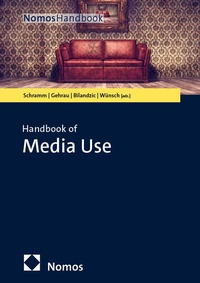
Handbook of Media Use
1st Edition
Published on 6. March 2026
740 pages
978-3-7489-6251-9 (ISBN)
Description

This handbook offers a comprehensive overview of the subjects and theories of media use research. In 37 contributions, the questions and subjects of the discipline are presented, the current state of research is analysed and an outlook on open questions is given. The contributions thus provide a systematic approach to the state of research on each topic from a communication science perspective. The handbook is divided into four parts: (1) the foundations of media use, (2) questions of media choice and attraction, (3) specific phenomena of media experiences and processes, and (4) the most important contexts of media use. Modern media effects theories can no longer forego analysing media experiences and processes. The handbook therefore examines these phenomena before and during media use in detail. The handbook's target readership is the broad specialist audience of communication science and its related subjects, such as sociology, psychology, political science, educational science as well as advanced students of these disciplines.
The editors
Prof. Dr. Holger Schramm is professor of Media and Business Communication at the University of Würzburg.
Prof. Dr. Volker Gehrau is professor of Communication Science at the University of Münster.
Prof. Dr. Helena Bilandzic is professor of Communication Science with a focus on media processes and effects at the University of Augsburg.
Prof. Dr. Carsten Wünsch is professor of Communication Science with focus on empirical and theoretical perspectives on media use and effects research at the University of Bamberg.
With contributions by
Stefanie Averbeck-Lietz | Anna Bartsch | Helena Bilandzic | Marco Dohle | Andreas Fahr | Luisa Gehle | Volker Gehrau | Alicia Gilbert | Uli Gleich | Anne Haage | Maren Hartmann | Uwe Hasebrink | Matthias R. Hastall | Andreas Hepp | Viktoria Heyer | Sarah Juricek | Anja Kalch | Veronika Karnowski | Christoph Klimmt | Thomas Koch | Anna Sophie Kümpel | Klara Langmann | Sophie Lecheler | Nicole Liebers-Trappe | Christine Linke | Merja Mahrt | Jörg Matthes | Fabian Mayer | Teresa K. Naab | Brigitte Naderer | Stephan Niemand | Magdalena Obermaier | Özen Odag | Zoe Olbermann | Daniel Possler | Elizabeth Prommer | Leonard Reinecke | Diana Rieger | Simon Sax | Svenja Schäfer | Christian Schemer | Daniela Schlütz | Anna Schnauber-Stockmann | Holger Schramm | Stephan Schwan | Ulrike Schwertberger | Philip Sinner | Denise Sommer | Monika Suckfüll | Freya Sukalla | Ralph Weiß | Werner Wirth | Carsten Wünsch | Tim Wulf
More details
Other editions
Additional editions
Holger Schramm | Volker Gehrau | Helena Bilandzic
Handbook of Media Use
Book
03/2026
1st Edition
Nomos
€119.00
Available immediately
