

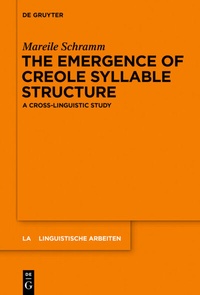
The Emergence of Creole Syllable Structure
A Cross-linguistic Study
1st Edition
Published on 12. December 2014
XI, 324 pages
978-3-11-033956-7 (ISBN)
Description

This book presents an empirical study of syllable structure and phonotactic restructuring in six Caribbean creoles with Dutch, English and French as main lexifier languages. It is shown that, although some structures are more commonly permitted than others, there is considerable cross-creole variation, especially with respect to word-final structures. The findings provide support for recent SLA approaches to the emergence of creole phonology.
More details
Other editions
Additional editions
E-Book
12/2014
1st Edition
De Gruyter
€149.95
Available for download
Book
11/2014
1st Edition
De Gruyter
€149.95
Shipment within 7-9 days
Person
Mareile Schramm, University of Siegen, Germany.
Content
- Intro
- Contents
- Acknowledgments
- Abbreviations and notational conventions
- 1 Introduction
- 2 Creole genesis and syllable structure
- 2.1 Introduction
- 2.2 Sources of creole structure and mechanisms in creolisation
- 2.3 Creolisation and syllable structure
- 2.4 Theories of syllable structure
- 2.5 Summary
- 3 Data and Methodology
- 3.1 Introduction
- 3.2 Selection of creole languages
- 3.3 The creoles and their historical background
- 3.3.1 Berbice Dutch
- 3.3.2 Negerhollands
- 3.3.3 Saramaccan
- 3.3.4 St Kitts
- 3.3.5 Guiana FC
- 3.3.6 Trindad FC
- 3.4 The creole corpora
- 3.4.1 Source texts for the Dutch-based creoles
- 3.4.2 Source texts for the English-based creoles
- 3.4.3 Source texts for the French-based creoles
- 3.4.4 The resulting corpora
- 3.5 Identification of etyma
- 3.5.1 The main lexifier varieties
- 3.5.2 Cognate words and the choice of etymon
- 3.5.3 Historical and variational aspects in etymon pronunciation
- 3.6 Data coding and analytical procedure
- 3.6.1 Coding of structural variables
- 3.6.2 Coding of process variables
- 3.6.3 Processes not considered in the analyses
- 3.6.4 The CHAID analyses
- 3.7 Summary
- 4 Syllable structure and phonotactic restructuring in the Dutch-based creoles
- 4.1 Introduction
- 4.2 Previous studies
- 4.3 Methodological issues
- 4.4 Results I: Berbice Dutch
- 4.4.1 Word-initial onsets in Berbice Dutch
- 4.4.2 Word-final codas in Berbice Dutch
- 4.4.3 Word-internal structures in Berbice Dutch
- 4.4.4 Summary: Berbice Dutch
- 4.5 Results II: Negerhollands
- 4.5.1 Word-initial onsets in Negerhollands
- 4.5.2 Word-final codas in Negerhollands
- 4.5.3 Word-internal structures in Negerhollands
- 4.5.4 Summary: Negerhollands
- 4.6 Comparison: Berbice Dutch vs. Negerhollands
- 5 Syllable structure and phonotactic restructuring in the English-based creoles
- 5.1 Introduction
- 5.2 Previous studies
- 5.3 Methodological issues
- 5.4 Results I: Early Saramaccan
- 5.4.1 Word-initial onsets in Early Saramaccan
- 5.4.2 Word-final codas in Early Saramaccan
- 5.4.3 Word-internal structures in Early Saramaccan
- 5.4.4 Summary: Early Saramaccan
- 5.5 Results II: Early St Kitts
- 5.5.1 Word-initial onsets in Early St Kitts
- 5.5.2 Word-final codas in Early St Kitts
- 5.5.3 Word-internal structures in Early St Kitts
- 5.5.4 Summary: Early St Kitts
- 5.6 Comparison: Early Saramaccan vs. Early St Kitts
- 6 Syllable structure and phonotactic restructuring in the French-based creoles
- 6.1 Introduction
- 6.2 Previous studies
- 6.3 Methodological issues
- 6.4 Results I: Guiana French Creole
- 6.4.1 Word-initial onsets in Guiana FC
- 6.4.2 Word-final consonants in Guiana FC
- 6.4.3 Word-internal structures in Guiana FC
- 6.4.4 Summary: Guiana FC
- 6.5 Results II: Trinidad French Creole
- 6.5.1 Word-initial onsets in Trinidad FC
- 6.5.2 Word-final consonants in Trinidad FC
- 6.5.3 Word-internal structures in Trinidad FC
- 6.5.4 Summary: Trinidad FC
- 6.6 Comparison: Guiana FC vs. Trinidad FC
- 7 Syllable structure in the six creoles: Similarities and differences
- 7.1 Introduction
- 7.2 Cross-creole similarities and differences in syllable types
- 7.3 Cross-creole similarities and differences in restructuring rates
- 7.3.1 Retention and restructuring of word-initial structures
- 7.3.2 Retention and restructuring of word-final structures
- 7.3.3 Retention and restructuring of word-internal structures
- 7.3.4 Summary: Comparison of restructuring rates
- 7.4 Cross-creole similarities and differences in targets of restructuring
- 7.4.1 Targets of restructuring among word-initial structures
- 7.4.2 Targets of restructuring among word-final structures
- 7.4.3 Targets of restructuring among word-internal structures
- 7.4.4 Summary: Comparison of targets of restructuring
- 7.5 Summary: Cross-creole comparison
- 8 Explaining creole phonotactic restructuring
- 8.1 Introduction
- 8.2 Two approaches to the emergence of creole phonology
- 8.3 Substrate syllable structure
- 8.4 Testing SLA approaches to creolisation
- 8.4.1 Mechanisms in creolisation: Berbice Dutch
- 8.4.2 Mechanisms in creolisation: Negerhollands
- 8.4.3 Mechanisms in creolisation: Early Saramaccan
- 8.4.4 Mechanisms in creolisation: Early St Kitts
- 8.4.5 Mechanisms in creolisation: Guiana French Creole
- 8.4.6 Mechanisms in creolisation: Trinidad French Creole
- 8.4.7 Mechanisms in creolisation: The overall picture
- 8.4.8 Similarities and differences across creoles: What causes the observed patterns?
- 8.4.9 Creole phonotactic restructuring: What motivates repair choices?
- 8.4.10 Summary
- 8.5 Creole syllable structure in phonological theory: previous approaches and future challenges
- 8.6 Summary
- 9 Creole syllable structure: A final assessment
- Bibliography
