

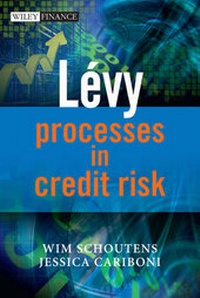
Levy Processes in Credit Risk
Published on 2. November 2010
200 pages
978-0-470-68506-8 (ISBN)
Description

This book is an introductory guide to using Lévy processes forcredit risk modelling. It covers all types of credit derivatives:from the single name vanillas such as Credit Default Swaps (CDSs)right through to structured credit risk products such asCollateralized Debt Obligations (CDOs), Constant ProportionPortfolio Insurances (CPPIs) and Constant Proportion DebtObligations (CPDOs) as well as new advanced rating models for AssetBacked Securities (ABSs).
Jumps and extreme events are crucial stylized features,essential in the modelling of the very volatile credit markets -the recent turmoil in the credit markets has once again illustratedthe need for more refined models.
Readers will learn how the classical models (driven by Brownianmotions and Black-Scholes settings) can be significantly improvedby using the more flexible class of Lévy processes. By doingthis, extreme event and jumps can be introduced into the models togive more reliable pricing and a better assessment of therisks.
The book brings in high-tech financial engineering models forthe detailed modelling of credit risk instruments, setting up thetheoretical framework behind the application of Lévy Processesto Credit Risk Modelling before moving on to the practicalimplementation. Complex credit derivatives structures such as CDOs,ABSs, CPPIs, CPDOs are analysed and illustrated with marketdata.
Reviews / Votes
"This text introduces into the use of Levy processes in credit riskmodeling. After a general overview of credit risk and standardcredit derivatives, the authors provide a short introduction intoLevy processes in general. This material is then used to studysingle-name credit derivatives. Following this, the authorsintroduce into firm-value Levy models, including the Merton model,Black-Cox model, Levy first passage model, variance gamma model andthe one sided Levy default model. The problem of calibration isdiscussed. After that, the authors introduce intensity Levy modelssuch as the Jarrow and Turnbull model, the Cox model and theintensity-OU model. Multivariate credit products, collateralizeddebt obligations and multivariate index modeling are discussed inthe following. In the final part of their book, the authors studycredit CPPIs and CPDOs as well as asset-backed securities."(Zentralblatt MATH, 2010)More details
Other editions
Additional editions
Wim Schoutens | Jessica Cariboni
Levy Processes in Credit Risk
Book
07/2009
Wiley
€140.50
Article not available at the moment
Persons
Wim Schoutens (Leuven, Belgium) is a research professor infinancial engineering in the Department of Mathematics at theCatholic University of Leuven, Belgium. He has extensive practicalexperience of model implementation and is well known for hisconsulting work in the banking industry. Wim is the author ofLévy Processes in Finance and co-editor of ExoticOption Pricing and Advanced Lévy Models both published byWiley. He teaches at 7city Learning and London Financial Studies.He is Managing Editor of the International Journal ofTheoretical and Applied Finance and Associate Editor ofMathematical Finance and Review of DerivativesResearch.
Jessica Cariboni (Ispra, Italy) has a PhD in appliedstatistics from the Catholic University of Leuven, Belgium. She wasa junior quantitative analyst at Nextra Investment Management. Sheis currently a functionary of the European Commission andresearcher at the European Commission DG-Joint Research Centre,Ispra, Italy. She is also co-author of the book GlobalSensitivity Analysis: The Primer published by Wiley.
Content
Preface.
Acknowledgements.
PART I: INTRODUCTION.
1 An Introduction to Credit Risk.
1.1 Credit Risk.
1.1.1 Historical and Risk-Neutral Probabilities.
1.1.2 Bond Prices and Default Probability.
1.2 Credit Risk Modelling.
1.3 Credit Derivatives.
1.4 Modelling Assumptions.
1.4.1 Probability Space and Filtrations.
1.4.2 The Risk-Free Asset.
2 An Introduction to Lévy Processes.
2.1 Brownian Motion.
2.2 Lévy Processes.
2.3 Examples of Lévy Processes.
2.3.1 Poisson Process.
2.3.2 Compound Poisson Process.
2.3.3 The Gamma Process.
2.3.4 Inverse Gaussian Process.
2.3.5 The CMY Process.
2.3.6 The Variance Gamma Process.
2.4 Ornstein-Uhlenbeck Processes.
2.4.1 The Gamma-OU Process.
2.4.2 The Inverse Gaussian-OU Process.
PART II: SINGLE-NAME MODELLING.
3 Single-Name Credit Derivatives.
3.1 Credit Default Swaps.
3.1.1 Credit Default Swaps Pricing.
3.1.2 Calibration Assumptions.
3.2 Credit Default Swap Forwards.
3.2.1 Credit Default Swap Forward Pricing.
3.3 Constant Maturity Credit Default Swaps.
3.3.1 Constant Maturity Credit Default Swaps Pricing.
3.4 Options on CDS.
4 Firm-Value Lévy Models.
4.1 The Merton Model.
4.2 The Black-Cox Model with Constant Barrier.
4.3 The Lévy First-Passage Model.
4.4 The Variance Gamma Model.
4.4.1 Sensitivity to the Parameters.
4.4.2 Calibration on CDS Term Structure Curve.
4.5 One-Sided Lévy Default Model.
4.5.1 Wiener-Hopf Factorization and DefaultProbabilities.
4.5.2 Illustration of the Pricing of Credit Default Swaps.
4.6 Dynamic Spread Generator.
4.6.1 Generating Spread Paths.
4.6.2 Pricing of Options on CDSs.
4.6.3 Black's Formulas and Implied Volatility.
Appendix: Solution of the PDIE.
5 IntensityLévy Models.
5.1 Intensity Models for Credit Risk.
5.1.1 Jarrow-Turnbull Model.
5.1.2 Cox Models.
5.2 The Intensity-OU Model.
5.3 Calibration of the Model on CDS Term Structures.
PART III: MULTIVARIATE MODELLING.
6 Multivariate Credit Products.
6.1 CDOs.
6.2 Credit Indices.
7 Collateralized Debt Obligations.
7.1 Introduction.
7.2 The Gaussian One-Factor Model.
7.3 Generic One-Factor Lévy Model.
7.4 Examples of Lévy Models.
7.5 Lévy Base Correlation.
7.5.1 The Concept of Base Correlation.
7.5.2 Pricing Non-Standard Tranches.
7.5.3 Correlation Mapping for Bespoke CDOs.
7.6 Delta-Hedging CDO tranches.
7.6.1 Hedging with the CDS Index.
7.6.2 Delta-Hedging with a Single-Name CDS.
7.6.3 Mezz-Equity hedging.
8 Multivariate Index Modelling.
8.1 Black's Model.
8.2 VG Credit Spread Model.
8.3 Pricing Swaptions using FFT.
8.4 Multivariate VG Model.
PART IV: EXOTIC STRUCTURED CREDIT RISK PRODUCTS.
9 Credit CPPIs and CPDOs.
9.1 Introduction.
9.2 CPPIs.
9.3 Gap Risk.
9.4 CPDOs.
10 Asset-Backed Securities.
10.1 Introduction.
10.2 Default Models.
10.2.1 Generalized Logistic Default Model.
10.2.2 Lévy Portfolio Default Model.
10.2.3 Normal One-Factor Default Model.
10.2.4 Generic One-Factor Lévy Default Model.
10.3 Prepayment Models.
10.3.1 Constant Prepayment Model.
10.3.2 Lévy Portfolio Prepayment Model.
10.3.3 Normal One-Factor Prepayment Model.
10.4 Numerical Results.
Bibliography.
Index.
1 An Introduction to Credit Risk
In general terms, credit risk refers to the risk that a specified reference entity does not meet its credit obligations within a specified time horizon T. If this happens, we say that a default event has occurred. Credit risk is present in everyday life. For instance, consider a person who goes to a bank and asks for a loan to buy a house; suppose the loan is granted by the bank, which agrees with the person that the money will be paid back following certain criteria and within a predetermined time period. In this situation the credit institution is exposed to the risk that this person will not be able to repay (part of) the loan, or will not meet the criteria established. The type of risk the bank is facing is exactly credit risk: the reference entity is the person who asks for the loan; default occurs on the day the creditor declares that he is not able to honour his obligations. This simple example shows the main characteristics of credit risk. We can see that two sides are involved: on one hand the bank, which is exposed to the risk; on the other the reference entity - sometimes called the obligor - who has to fulfil a series of obligations. Further, there is a set of criteria that defines how these obligations have to be met, i.e. a set of criteria that identifies the default of the entity. Finally, the risk is spread over a determined time length [0, T ], where T is often referred to as the maturity or the time horizon. Moreover, the example shows that there are various elements that the bank does not know on the day it grants the loan. First, the bank does not know the probability that the default will actually occur. Banks try to overcome this problem by collecting information about the person who is asking for the loan in order to get a flavour of the probability that the person will not be able to repay the money. Hypothesizing that default will occur, it is uncertain when this will happen. Also, the severity of the loss is indefinite. In finance, life is a bit more complicated, but credit risk can always be characterized in terms of these components: the obligor, the set of criteria defining default, and the time interval over which the risk is spread. Often, instead of dealing with persons and loans, one deals with companies and bonds. In this case default can be defined in a variety of ways. Besides the complete financial bankruptcy of the reference entity, other examples of default can be the failure to pay an obligation (e.g. the coupon of a bond), a rating downgrade of the company, its restructuring, or a merger with another corporation. It is sufficient to switch on the TV to understand that default events are quite rare but have a strong impact on financial markets. Every day rating agencies such as Moody’s and Standard & Poor evaluate the creditworthiness of hundreds of companies traded on the market. A change in the rating of a company will affect the prices of all related financial instruments, such as spreads of corporate bonds. Credit risk thus affects the profits and losses of thousands of billions of euros invested every day by banks in financial portfolios, grouping together baskets of reference entities that might jointly default within the same time horizon. It is clear that in this case there is an additional element to be taken into consideration, which is the joint default probability distribution of portfolio components. Multiple defaults are extremely rare events that can be driven, for instance, by natural catastrophes, systemic defaults, political events, terrorist episodes, or caused by the complex linked-structure of the capital market. Following the Basel Accord (2004), banks have to set aside a certain amount of capital to cover the risk inherent in their credit portfolios. Subject to certain minimum conditions and disclosure requirements, the Basel II Accord allows credit institutions to rely on their own internal estimates of risk components, which determine the capital requirements to cover credit risk. The risk components include measures of the probability of default, the recovery rate and the exposure at default. This has, of course, encouraged banks to invest in modelling credit risk with more and more sophisticated approaches. Banks have also a second option to mitigate their credit risk: they can hedge credit risk by buying credit derivatives. The Basel II Accord also provides the inclusion of credit risk mitigation techniques to assess the overall risk of a credit portfolio.
The main objective of the present book is to build advanced models to price different kinds of financial instruments whose price is related to the probability that a default event will occur or not between time 0 and time t (0 ? t ? T, T being the maturity) for a reference entity or a bunch of reference entities. In mathematical finance, there are two important probability measures: a historical and a risk-neutral (or pricing) measure. The historical probability of an event is the probability that this event happens in reality (in the so-called real world). The risk-neutral measure is an artificial measure: The risk-neutral probability of an event is the probability that one uses to value (by so-called risk-neutral valuation techniques) derivatives contracts depending on the event. Since we are dealing in this book with the valuation of credit derivatives contracts, the measure of interest to us will be the risk-neutral measure. More precisely, the risk-neutral valuation principle states that the price of a derivative is given by the expected value under the risk-neutral measure of the discounted payoff: In our framework - the valuation of credit derivatives contracts - we are interested in identifying the proper risk-neutral probability. Throughout the book, the risk-neutral probability that a default event will not occur between time 0 and time t for a single-reference entity will be referred to as survival probability: (1.1) Correspondingly, we will call default probability the risk-neutral probability that the obligor does actually default between 0 and t: (1.2) Clearly for each 0 ? t ? T , we will have that PDef (t) = 1 ? PSurv(t). Although, as mentioned above, we will almost always work with risk-neutral probabilities, one can also get a flavour of the historical default probabilities observed in the market. Figure 1.1 shows the average 1-year default rates for the period 1983-2000 by rating classes, following Moody’s classification. Each bar represents the average over the sample period of the fraction of companies defaulted in 1 year in each rating class. Figure 1.1 Historical average 1-year default rate for 1983-2000 following Moody’s classification. Source: Moody’s, in Duffie and Singleton (2003) In the multivariate setting, the (risk-neutral) probability that more defaults occur within the time horizon needs to be estimated. Consider, for simplicity, two obligors, i and j . The joint (risk-neutral) survival and default probabilities are defined as: If the two obligors are independent, we have that However, market data provides evidence that the hypothesis of independence does not hold. The dependence structure among obligors relates to the fact that they live in the same global market, and often financial/commercial relationships exist among companies.
Bond traders have developed procedures for taking credit risk into account when pricing corporate bonds. They collect market data on actively traded bonds to calculate a generic zero-coupon yield curve for each credit rating category. These zero-coupon yield curves are then used to value other corporate bonds. For example, a newly issued A-rated bond will be priced using the zero-coupon yield curve calculated from other A-rated bonds. Under specific assumptions, if the yield curve of a risk-free zero-coupon bond and the yield curve of a corporate bond with the same maturity are known, it is possible to estimate the default probability of the corporation issuing the corporate bond. Let us indicate with y*(T) and y(T) respectively the yield on a corporate zero-coupon bond with maturity T and the yield on a risk-free zero-coupon bond with the same maturity. Considering a principal F = 100, the values at time t = 0 of these bonds will thus be, respectively: To estimate risk-neutral default probabilities from these bond prices, we assume that the present value of the cost of default equals the excess of the price of the risk-free bond over the price of the corporate bond: This means that the higher yield on a corporate bond is entirely the compensation for possible losses from default. Note that this is only an approximation, since other factors, such as liquidity, also influence the spread. If we assume that there is no recovery in the event of default, the calculation of the default probability PDef(T) is relatively easy. In fact there is a probability PDef(T) that the corporate bond will be worth zero at maturity and a probability of (1 ? PDef(T)) that it will be worth 100. This means that (by risk-neutral valuation) Hence, we can estimate the risk-neutral default probability as: For example,...
1.1 CREDIT RISK
In general terms, credit risk refers to the risk that a specified reference entity does not meet its credit obligations within a specified time horizon T. If this happens, we say that a default event has occurred. Credit risk is present in everyday life. For instance, consider a person who goes to a bank and asks for a loan to buy a house; suppose the loan is granted by the bank, which agrees with the person that the money will be paid back following certain criteria and within a predetermined time period. In this situation the credit institution is exposed to the risk that this person will not be able to repay (part of) the loan, or will not meet the criteria established. The type of risk the bank is facing is exactly credit risk: the reference entity is the person who asks for the loan; default occurs on the day the creditor declares that he is not able to honour his obligations. This simple example shows the main characteristics of credit risk. We can see that two sides are involved: on one hand the bank, which is exposed to the risk; on the other the reference entity - sometimes called the obligor - who has to fulfil a series of obligations. Further, there is a set of criteria that defines how these obligations have to be met, i.e. a set of criteria that identifies the default of the entity. Finally, the risk is spread over a determined time length [0, T ], where T is often referred to as the maturity or the time horizon. Moreover, the example shows that there are various elements that the bank does not know on the day it grants the loan. First, the bank does not know the probability that the default will actually occur. Banks try to overcome this problem by collecting information about the person who is asking for the loan in order to get a flavour of the probability that the person will not be able to repay the money. Hypothesizing that default will occur, it is uncertain when this will happen. Also, the severity of the loss is indefinite. In finance, life is a bit more complicated, but credit risk can always be characterized in terms of these components: the obligor, the set of criteria defining default, and the time interval over which the risk is spread. Often, instead of dealing with persons and loans, one deals with companies and bonds. In this case default can be defined in a variety of ways. Besides the complete financial bankruptcy of the reference entity, other examples of default can be the failure to pay an obligation (e.g. the coupon of a bond), a rating downgrade of the company, its restructuring, or a merger with another corporation. It is sufficient to switch on the TV to understand that default events are quite rare but have a strong impact on financial markets. Every day rating agencies such as Moody’s and Standard & Poor evaluate the creditworthiness of hundreds of companies traded on the market. A change in the rating of a company will affect the prices of all related financial instruments, such as spreads of corporate bonds. Credit risk thus affects the profits and losses of thousands of billions of euros invested every day by banks in financial portfolios, grouping together baskets of reference entities that might jointly default within the same time horizon. It is clear that in this case there is an additional element to be taken into consideration, which is the joint default probability distribution of portfolio components. Multiple defaults are extremely rare events that can be driven, for instance, by natural catastrophes, systemic defaults, political events, terrorist episodes, or caused by the complex linked-structure of the capital market. Following the Basel Accord (2004), banks have to set aside a certain amount of capital to cover the risk inherent in their credit portfolios. Subject to certain minimum conditions and disclosure requirements, the Basel II Accord allows credit institutions to rely on their own internal estimates of risk components, which determine the capital requirements to cover credit risk. The risk components include measures of the probability of default, the recovery rate and the exposure at default. This has, of course, encouraged banks to invest in modelling credit risk with more and more sophisticated approaches. Banks have also a second option to mitigate their credit risk: they can hedge credit risk by buying credit derivatives. The Basel II Accord also provides the inclusion of credit risk mitigation techniques to assess the overall risk of a credit portfolio.
1.1.1 Historical and Risk-Neutral Probabilities
The main objective of the present book is to build advanced models to price different kinds of financial instruments whose price is related to the probability that a default event will occur or not between time 0 and time t (0 ? t ? T, T being the maturity) for a reference entity or a bunch of reference entities. In mathematical finance, there are two important probability measures: a historical and a risk-neutral (or pricing) measure. The historical probability of an event is the probability that this event happens in reality (in the so-called real world). The risk-neutral measure is an artificial measure: The risk-neutral probability of an event is the probability that one uses to value (by so-called risk-neutral valuation techniques) derivatives contracts depending on the event. Since we are dealing in this book with the valuation of credit derivatives contracts, the measure of interest to us will be the risk-neutral measure. More precisely, the risk-neutral valuation principle states that the price of a derivative is given by the expected value under the risk-neutral measure of the discounted payoff: In our framework - the valuation of credit derivatives contracts - we are interested in identifying the proper risk-neutral probability. Throughout the book, the risk-neutral probability that a default event will not occur between time 0 and time t for a single-reference entity will be referred to as survival probability: (1.1) Correspondingly, we will call default probability the risk-neutral probability that the obligor does actually default between 0 and t: (1.2) Clearly for each 0 ? t ? T , we will have that PDef (t) = 1 ? PSurv(t). Although, as mentioned above, we will almost always work with risk-neutral probabilities, one can also get a flavour of the historical default probabilities observed in the market. Figure 1.1 shows the average 1-year default rates for the period 1983-2000 by rating classes, following Moody’s classification. Each bar represents the average over the sample period of the fraction of companies defaulted in 1 year in each rating class. Figure 1.1 Historical average 1-year default rate for 1983-2000 following Moody’s classification. Source: Moody’s, in Duffie and Singleton (2003) In the multivariate setting, the (risk-neutral) probability that more defaults occur within the time horizon needs to be estimated. Consider, for simplicity, two obligors, i and j . The joint (risk-neutral) survival and default probabilities are defined as: If the two obligors are independent, we have that However, market data provides evidence that the hypothesis of independence does not hold. The dependence structure among obligors relates to the fact that they live in the same global market, and often financial/commercial relationships exist among companies.
1.1.2 Bond Prices and Default Probability
Bond traders have developed procedures for taking credit risk into account when pricing corporate bonds. They collect market data on actively traded bonds to calculate a generic zero-coupon yield curve for each credit rating category. These zero-coupon yield curves are then used to value other corporate bonds. For example, a newly issued A-rated bond will be priced using the zero-coupon yield curve calculated from other A-rated bonds. Under specific assumptions, if the yield curve of a risk-free zero-coupon bond and the yield curve of a corporate bond with the same maturity are known, it is possible to estimate the default probability of the corporation issuing the corporate bond. Let us indicate with y*(T) and y(T) respectively the yield on a corporate zero-coupon bond with maturity T and the yield on a risk-free zero-coupon bond with the same maturity. Considering a principal F = 100, the values at time t = 0 of these bonds will thus be, respectively: To estimate risk-neutral default probabilities from these bond prices, we assume that the present value of the cost of default equals the excess of the price of the risk-free bond over the price of the corporate bond: This means that the higher yield on a corporate bond is entirely the compensation for possible losses from default. Note that this is only an approximation, since other factors, such as liquidity, also influence the spread. If we assume that there is no recovery in the event of default, the calculation of the default probability PDef(T) is relatively easy. In fact there is a probability PDef(T) that the corporate bond will be worth zero at maturity and a probability of (1 ? PDef(T)) that it will be worth 100. This means that (by risk-neutral valuation) Hence, we can estimate the risk-neutral default probability as: For example,...
