

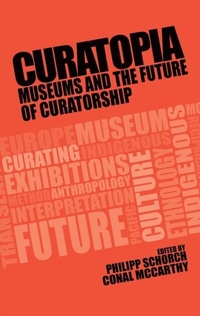
Curatopia
Museums and the Future of Curatorship
1st Edition
Published on 30. November 2018
360 pages
978-1-5261-1820-2 (ISBN)
Available for download
Description

What is the future of curatorship? Is there a vision for an ideal model, a curatopia, whether in the form of a utopia or dystopia? Or is there a plurality of approaches, amounting to a curatorial heterotopia? This pioneering volume addresses these questions by considering the current state of curatorship. It reviews the different models and approaches operating in museums, galleries and cultural organisations around the world and discusses emerging concerns, challenges and opportunities. The collection explores the ways in which the mutual, asymmetrical relations underpinning global, scientific entanglements of the past can be transformed into more reciprocal, symmetrical forms of cross-cultural curatorship in the present, arguing that this is the most effective way for curatorial practice to remain meaningful. International in scope, the volume covers three regions: Europe, North America and the Pacific. -- .
Reviews / Votes
'This provocative and timely volume, which assembles key perspectives from an impressive ensemble of international curators, scholars and critics, provides a series of critical yet rousing reflections on the future of curatorial practice. Aiming to advance the field beyond the terms of existing debates, the book maps out new futures for museums and collections, acknowledging that these profoundly cross-cultural institutions can only be made relevant by engaging them collaboratively and dialogically.'Rodney Harrison, Professor of Heritage Studies, University College London
'This ambitious and trans-disciplinary volume goes beyond familiar postcolonial critiques, which foreground imperial impositions, to convincingly argue for the centrality of global Indigenous people to past and future museological endeavors. Focusing on curation as an eminently performative, intercultural, and social process, the contributors draw on anthropology's dialogic foundations and ethnographic methods to demonstrate how current efforts to decolonize the ethnological museum can provide a model for the invigoration of ethical curatorial practice in other kinds of exhibitionary contexts as well.'
Aaron Glass, Associate Professor of Anthropology and Material Culture, Bard Graduate Center
'Curatopia: Museums and the Future of Curatorship is a welcome compendium that values and explores the diverse, complex and increasingly experimental roles that curators perform in the 21st century. It provides a timely discourse in an era when the role of curators is threatened by economic rationalism and reduced by the demand for content producers in those museums that prioritize entertainment over conversations about divergent histories, difficult issues and multiple world-views. Focused on curatorship in anthropological and ethnographic museums, Curatopia is an inspiring contribution to the field of museum practice because it articulates and grapples with emerging, critical and ethical approaches to contemporary museum curatorship.'
Joanna barrkman, Senior Curator UCLA, The Journal of Pacific History, 2019
'The ultimate achievement of Curatopia is to go beyond mere critics and to seriously engage in potential futures and concrete strategies, based on real curatorial experiences in museums in Europa, North America and the Pacific. In light of its programmatic title - and as an alternative to burning museums so to say - Curatopia opens up a space where "museums have a role to play"'
Boasblogs
'Curatopia is largely about navigating decolonization together as the colonizer and the colonized, the 'curatopia' being the journey that must be taken by museum professionals, museum audiences and source communities alike. Throughout the book, this argument is proven to be multifaceted, achieved through eighteen thoroughly distinguished chapters and two afterwords that display an admirable devotion to progress in the museums sector.'
Journal of Curatorial Studies -- .
More details
Language
English
Place of publication
Manchester
United Kingdom
Target group
College/higher education
Professional and scholarly
Edition type
Digital original
Illustrations
56 black & white illustrations
56 black & white illustrations
ISBN-13
978-1-5261-1820-2 (9781526118202)
Copyright in bibliographic data and cover images is held by Nielsen Book Services Limited or by the publishers or by their respective licensors: all rights reserved.
Schweitzer Classification
Other editions
Additional editions
Book
04/2020
Manchester University Press
€41.70
Shipment within 15-20 days
Book
11/2018
Manchester University Press
€135.50
Shipment within 15-20 days
Persons
Philipp Schorch is Professor of Museum Anthropology at Ludwig-Maximilians-Universitaet in Munich, Germany
Conal McCarthy is Professor and Director of the Museum and Heritage Studies Programme at Victoria University of Wellington, Aotearoa New Zealand -- .
Conal McCarthy is Professor and Director of the Museum and Heritage Studies Programme at Victoria University of Wellington, Aotearoa New Zealand -- .
Content
Introduction: conceptualising Curatopia - Philipp Schorch, Conal McCarthy and Eveline Duerr
Part I: Europe
1 The museum as method (revisited) - Nicholas Thomas
2 What not to collect? Post-connoisseurial dystopia and the profusion of things - Sharon Macdonald and Jennie Morgan
3 Concerning curatorial practice in ethnological museums: an epistemology of postcolonial debate - Larissa Foerster and Friedrich von Bose
4 Walking the fine line: From Samoa with Love? at the Museum Fuenf Kontinente, Munich - Hilke Thode-Arora
5 Curating across the colonial divides - Jette Sandahl
6 Thinking and working through difference: remaking the ethnographic museum in the global contemporary - Viv Golding and Wayne Modest
Part II: North America
7 The times of the curator - James Clifford
8 Baroque modernity, critique and Indigenous epistemologies in museum representations of the Andes and Amazonia - Anthony Alan Shelton
9 Swings and roundabouts: pluralism and the politics of change in Canada's national museums - Ruth B. Phillips
10 Community engagement, Indigenous heritage and the complex figure of the curator: foe, facilitator, friend or forsaken? - Bryony Onciul
11 Joining the club: a Tongan 'akau in New England - Ivan Gaskell
12 c'?sna??m, the City before the City: exhibiting pre-Indigenous belonging in Vancouver - Paul Tapsell
Part III: Pacific
13 The figure of the kaitiaki: learning from Maori curatorship past and present - Conal McCarthy, Arapata Hakiwai and Philipp Schorch
14 Curating the uncommons: taking care of difference in museums - Billie Lythberg, Wayne Ngata and Amiria Salmond
15 Collecting, curating and exhibiting cross-cultural material histories in a post-settler society - Bronwyn Labrum
16 Curating relations between 'us' and 'them': the changing role of migration museums in Australia -- Andrea Witcomb
17 Agency and authority: the politics of co-collecting - Sean Mallon
18 He alo a he alo / kanohi ki te kanohi / face to face: curatorial bodies, encounters and relations - Noelle M.K.Y. Kahanu, Moana Nepia and Philipp Schorch
Afterwords
19 Curating time - Ian Wedde
20 Virtual museums and new directions? - Vilsoni Hereniko
Index -- .
Part I: Europe
1 The museum as method (revisited) - Nicholas Thomas
2 What not to collect? Post-connoisseurial dystopia and the profusion of things - Sharon Macdonald and Jennie Morgan
3 Concerning curatorial practice in ethnological museums: an epistemology of postcolonial debate - Larissa Foerster and Friedrich von Bose
4 Walking the fine line: From Samoa with Love? at the Museum Fuenf Kontinente, Munich - Hilke Thode-Arora
5 Curating across the colonial divides - Jette Sandahl
6 Thinking and working through difference: remaking the ethnographic museum in the global contemporary - Viv Golding and Wayne Modest
Part II: North America
7 The times of the curator - James Clifford
8 Baroque modernity, critique and Indigenous epistemologies in museum representations of the Andes and Amazonia - Anthony Alan Shelton
9 Swings and roundabouts: pluralism and the politics of change in Canada's national museums - Ruth B. Phillips
10 Community engagement, Indigenous heritage and the complex figure of the curator: foe, facilitator, friend or forsaken? - Bryony Onciul
11 Joining the club: a Tongan 'akau in New England - Ivan Gaskell
12 c'?sna??m, the City before the City: exhibiting pre-Indigenous belonging in Vancouver - Paul Tapsell
Part III: Pacific
13 The figure of the kaitiaki: learning from Maori curatorship past and present - Conal McCarthy, Arapata Hakiwai and Philipp Schorch
14 Curating the uncommons: taking care of difference in museums - Billie Lythberg, Wayne Ngata and Amiria Salmond
15 Collecting, curating and exhibiting cross-cultural material histories in a post-settler society - Bronwyn Labrum
16 Curating relations between 'us' and 'them': the changing role of migration museums in Australia -- Andrea Witcomb
17 Agency and authority: the politics of co-collecting - Sean Mallon
18 He alo a he alo / kanohi ki te kanohi / face to face: curatorial bodies, encounters and relations - Noelle M.K.Y. Kahanu, Moana Nepia and Philipp Schorch
Afterwords
19 Curating time - Ian Wedde
20 Virtual museums and new directions? - Vilsoni Hereniko
Index -- .

