

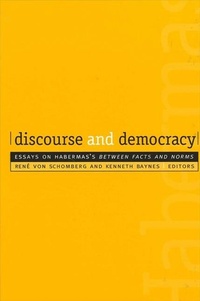
Discourse and Democracy
Description

Discourse and Democracy offers a variety of perspectives by an international group of scholars on Jürgen Habermas's Between Facts and Norms. The collection presents not just a summary of Habermas's own views, but locates him with respect to modern and contemporary moral, political, and legal theory. The result is a volume useful to those first approaching Habermas's thought as well as those already familiar with its general outlines.
René von Schomberg is a Research Fellow at the European Commission. He is the editor of Science, Politics, and Morality: Scientific Uncertainty and Decision Making and the coeditor, with Peter Wheale and Peter Glasner, of The Social Management of Genetic Engineering. Kenneth Baynes is Associate Professor of Philosophy at the State University of New York at Stony Brook. He is the author of The Normative Grounds of Social Criticism: Kant, Rawls, and Habermas, also published by SUNY Press, and the coeditor, with James Bohman and Thomas McCarthy, of After Philosophy: End or Transformation?
More details
Other editions
Additional editions
Persons
René von Schomberg is a Research Fellow at the European Commission. He is the editor of Science, Politics, and Morality: Scientific Uncertainty and Decision Making and the coeditor, with Peter Wheale and Peter Glasner, of The Social Management of Genetic Engineering. Kenneth Baynes is Associate Professor of Philosophy at the State University of New York at Stony Brook. He is the author of The Normative Grounds of Social Criticism: Kant, Rawls, and Habermas, also published by SUNY Press, and the coeditor, with James Bohman and Thomas McCarthy, of After Philosophy: End or Transformation?
Content
Acknowledgments
Introduction
I. Initial Assessments of Between Facts and Norms
1. Deliberative Democracy and the Limits of Liberalism
Kenneth Baynes
2. Discourse and Democracy: The Formal and Informal Bases of Legitimacy in Between Facts and Norms
William Rehg and James Bohman
3. Between Radicalism and Resignation: Democratic Theory in Habermas's Between Facts and Norms
William E. Scheuerman
II. Historical and Comparative Perspectives
4. Liberties and Popular Sovereignty: On Habermas's Reconstruction of the System of Rights
Ingeborg Maus
5. Habermas, Hegel, and the Concept of Law
Andrew Buchwalter
6. Rawls and Habermas
Hauke Brunkhorst
III. Further Assessments and Wider Implications
7. Law, Solidarity, and the Tasks of Philosophy
Peter Dews
8. Rational Politics? An Exploration of the Fruitfulness of the Discursive Concept of Democracy
Geert Munnichs
9. The Disappearance of Discourse Ethics in Habermas's Between Facts and Norms
Matthias Kettner
10. The Erosion of Our Value Spheres: The Ways in which Society Copes with Scientific, Moral, and Ethical Uncertainty
René von Schomberg
IV. Interview
11. A Conversation about Questions of Political Theory
Jürgen Habermas
Contributors
Index
