

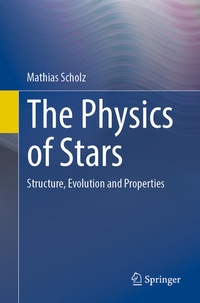
The Physics of Stars
Description

Interested students in the natural and engineering sciences, as well as high school graduates, instructors, teachers, and amateur astronomers, will find a valuable overview of the physics of stars in this book. The only prerequisite is a basic mathematical and physical background, which does not go beyond the knowledge of integral and differential calculus. In this regard, this book aims to bridge the gap with the specialized literature available on the internet, allowing readers to benefit from it.
The first part traces the historical development that led to a detailed understanding of the nature of stars and their life cycles. The goal of the following chapters is to provide a pragmatic introduction to the physical processes that determine the structure and evolution of stars based on their fundamental parameters such as mass and chemical composition. It will show what can be learned from the analysis of starlight about stellar atmospheres, the fundamental role of the virial theorem in the lives of stars, and the nuclear processes deep inside stars that provide the energy that makes them shine. Finally, there will be an in-depth phenomenological look at the final stages of stellar evolution. This section will discuss states of matter that are far from experimental realization but whose properties can be, at least in principle, inferred from the observation of concrete objects such as white dwarfs or neutron stars. Exciting developments are still expected in this area in the future.
Mathias Scholz
is hobby astronomer. He studied physics at the University of Rostock from 1981 to 1986.
Interested students in the natural and engineering sciences, as well as high school graduates, instructors, teachers, and amateur astronomers, will find a valuable overview of the physics of stars in this book. The only prerequisite is a basic mathematical and physical background, which does not go beyond the knowledge of integral and differential calculus. In this regard, this book aims to bridge the gap with the specialized literature available on the internet, allowing readers to benefit from it.
The first part traces the historical development that led to a detailed understanding of the nature of stars and their life cycles. The goal of the following chapters is to provide a pragmatic introduction to the physical processes that determine the structure and evolution of stars based on their fundamental parameters such as mass and chemical composition. It will show what can be learned from the analysis of starlight about stellar atmospheres, the fundamental role of the virial theorem in the lives of stars, and the nuclear processes deep inside stars that provide the energy that makes them shine. Finally, there will be an in-depth phenomenological look at the final stages of stellar evolution. This section will discuss states of matter that are far from experimental realization but whose properties can be, at least in principle, inferred from the observation of concrete objects such as white dwarfs or neutron stars. Exciting developments are still expected in this area in the future.
More details
Other editions
Additional editions
Person
Mathias Scholz is hobby astronomer. He studied physics at the University of Rostock from 1981 to 1986.
